


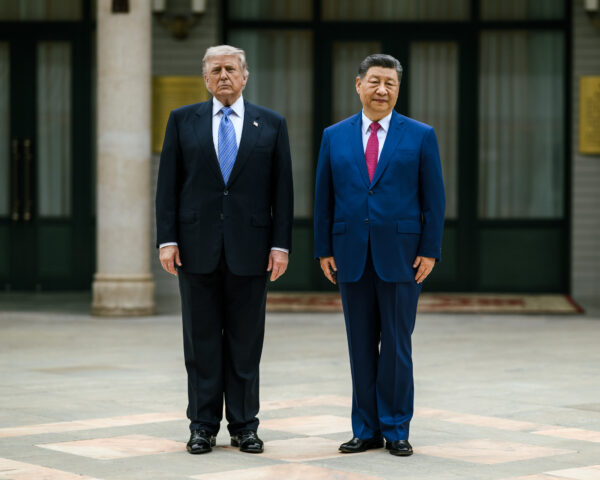
China’s recent calls for “constructive strategic stability” with the United States and a “new type of international relations” with Russia indicate that Beijing intends to manage competition with Washington to create the strategic space needed to build a world order that will no longer be led by the United States. US President Donald Trump’s visit to Beijing in mid-May revealed a new dynamic in Sino-US relations, with Beijing showing greater agency in shaping bilateral relations. This dynamic was reinforced a few days later when Chinese party and state leader Xi Jinping expressed his preferred vision of the international order while receiving Russian President Vladimir Putin in the Chinese capital.
China is seeking to reduce tensions with the United States by reframing its relationship around managed competition rather than confrontation – while avoiding major concessions on trade or Taiwan. But by resetting the agenda for bilateral relations that have deteriorated over the past decade, Beijing is also challenging the universalist pretensions of the liberal international order.
Foreign Minister Wang Yi said “constructive strategic stability” meant “the relationship becomes more resilient through exchange and cooperation” and that stability should be based on “respect for each other’s social systems and development paths, core interests and major concerns.” This reflects the Chinese Communist Party’s growing confidence and view that the authoritarian political system is not inferior to Western liberal democracy – and may even be superior to it.
With Russia, Beijing is more explicitly expressing its vision of a world order after the end of American leadership. In their joint statement on building a “new type of international relations” in May, China and Russia say the world is becoming more dynamic and “undergoing profound changes,” creating the need for a transition to “equal and orderly multilateralism” that would provide a fairer system of global governance.
As realistic as this goal may be, Beijing’s ability to define the terms of its engagement – even with the United States – demonstrates China’s growing ability to shape the global agenda. Washington may not have explicitly endorsed the idea of ”constructive strategic stability,” but he adopted the wording of China. The term therefore reflects both the changing power dynamics between the United States and China and Beijing’s attempt to define the limits of Sino-American competition, a role once largely exercised by Washington. The power to establish the vocabulary and framework through which the bilateral relationship is understood has obviously shifted in China’s favor.
This is not just a success story for Beijing. Trump’s unilateralism has even encouraged U.S. allies to reconsider their cautious and confrontational approaches toward China. The series of Western leaders – from Germany, France, the UK, Canada and elsewhere – visiting Beijing has created a more favorable geopolitical environment for China. China’s relations with its neighboring countries have also improved, as evidenced by Indian Prime Minister Narendra Modi’s participation in the Shanghai Cooperation Organization summit in late summer 2025 and the signing of the ASEAN-China Free Trade Area Upgrade Protocol 3.0 a few months later. Trump’s “America First” foreign policy has reinforced perceptions of China’s economic centrality and regional influence.
In an advantageous position to advance its geopolitical vision, Beijing has held back-to-back summits with Trump and Putin to show that China matters to all world leaders, even the most powerful. Facing growing pressure from his war in Ukraine, Putin needs the economic lifeline of China to support his invasion. The United States, meanwhile, depends on China for supplies of critical rare earths and for its huge market in agricultural products, while hoping that Beijing will play a constructive role in restraining Iran’s nuclear ambitions and maintaining stability in the Taiwan Strait. Both Moscow and Washington currently need China, albeit in very different ways.
These diplomatic engagements have not only placed China at the center of the global stage, but also strengthened its ability to shape the international order rather than simply declaring its ambitions to do so. Describing Taiwan as “the most important issue in U.S.-China relations” and exhorting Washington must “exercise greater caution in handling the Taiwan issue,” Xi drew a red line for Washington in May. After leaving Beijing, Trump said of the island: “I’m not looking for anyone to become independent” – a line most likely well received in Beijing.
By claiming “uphold the United Nations and international lawXi and Putin’s joint statement on the “new type of international relations” can be read as a concentrated expression of China’s broader diplomatic strategy, developed over many years: security, diversity and global governance, all with Chinese characteristics and distinct from the liberal international order. It calls for “equal and indivisible security”, emphasizing that “the security of one state cannot come at the expense of the security of another country” and for the “democratization of international relations”, arguing that “rules set by a minority of States cannot replace commonly accepted international standards.
This ignores Russia’s quest for security at Ukraine’s expense and China’s rejection of a 2016 ruling by an international tribunal under the United Nations Convention on the Law of the Sea regarding the illegality of its vast maritime claims in the South China Sea. Indeed, even as it calls for a multilateral world to prevent a return to the “law of the jungle,” China risks replicating elements of the US-led system it wants to replace. China may support the UN, the SCO and other multilateral institutions, but its selective adherence to common rules risks turning its multilateralism into a means of competing with the United States rather than restricting great power rivalry.
China is taking advantage of a favorable international environment to promote an alternative world order. But how long these conditions last will depend on geopolitical dynamics and the actions of China itself. The key question is whether China can bring enough stability to international society to legitimize its agenda. For now, it may simply be taking advantage of short-term efforts by other countries to hedge against a perceived U.S. retreat from global leadership.
In the long term, China will have to prove that it offers the world much more than a new form of hegemony. To gain legitimacy, Beijing must show that it is willing to respect common rules, exercise restraint and provide the public goods expected of a responsible great power.