


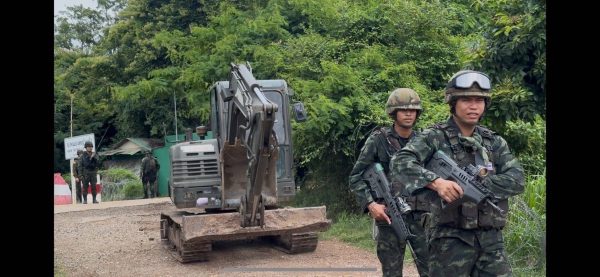
Tribalism and war often go hand in hand, and last year’s border conflict between Cambodia and Thailand was no exception. Nationalist rhetoric has been amplified on both sides of the border and has too often turned any meaningful discourse into heresy.
Those who dared to express their opinion were and still are hit by the law. In this regard, Cambodia’s ruling “elites” have a lot to answer for, having lost control of a strategically important border territory to Thailand.
Licadho, a local human rights group that monitors Cambodia’s courts, has published news reports about at least 20 people who have been arrested, charged and imprisoned after offending the wrong people with Facebook posts. Almost all of them concerned the conflict with Thailand.
Among them were journalists and opposition politicians, but also a monk, teachers, street vendors and vendors – people from all walks of life who simply questioned the undeclared war.
This is why Rin (a pseudonym) would prefer to remain anonymous while speaking to regional media to publicize his efforts to curb the nationalist nonsense that continues to erupt on both sides of the border.
He created Apology Culture, a website in English, Thai and Khmer, and posted short videos through his YouTube channel with translated subtitles.
“Most media primarily cater to one audience,” Rin said. “As a result, people often only hear the other side’s mistakes and rarely think for themselves. »
Rin told The Diplomat that his goal was not to shame either nation but to create a culture where difficult issues can be discussed without immediately being seen as a betrayal.
“Just as we created sex education to manage our natural instincts, I believe we are in dire need of some kind of maturity education to manage our tribal instincts. Since schools do not teach it, I am trying to fill this gap through these pages,” he said.
Rin comes from a mixed family, a Khmer mother and a Thai father, and says: “As a Cambodian, I am willing to ask, ‘Have we perhaps encroached?’ As a Thai, I am willing to ask: “Have we perhaps gone too far?” »
From an outside perspective, the answer to both questions is yes.
“Seeing both sides of my family blindly consuming propaganda and attacking each other was painful. As someone who consumes both sides’ narratives, I could not accept this as inevitable, especially when any future conflict could cost me or my loved ones their lives,” Rin said.
The border conflict was marked by two major military clashes in July and December that ended with a ceasefire on December 27 – and there are legitimate fears that a third round of fighting is imminent.
Online insults like “Claimbodia” – a Thai reference to Cambodian territorial claims – or “Don’t Thai to me” – a Cambodian shorthand for Thai put-downs – are as common as accusations and threats made by nationalist politicians in Bangkok and Phnom Penh who need easy votes.
Insults have been traded around kickboxing, football and the origins of sticky rice and mango, while the boycott of Thai imports into Cambodia and the strict ban on Khmer workers in Thailand only add fuel to the fire of insults.
Rin’s approach is a 21st century media campaign that questions both sides while noting mistakes and calling for honest compromise, but he said, “The work is mentally exhausting when people swear and call me a traitor in the comments.” »
Video production began after the second clash, and he says Apology Culture slowly built up a small group of about 50 like-minded Thais and Cambodians who help with production.
“One thing I learned: a Thai who apologizes to Cambodians is often much more powerful than a Cambodian who lectures other Cambodians and vice versa. This realization led me to create a hybrid persona online,” he said.
The culture of excuses deserves attention. Neither Thailand nor Cambodia are in great shape, and sensible government officials on both sides of the border told this reporter that nationalist rhetoric has only made the situation worse.