


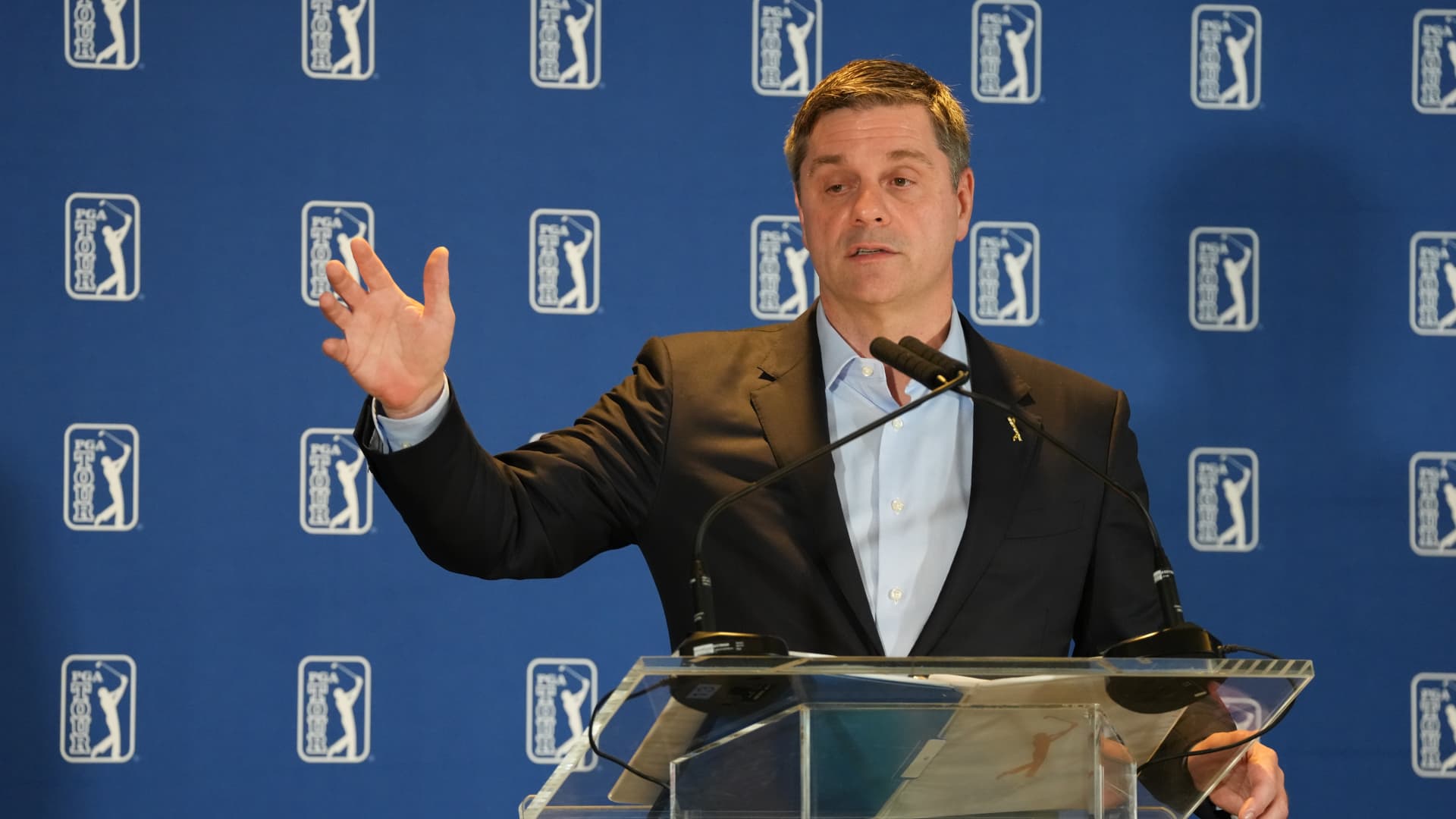
PGA TOUR CEO Brian Rolapp speaks during the announcement of a new competitive model for the PGA TOUR, ahead of the Travelers Championship at TPC River Highlands on June 23, 2026 in Cromwell, Connecticut.
Ben Jared | PGA Tour | Getty Images
Golf fans are finally getting details on a new chapter of the PGA Tour designed to elevate competition and increase winner payouts.
PGA Tour CEO Brian Rolapp revealed the new competitive model for professional golf’s premier tour ahead of this week’s Travelers Championship outside Hartford, Connecticut.
Rolapp has prioritized modernizing the Tour since he was named CEO in June 2025 after a 22-year career in the NFL. The Tour boards also approved the appointment of Rolapp to succeed Jay Monahan as commissioner following Monahan’s retirement at the end of the year, the Tour announced Tuesday. Rolapp will retain his role as CEO.
“We had a productive meeting yesterday where our boards approved the Future Competition Committee’s recommendation to establish a new competitive model for the PGA Tour that will begin with the 2028 season,” Rolapp announced Tuesday.
Instead of a main schedule of tour events, the new format will feature two distinct series of tournaments: one, a premier track called the PGA Tour Championship Series and a second that provides a path to those high-profile events called the PGA Tour Challenger Series.
The new format will be familiar to fans of other sports like soccer, where some leagues feature differentiated divisions that promote and retain top-performing teams, while relegating those that aren’t as successful to lower circuits.
In the press release, Rolapp called it “a new competitive model built on meritocracy, with clearer pathways, higher stakes and more consistency when the best players compete together.” He added that the focus will now be on finalizing the details and preparing to implement the system for the 2028 season.
Wyndham Clark, fresh off Sunday’s U.S. Open victory, applauded the changes Tuesday, telling CNBC in an interview that the Tour is in “an incredible place.”
“I think this two-track system is going to bring meritocracy and make it easier to follow the PGA Tour, and then the match play should be a lot of fun to watch,” he said. “I think the Tour has made an incredible effort to improve itself and its product.”

The proposed two-track system will create a schedule of approximately 23 to 24 events for the season, including the Players Championship, major golf championships – the Masters Tournament, PGA Championship, US Open and Open Championship – season-ending tournaments and all international team events played each year, such as the Ryder Cup or Presidents Cup.
The season will run from February to August each year and will typically feature tournaments with four 18-hole rounds where approximately half the field will advance to play the full event after a 36-hole cut.
The Tour will also bring back playoff events featuring so-called “match play,” where winners are determined by a process of beating other players in head-to-head matchups, rather than “medal play,” which determines a winner by the best overall score over four rounds of play.
Match play most closely resembles other championship formats in sports like NCAA basketball or the FIFA World Cup round of 16.
Another big distinction will be seen in the cash prizes up for grabs each week.
For the Championship Series, the minimum purse each week will be $20 million and venues will be located in higher profile locations and larger media markets. Challenger Series events will feature purses of at least $4 million at a minimum of 20 events during the season at “distinguished venues that have traditionally hosted PGA Tour events.”
There will be separate points systems in place for the two circuits, resulting in a promotion and relegation construct in which a minimum of 90 players will retain their place in the Championship Series after each season, and 20 players from the Challenger Series will be elevated, while players falling behind will be relegated.
The announcement of the PGA Tour’s new format comes at a time when professional golf’s competitive dynamics are at a crossroads. The past few years have led to what some golf fans have called a “civil war” in the sport, after the LIV Golf League debuted in 2022 to great fanfare and seemingly endless funding from the Saudi Public Investment Fund.
Some of the sport’s best players have left the PGA Tour ranks to join LIV Golf for big money. But LIV Golf’s future was thrown into doubt earlier this year after Saudi Arabia’s sovereign wealth fund announced it would no longer finance LIV Golf beyond the end of the current season.
LIV Golf CEO Scott O’Neil is in the process of raising new capital to fund the league’s operations in a post-PIF world. The league has retained the services of investment bank Ducera Partners and is actively involved in soliciting investments. CNBC previously reported that the league was looking to raise between $250 million and $350 million to help run its own revamped schedule and format that will focus much more on team golf franchises and competition in the future.
The PGA Tour’s revamped structure is the result of much deliberation by its Future Competition Committee, made up of six player representatives from the Tour ranks, alongside three business advisors.
The committee is chaired by golfing great Tiger Woods and includes fellow players Patrick Cantlay, Maverick McNealy, Keith Mitchell, Adam Scott and Camilo Villegas, as well as current PGA Tour Board of Directors and PGA Tour Enterprises Chairman and former Valero Energy CEO Joe Gorder, Fenway Sports Group founder and principal owner John Henry and Fenway Sports Group senior advisor and former Major League Baseball executive Theo Epstein.
“It was about bringing together different perspectives, having honest and difficult conversations and thinking broadly about what is best for the game we all love,” Woods said at the event, his first public appearance since his arrest for drunk driving in March.