


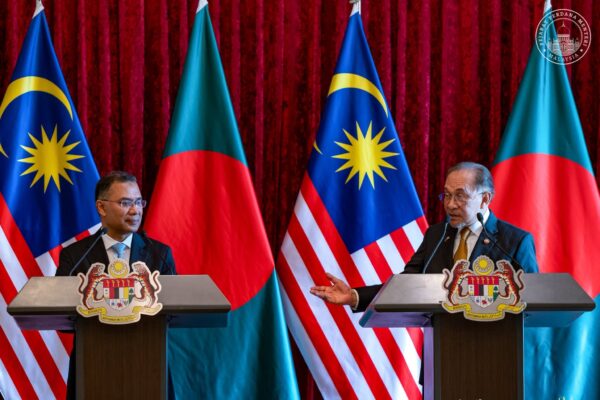
Bangladesh’s new prime minister has asked Malaysia to consider reopening its labor market to Bangladeshi migrant workers, as he and his Malaysian counterpart pledged a broad expansion of economic ties.
Prime Minister Tarique Rahman made the request to Prime Minister Anwar Ibrahim during a meeting in Putrajaya yesterday. The visit, Tarique’s first since taking office in February, is aimed at attracting investment and economic support, and will also involve a three-day state visit to China.
At a joint press conference, Tarique said he had asked Anwar to consider reopening the job market to Bangladeshi workers as soon as possible, while also raising issues related to undocumented workers and the possible repatriation of detained Bangladeshis.
“We agree that recruitment should be transparent, fair and affordable, reducing the role of middlemen and lowering the cost of overseas employment,” he said, the South China Morning Post reported.
Bangladesh has for years been a major source of migrant labor for Malaysia and relies heavily on remittances from foreign workers, which totaled more than $27 billion in 2024. But advocates for migrant workers say the sector has long been plagued by practices such as debt bondage, forced labor, excessive recruitment fees and scams that have seen workers left penniless in Malaysia.
This has prompted Malaysia to restrict the admission of Bangladeshi workers several times in the past. The most recent of these was in 2024, when experts appointed by the United Nations Human Rights Council highlighted the poor treatment of Bangladeshi workers.
UN experts have uncovered numerous cases of workers stranded by scams promising jobs that later turned out to be non-existent, and called on Malaysia “to take urgent action to address the dire humanitarian situation of migrants and protect them from exploitation, criminalization and other human rights violations.”
Anwar told reporters that the two countries had agreed to take measures to ensure transparency in the recruitment of workers and protect their well-being.
“This continued use of exploited, abused workers… purely for personal corporate gain cannot be tolerated,” he said, according to Reuters.
The joint statement issued by the two sides following their meeting suggests some caution on the part of Malaysia in resuming the “status quo” regarding migrant labour.
According to the statement, Malaysia “acknowledged Bangladesh’s proposal regarding worker recruitment”, but added that both sides “recognized that approvals for new foreign worker quotas are currently assessed strictly on a case-by-case basis, based on verified employer requirements and sectoral caps.”
This suggests that any arrival of foreign workers from Bangladesh will likely be limited and controlled, and that a full resumption of recruitment will require both countries to address years of debt bondage and abuse.
The SCMP said Malaysia accepted around 800 Bangladeshi workers between December 2025 and January 2026, after what it described as a “stricter selection process”. The joint statement said the two countries will soon convene a meeting of their joint working group to evaluate the current memorandum of understanding on labor cooperation and begin drafting “a new, updated memorandum of understanding that meets the current needs of both nations.”
Besides the issue of migrant workers, the two sides expressed their commitment to further strengthen cooperation in trade, investment, defense and other areas, according to the joint statement. In particular, they agreed to continue negotiations on a free trade agreement, with a view to concluding the agreement in 2027. They also “emphasized the importance of strengthening defense capacity through courses and training programs.”
Tarique and Anwar also witnessed the exchange of several agreements, including collaborations on investment promotion, cultural cooperation and combating terrorism.