


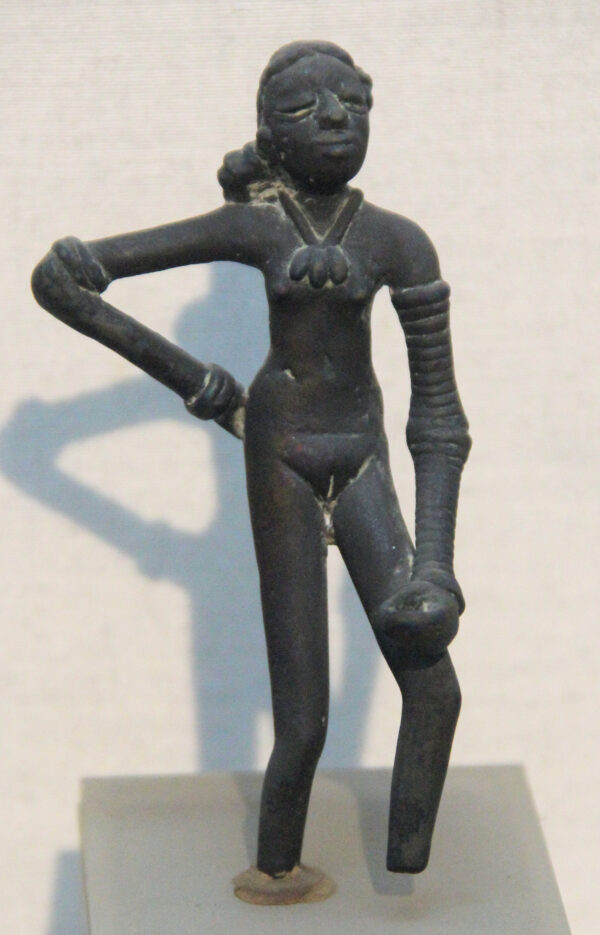
Following heavy criticism from educationists and historians for blurring the image of a figurine of a naked young woman in its history textbook for Class IX students, the Indian National Council of Educational Research and Training (NCERT) was forced to backtrack. He agreed to replace the altered image of the iconic figurine with its “original version.”
“The correction is being implemented immediately in the digital version of the textbook, while the revised printed editions will contain the original version of the image,” NCERT director Dinesh Saklani told news agency ANI. An autonomous body under the Federal Ministry of Education, NCERT oversees curriculum changes and textbook content for children taking exams under the government-run CBSE system.
At the center of the controversy is the image of a four-inch bronze figurine, one of the most recognized and acclaimed artifacts of the Indus Valley Civilization, which dates back to around 2600-1900 BCE.
The figurine, known as the “Dancing Girl”, was discovered in Mohenjo-daro, in what is now Pakistan, in the early 20th century. The sculpture depicts a young woman with her right hand resting on the back of her hips, her chin tilted slightly upwards, and her legs slightly bent at the knees. The figure has a completely naked torso. Her hair is tied in a bun and she wears bracelets and a necklace. Her pose is striking for the confidence she exudes.
For decades, school history textbooks have featured images of the Dancing Girl figurine, which today resides in the National Museum in New Delhi, a proud symbol of the artistic prowess of an ancient civilization. Most of the Indus Valley Civilization artifacts found so far were made of terracotta; the Dancing Girl figurine is made of bronze and indicates civilization’s mastery over metallurgy. The figurine gave the students an insight into the social life of the people of the Indus Valley, their ornaments and aesthetics.
But in a recently released NCERT Class IX textbook, the figure’s torso has been shaded, hiding its anatomical features.
So why did the NCERT officials decide to revamp the Dancing Girl pictures? The fact that she was naked seemed to have rattled them, prompting them to shade the image of her bare torso to make it look like she was clothed.
India has never been a puritanical society. The temples are full of sculptures of naked but jeweled gods and goddesses. The Khajuraho group of temples, built between 900 and 1130 AD, are decorated with erotic sculptures.
It was under British colonial rule that Victorian morality and prudery largely infiltrated society.
Under the rule of the Hindu nationalist Bharatiya Janata Party (BJP), which is socially conservative and deeply patriarchal, even misogynistic in its outlook and policies, India has regressed in multiple ways, particularly since 2014, when the Narendra Modi-led BJP rose to power nationwide. The Modi government has transformed the NCERT and other education boards in BJP-ruled states into tools to advance its Hindutva agenda. The NCERT, in particular, has worked assiduously to modify curricula, rewrite history and other social science textbooks in order to advance its Hindutva project.
While Saklani told NDTV that there was “no specific reason for obscuring the torso” of the Dancing Girl image in NCERT textbooks, it appears that the NCERT moral police themselves believed that an image of a naked woman was inappropriate for students or acted to please their masters in the Sangh Parivar, the Hindutva outfit family of which the BJP is a part.
This is not the first time that the Dancing Girl has been dressed by Indian patriarchs.
On May 18, 2023, Modi unveiled a statue inspired by the Dancing Girl. He was to be the “gate keeper” of the International Museum Exhibition held in New Delhi. The statue was not a replica of the original figurine but a “stylized… contemporary… life-size” version.
Significantly, this Dancing Girl avatar had pink skin and clothing.
The Dancing Girl figurine also caused unease in Pakistan. At the time of Partition, when the sharing of assets between India and Pakistan was being negotiated, officials were also arguing over Harappan artifacts. When they finally agreed on a 50/50 split of Harappan artifacts, Pakistan rejected the Dancing Girl in favor of a figurine of a male priest-king. In an academic article titled “Sahib’s Nautch Girl: Colonial Archeology and Identity Formation of a Bronze Girl Statue from Mohenjodaro,” Punjab University historian Ashish Kumar wrote: “Pakistani authorities chose the king-priest to avoid any negative reactions at home that a naked adolescent figure might have invoked from religious quarters.” “The ‘nudity’ of a teenage girl,” he argued, “impacted the decision of Pakistani authorities, who viewed her sexuality as a threat to their moral convictions.”
It is important to note that Indian historians have disputed the naming of the figurine as Dancing Girl. In “A History of Ancient and Medieval India,” historian Upinder Singh wrote: “The dancer may not have been dancing at all, and even if she did, she may not represent a professional dancer. »
It turns out that it was British colonial archaeologist John Marshall who interpreted the figurine as that of a “Nautch girl” (literally a dancer; during colonial rule, nautical girls were associated with prostitution). And this name stuck.
No one, it seems, is comfortable around a confident young woman.
This time, the four-inch figurine of the Indus Valley woman won the battle against the puritans seeking to shame her. But how long before the Puritans return to make war on it or other nude sculptures? How far will they go? Will they take their fight to Hindu temples?