


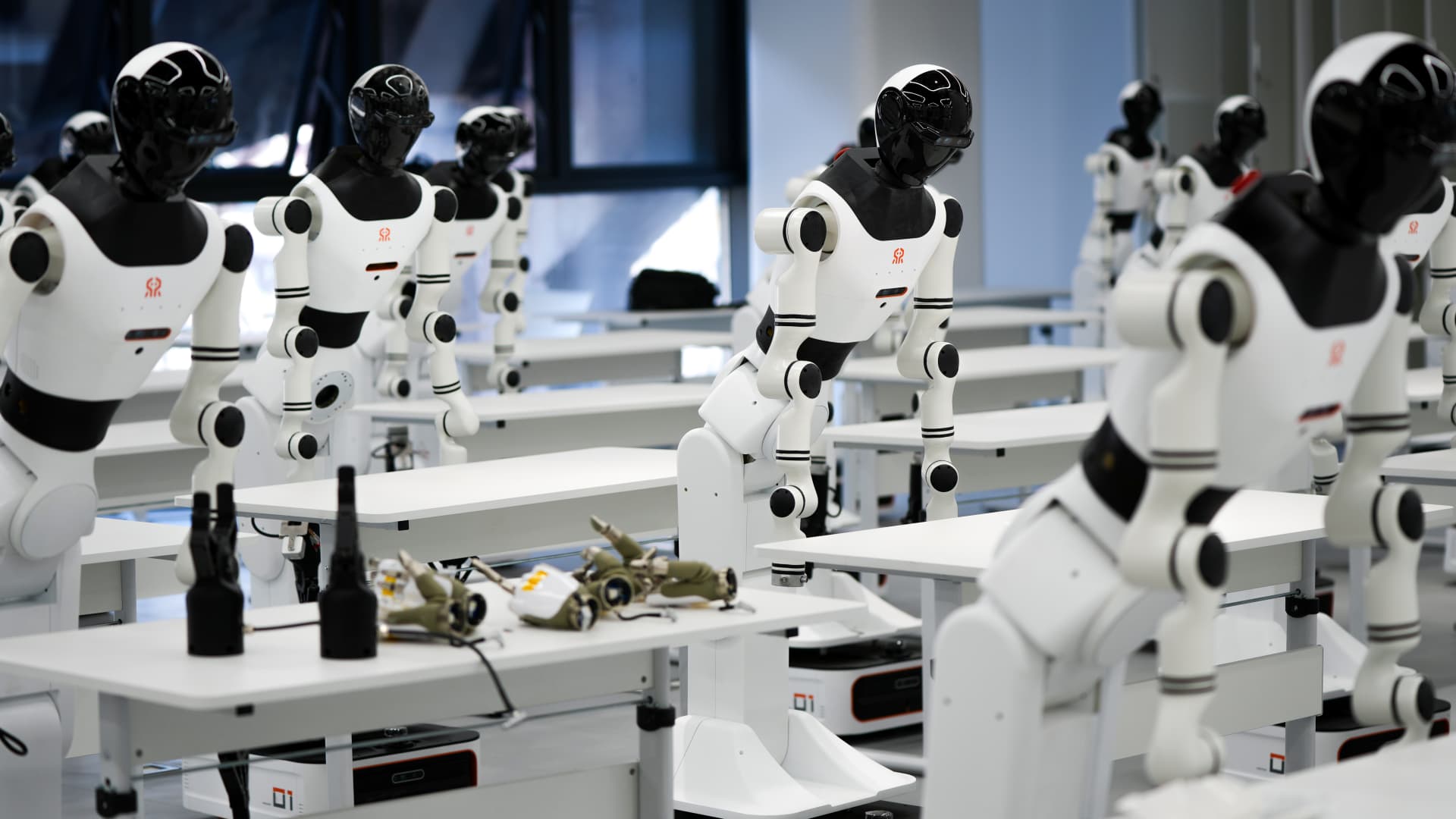
Humanoid industrial robots are displayed at the Shougang Park Humanoid Robot Data Training Center on March 27, 2025 in Beijing, China.
VCG | Chinese Press Service | Getty Images
PARK CITY, Utah — Rivian Automobile CEO RJ Scaringe envisions a day in the not-so-distant future when the electric vehicle maker’s manufacturing employees will have a new kind of co-worker: humanoid robots.
“There will be thousands of people collaborating alongside these robots. They’ll be taking pictures, ‘Hey, look at this! My colleague’s name is Phil, and he’s a robot,'” Scaringe said at a media event for the Rivian R2 EV launch.
The 43-year-old car enthusiast and technology entrepreneur launched a robotics company called Mind Robotics last year. The company has raised more than $1 billion, according to Scaringe.
Humanoid robots are designed to be shaped and move like people. Artificial intelligence algorithms power their capabilities with complex hardware like semiconductors. Supporters say they could be used in a variety of settings, from factories to hospitality and even the home, while others have expressed concerns about these devices replacing human jobs.
Scaringe said the company plans to unveil its first product in less than a year, with Rivian as a significant minority shareholder and launch customer. Mind currently has about 20 open positions, ranging from software and hardware engineers to data architects, according to its website.
Rivian CEO RJ Scaringe, who founded Mind Robotics late last year, speaks to the media on June 3, 2026 during an R2 electric SUV launch event in Utah.
Michael Wayland/CNBC
Scaringe, executive chairman and interim CEO of Mind, told CNBC that the plan is to keep the robotics company separate from Rivian, as opposed to the automaker pivoting partially to making humanoid robots, like Tesla CEO Elon Musk is doing well with his company.
“We have a deep relationship, and that’s actually how we’ve structured it,” Scaringe said in an interview. “A big part of structuring the business was to allow me to be able to devote time to both.”
The robotics strategy adds to the narrative that Scaringe does things differently than Musk, despite obvious similarities between their companies. There have been enough comparisons that Rivian has even been called “anti-Tesla” and Scaringe has been called “anti-Elon.”
“I would say there’s a lot of alignment there, and I think it’s because, obviously, I’m biased, but I think they’re right… that autonomy is an extremely important technology,” Scaringe said of Tesla and Rivian. “But in terms of products, in many ways they couldn’t be more different.”
So far, Rivian and Mind are helping each other, just as Musk’s companies also did during the development phases. That includes Musk’s xAI company merging with SpaceX ahead of the company’s record IPO Friday, as well as SpaceX purchasing vehicles from Tesla.
Scaringe said Rivian would be a “big beneficiary” of Mind, which uses Rivian data to train its AI models. With Rivian’s participation, the automaker will be Mind’s first customer for robots.
“We realized this was a huge opportunity that deserved to be its own business,” Scaringe said. He said he believes there is a multibillion-dollar total addressable market for industrial labor.
A Tesla Optimus robot distributes candy in front of the Nasdaq MarketSite in New York, United States, Monday, October 27, 2025.
Michael Nagle | Bloomberg | Getty Images
Scaringe was visibly excited when speaking with the media about the potential of AI and humanoid robotics, calling it “one of the most exciting times, perhaps in human history.”
“A hundred years from now, they will inherit the work that we will do throughout our lives, and so I think we are so lucky to be alive when AI is born,” Scaringe said.
Despite optimism about humanoid robots, Scaringe said he expects the devices to work alongside humans rather than completely replacing them in the near future, saying it takes “a long time” for vehicle assembly plants to become so-called “dark factories” that can be run almost entirely by robots.
“What I see is that the simplest tasks will be taken over by robots. The more complex tasks that require higher levels of reasoning or more complex, more tactile levels of dexterity. [will be done by humans]” he said.
Scaringe said automakers were facing an “extreme lack of labor” from other automakers. Rivian currently has more than 30 manufacturing and engineering job openings, according to the company’s website.
The need for such workers, along with the rapid development of AI, Scaringe believes, will mean that human employees will be working alongside a robot named “Phil” much sooner than expected.
“The pace at which this is changing is much faster than I would say – an order of magnitude faster – than the average person in society understands,” he said. “It’s going to be a particularly big challenge in the short term to allow the average person to realize how quickly the models learn and how capable they are of doing almost anything.”
—CNBC Arjun Kharpal contributed to this report.