


Technicians work on an engine at the GE Aerospace engine shop in Lafayette, Indiana.
Leslie Josephs/CNBC
RIO DE JANEIRO — Aircraft engine makers have failed to keep their promises to airlines, CEOs of major airlines say, a problem that vexes an industry that has struggled for years with a shortage of planes and, more recently, a doubling of fuel prices.
It’s a paradox: engine manufacturers have dazzled carriers with more fuel-efficient options for new airliners. Boeing and Airbus. But production shortfalls and disappointing reliability of those engines are becoming costly problems, CEOs said in interviews at the industry’s biggest annual gathering here.
Airline executives said they were being forced to remove the engines and take them for maintenance to crowded workshops earlier than planned, driving up costs and eating up fuel savings they were supposed to achieve from the engines.
Airline executives told CNBC this week that travel demand is still strong despite higher fares, so having planes on the ground means there is money left on the table, just as a $100 billion higher fuel bill this year reduces airlines’ profit prospects.
Alexis von Hoensbroech, CEO of Canada’s WestJet, told CNBC in an interview before the International Air Transport Association’s annual meeting of more than 370 airlines that the new engines promising fuel savings of around 15% or more over previous models were “engineering marvels.”
“However, as you push the limits, sometimes it comes at the cost of reliability, and what we’re all seeing is that these engines are having to undergo unscheduled maintenance much more frequently than previous generations of engines,” he said.
Newer models of aircraft engines burn hotter, allowing them to use less fuel. This is a key element since fuel is the largest cost for airlines after labor. But it can also mean they wear out more quickly, which can ground planes even if carriers keep a few spare engines.
Von Hoensbroech and other airline executives told CNBC that the new engines had not achieved the reliability airlines needed, although improvements had been made.
“It’s a big fight, because it adds a lot of cost,” he said. “A lot of the fuel savings are actually eaten up by unexpected maintenance costs.”
“Lack of engines”
Manufacturers have invested heavily in expanding engine overhaul and other maintenance capabilities, while third-party shops have also seen a boon.
New engines are expensive, but aircraft production is always behind schedule, which also maintains the value of older engines.
For example, a CFM56 engine manufactured by GE Aerospace and its French partner Safran, which equips old Boeing 737s, was sold for $9.2 million at the start of the year, up 17% since 2019, according to the IBA group. The price of the Pratt & Whitney PW1127 for Airbus’ new narrow-body aircraft has increased more than 57% during that period, according to the aviation intelligence and consulting firm.
Engine overhaul and maintenance has become a $58 billion-plus business.

Willie Walsh, the outgoing director general of IATA, told the conference in Rio de Janeiro that he was “deeply disappointed that customers have not dented manufacturers’ finances”, and pointed to a rise in profits for engine suppliers.
“My message to the engine [original equipment manufacturers] “It’s simple: Stop ripping us off and get back to making great engines that work and last,” he said. “Allowing these failures to continue into the next decade is completely unacceptable to customers.”
For its part, GE Aerospace, which manufactures engines for Airbus’ A320 narrow-body aircraft and Boeing narrow-body and wide-body aircraft, said it has been working on improvements and has also increased production.
“We have made significant investments to improve flight time, reduce ownership costs and increase production and will continue to invest to make significant improvements,” the company said in a statement. “While there is still much to do, we are making progress every day to continue delivering long-term value to our customers.”
GE powers Boeing’s best-selling 737 Max through its CFM joint venture with France’s Safran. These Leap engines are also options on Airbus A320 narrow-body aircraft, with Pratt & Whitney being the other. GE engines are also used on the majority of 787 Dreamliners.
United Airlines CEO Scott Kirby praised GE for making improvements, but said the industry still faces concerns.
“The biggest constraint for at least the next five years will be the lack of engines,” Kirby said.
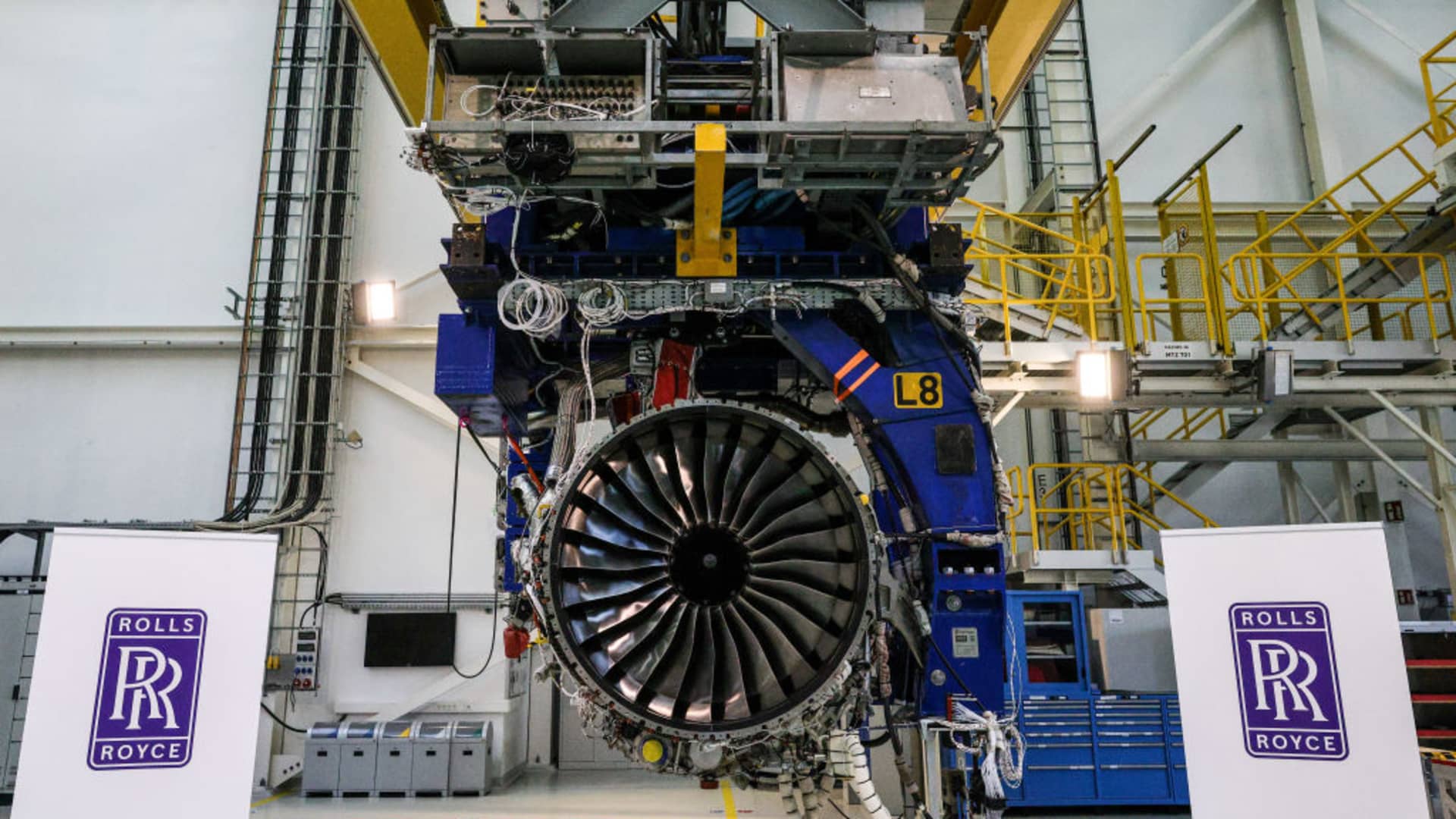
A Rolls Royce jet engine on display at the Rolls-Royce aircraft jet engine production and repair plant in Blankenfelde on February 28, 2023, near Berlin, Germany.
Omer Messinger | Getty Images News | Getty Images
He pointed to a lack of parts like forgings and castings and said in terms of smoothing out the supply, “I don’t really think we’ve started yet.”
Pratt and some of its customers face the added problem of a years-old manufacturing defect. The problem forced airlines to ground planes with these engines, which was one of the biggest challenges facing the now-defunct Spirit Airlines. Pratt’s relative, RTXdid not immediately comment.
Rolls-Royce, another manufacturer, said it was still working on efficiency. The company said it had invested £1 billion ($1.33 billion) in its Trent engine fleet and in a mode that “delivers up to three times the time on wing, resulting in better fleet planning and a reduced maintenance burden for customers.”