


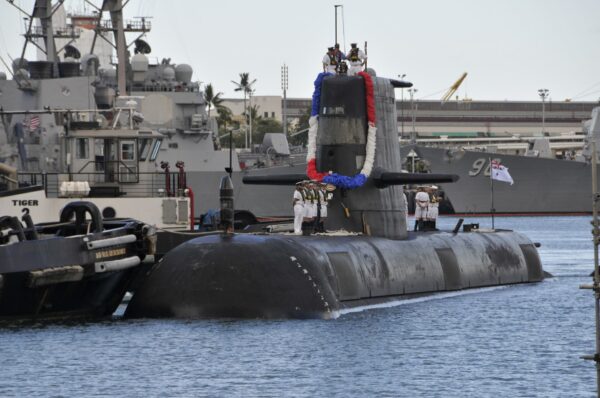
Acquiring a new submarine fleet has been a persistent problem for Australia’s defense strategy for almost two decades. In 2009, the government of Kevin Rudd commissioned a white paper on defense which recognized the need for Australia to replace its aging Collins-class submarines and expand its fleet from six to 12 boats. What followed was a chaos of indecision, changes of plans and wasted opportunities. All of this has left the maritime nation, heavily dependent on Indo-Pacific sea lines of communication, without adequate equipment to defend its own interests.
From initial negotiations with Japan to build a new fleet, to the deal with France to produce 12 diesel-powered Attack-class submarines – which was canceled in favor of AUKUS after work began – Canberra has continually returned to square one. Now, all six Collins-class boats are expected to remain in service until the early 2040s, when the first nuclear-powered AUKUS class submarines should become operational. Submarines that entered service in the 1990s will have to serve for half a century.
This put the government in a bind. Previously, the government was looking to invest in a “life extension” (LOTE) program for the Collins-class submarines. However, at a speech for the Lowy Institute in Melbourne this week, Deputy Prime Minister and Defense Minister Richard Marles announced a major A refocusing of $7.8 billion of the program.
Rather than replacing key fleet systems – including diesel engines and generators – the government will now adopt what it calls a “conditions-based sustainment” approach. Each submarine will be assessed individually and upgraded only when deemed strictly necessary, with priority given to combat systems, weapons and sensors.
The logic put forward is pragmatic: reduce technical risks, shorten maintenance periods and maximize operational availability during the critical transition period preceding the arrival of nuclear submarines. HMAS Farncomb, which is due to retire at the end of May, will undergo a detailed technical assessment, although this is I don’t expect to come back in active service for at least two years.
The case for extending the life of the Collins-class submarines is based not only on the timely delivery of the AUKUS-class submarines, but also on the expectation that the United States will deliver three Virginia-class submarines to Australia under the AUKUS agreement. But the provision of the agreement is that delivery will only take place if Washington manages to spare the submarines. It’s a massive bet Canberra is making on something that seems unlikely: US submarine production is in decline. currently experiencing delaysproducing submarines at a rate of about 1.1 boats per year, a far cry from the U.S. Navy’s goal of 2.2 to 2.3 boats per year.
Australia’s submarine program has arrived at a balance sheet that is, as Marles pointed out, the direct product of a decade of delayed decision-making. In a highly political speech, Marles blamed the previous coalition government’s indecision during its nine years in power and claimed Labor was the only party that had consistently taken Australia’s national defense seriously, citing a long history of Labor investment dating back to Creation of the Royal Australian Navy by the government of Andrew Fisher in 1911.
Accusations aside, the piecemeal expansion of the Collins-class submarines may now be the least bad option available. It’s a recognition that this is now what Australia has and there is a need to make it work in the best possible way.
Yet Marles’ speech also offered another potential solution by discussing Australia’s burgeoning autonomous underwater systems. THE Ghost shark – Australia’s pioneering long-range autonomous underwater vehicle – represents a truly different logic of underwater capability. This is a logic based not on maintaining aging submarines with crew, but on new forms of surveillance, reconnaissance and strike capability.
Investing more heavily and urgently in autonomous systems, while retaining the viable operational capabilities for which Collins-class submarines can be useful, could provide a comparable deterrence and surveillance capability at lower risk and potentially at lower cost. The war in Ukraine highlighted the effectiveness of asymmetric warfare; Australia may now be in a position where it needs to think more creatively about asymmetric deterrence.