



Zoey Gong, a Chinese dietary therapist, was days away from boarding an Emirates flight from Paris to Shanghai via Dubai, United Arab Emirates, when the United States and Israel attacked Iran on Saturday.
As a result, Gong, 30, found her flight plans derailed, and she told CNBC she had to pay $1,600 to get to Shanghai, more than double the price of her original ticket.
She is among millions of travelers swept up in war and other conflicts from Iran to Mexico this year, problems that threaten the global tourism industry, worth an estimated $11.7 trillion to the global economy, according to the industry group World Travel & Tourism Council. This shows that people who are far from missile strikes, drone attacks and other geopolitical hotspots are not immune to ripple effects.
“The quagmire of aviation”
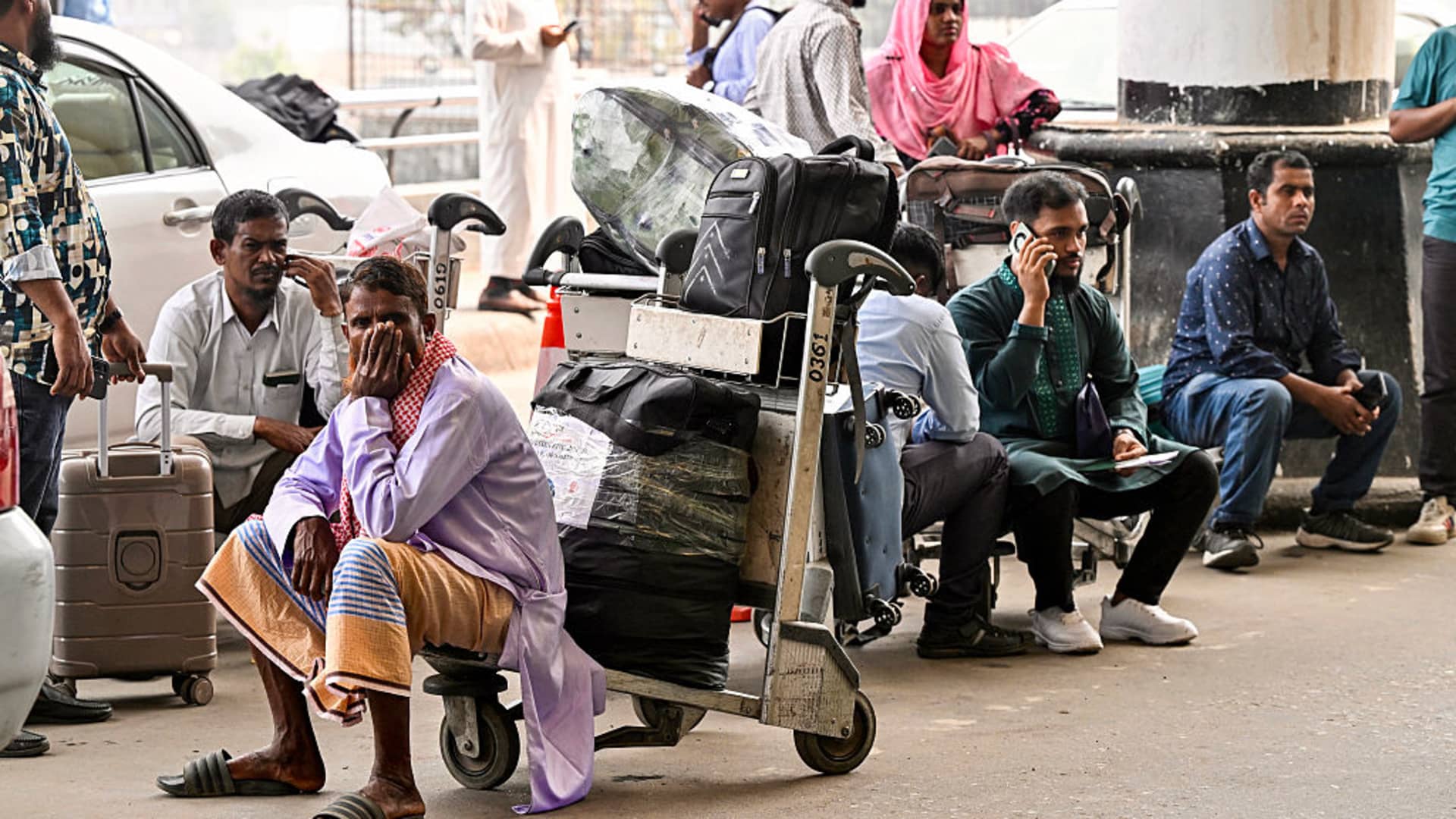
Stranded passengers wait with their luggage outside Dhaka’s Hazrat Shahjalal International Airport on March 3, 2026 after carriers canceled flights due to the Middle East conflict.
Munir Uz Zaman | Afp | Getty Images
The US-Israeli attack on Iran has triggered massive aviation, travel and security crises.
More than a million people worldwide are stranded due to airspace closures that have grounded more than 20,000 flights since Saturday, according to aviation data firm Cirium. Some were also stuck on cruise ships. Requests for more expensive travel insurance “to be canceled for any reason” increased 18-fold this week, said Chrissy Valdez, senior director of operations at Squaremouth, an online insurance marketplace.
Since Saturday, Iran has launched retaliatory attacks against the United Arab Emirates – home to Dubai International Airport, the world’s busiest for international passenger traffic, according to the Airports Council International – as well as Qatar, Jordan, Israel and Cyprus. The comings and goings of attacks have left airlines with little recourse to repatriate travelers.
Days after the attack, the U.S. State Department asked citizens in much of the region to leave immediately, with few options available to them. The department said it was arranging charter flights for U.S. citizens wanting to return from Saudi Arabia, Israel, the United Arab Emirates and Qatar.
“This has turned into a quagmire for aviation,” said Henry Harteveldt, a former airline executive and founder of the travel consultancy Atmosphere Research Group.
Other sectors of the travel industry are also facing the consequences of the war. Debris fell nearby Accorat the Fairmont The Palm Hotel in Dubai this weekend. The company said four people were injured, but there were no guests, visitors or staff members. Meanwhile, the iconic Burj Al Arab hotel caught fire earlier this week after being hit by debris from an Iranian drone.
(L to R) Maltese-flagged cruise ships Aroya Manara and MSC Euribia are anchored at Dubai Port on March 4, 2026.
Giuseppe Cacacé | AFP | Getty Images
MSC Cruises’ more than 6,300-passenger ship MSC Euribia is stuck in Dubai and the company is trying to secure flights for affected guests, it said. “We ask our partners to prioritize our guests,” the company said in a statement.
“In order to speed up repatriation, we are working on other options such as charter flights” from Dubai, Abu Dhabi, United Arab Emirates, or Muscat, Oman, but the situation on board “remains calm,” the cruise company said.
Earlier this week, MSC announced it would cancel its remaining sailings from Dubai for the winter. “We understand this will be disappointing, but we are confident that affected customers will understand this decision,” he said.
Setting aside the Covid-19 health crisis that has halted most international travel, Harteveldt called this week “the most chaotic event we’ve seen frankly since 9/11, when the United States chose to close its airspace. We haven’t seen anything that has had such a long-term and geographically wide-ranging impact on travel.”
Global conflicts
Flightradar24 shows air traffic across the Middle East on March 4, 2026.
Source: Flightradar24.com
The war in Iran is this year’s most serious military conflict, but it is part of a series of hurdles that threaten travel demand and the profits of hotels, airlines and cruise lines, as well as local economies that rely heavily on travel, particularly international tourists, who tend to spend more than local visitors.
Three days into 2026, the United States struck Venezuela and captured its president, Nicolás Maduro, and his wife, Cilia Flores. The attack prompted the United States to close airspace throughout the Caribbean, stranding travelers, many of them in expensive resorts and rental homes they had booked for vacations.
Then, in February, flights were grounded in parts of Mexico, including the resort town of Puerto Vallarta and Guadalajara, after violence erupted following the Mexican army’s killing of a cartel leader.
Executives have already had to make costly changes: rerouting or canceling departures, adopting flexible booking and refund policies, grounding planes and completely changing flight plans, and even reducing hotel rooms.
The cost of these conflicts is still being calculated, including that of fuel, one of the biggest expenses for cruise lines and airlines along with labor, and is usually passed on to consumers, meaning more expensive tickets and stays could be the order of the day.
Australian carrier Qantas, for example, told CNBC that its flight from Perth, Australia, to London will now take a route that will require it to stop to refuel in Singapore, but will also allow it to take on about 60 other passengers.
Best year ever?
Passengers look at departure screens showing canceled flights to Puerto Vallarta at Benito Juarez International Airport after authorities stepped up security following roadblocks and arsons carried out by organized crime in several states, following a military operation in which a government source said Mexican drug lord Nemesio Oseguera, known as “El Mencho”, was killed in Jalisco state, Mexico City, Mexico, on February 22, 2026.
Luis Cortes | Reuters
Travel officials began 2026 as they often do: optimistic. Some airline executives, including those of the most profitable U.S. carriers, Delta Airlines And United Airlinesforecasts record profits this year.
War and other incidents erupted as the travel industry relied on high-end options to woo wealthier customers, who account for a larger share of overall spending. Losing the basis for more expensive travel could be even more disadvantageous to these businesses and local economies.
In Mexico, for example, tourism accounts for almost 9% of the economy and international tourist arrivals increased 13.6% last year to 98.2 million people, who spent almost $35 billion, according to the country’s Tourism Ministry.
Airlines are now opting out of flying to Puerto Vallarta, at least from the United States in the short term. Delta cut routes from April 3 through the end of the month to the city, except for once-daily flights from Los Angeles and Atlanta, according to the Cranky Network Weekly newsletter, which covers the airline industry’s network changes. Alaska Airlines And Southwest Airlines also cut service in March.
“Maybe people will forget the PVR [Puerto Vallarta International Airport] We are now concerned that headlines will shift to the Middle East and bookings will rebound, but we will monitor capacity changes as leading indicators,” Brett Snyder and Courtney Miller, the newsletter’s authors, said in the March 1 edition.
Smoke rises amid a wave of violence, with vehicles burned and gunmen blocking highways in more than half a dozen states, following a military operation in which a government source said Mexican drug lord Nemesio Oseguera, known as “El Mencho,” was killed, in Puerto Vallarta, Jalisco, Mexico, February 22 2026.
@morelifediares via Instagram | Reuters
The recent numbers also come three months before the FIFA World Cup, which will take place in cities across Canada, Mexico and the United States.
Some hotels in Mexico are also starting to notice a change.
Victor Razo, manager of the Rivera del Rio hotel in Puerto Vallarta, told CNBC that reservations are down about 10% from last year.
“We’ve had some promotions given what’s happened,” he said, adding that this has driven prices down between 10 and 20 percent as spring break and Holy Week approach this coming month.
He added that the hotel was not close to the problems, including roadblocks, and that bookings have since stabilized.
“It’s not like the beginning of the pandemic,” he said. “There is no comparison.”