
Close Menu
Crazy Peks NewsCrazy Peks News
  • Home
  • America
  • Asia
  • Europe
  • Business & Money
  • Politics
  • Technology
  • Sports
  • Entertainment
  • Privacy Policy
  • Get In Touch
Facebook X (Twitter) Instagram
Trending
  • Travel app Hopper agrees to $35 million FTC settlement following allegations the company misled users by charging hidden fees and misrepresenting total costs (Lauren Forristal/TechCrunch)
  • Jersey Mike’s IPO filings
  • Premier Lacrosse League plans to sell teams by 2028 or shortly after
  • Emails leaked in court filing detail difficult exchanges between DOD’s Dario Amodei and Emil Michael and how Anthropic’s relationship with DOD deteriorated (Wall Street Journal)
  • Asia is heading towards the Arctic, but it’s not easy – The Diplomat
  • What the ‘mother of all trade deals’ learned from the India-ASEAN FTA – The Diplomat
  • Stock market gains will create new millionaires in 2025, according to UBS
  • Anthropic has launched development of a custom AI server chip and held preliminary discussions with Samsung on manufacturing the chip (Qianer Liu/The Information)
Facebook X (Twitter) Instagram
Crazy Peks NewsCrazy Peks News
Demo
  • America
  • Asia

    Asia is heading towards the Arctic, but it’s not easy – The Diplomat

    July 2, 2026

    What the ‘mother of all trade deals’ learned from the India-ASEAN FTA – The Diplomat

    July 2, 2026

    Singapore police seize $42 million bungalow in Nvidia chip smuggling probe – The Diplomat

    July 2, 2026

    A sign of cautious reconciliation between Japan and South Korea – The Diplomat

    July 1, 2026

    Drug case on USS Ronald Reagan raises questions about off-base reach in Japan – The Diplomat

    July 1, 2026
  • Europe
  • Business & Money

    Jersey Mike’s IPO filings

    July 2, 2026

    Premier Lacrosse League plans to sell teams by 2028 or shortly after

    July 2, 2026

    Stock market gains will create new millionaires in 2025, according to UBS

    July 2, 2026

    Ford eyes level playing field with Toyota and GM imports under new USMCA

    July 2, 2026

    Automakers report mixed U.S. sales results as hybrids drive market

    July 1, 2026
  • Politics

    Trump fears no one will show up for his July 4 speech

    July 1, 2026

    Trump hands election to Democrats by holding midterm convention

    June 30, 2026

    Mike Johnson groans in defeat after SCOTUS overturns Trump on citizenship rights

    June 30, 2026

    House Democrats to force vote to cut Trump’s arms fund

    June 29, 2026

    Supreme Court condemns Republicans in midterms with ruling on mail-in voting

    June 29, 2026
  • Technology

    Travel app Hopper agrees to $35 million FTC settlement following allegations the company misled users by charging hidden fees and misrepresenting total costs (Lauren Forristal/TechCrunch)

    July 2, 2026

    Emails leaked in court filing detail difficult exchanges between DOD’s Dario Amodei and Emil Michael and how Anthropic’s relationship with DOD deteriorated (Wall Street Journal)

    July 2, 2026

    Anthropic has launched development of a custom AI server chip and held preliminary discussions with Samsung on manufacturing the chip (Qianer Liu/The Information)

    July 2, 2026

    President Trump bought up to $5 million each in Broadcom, Meta, Amazon, Apple, Microsoft and Nvidia stock on July 23, the same day as his AI action plan (New York Times)

    July 2, 2026

    A survey of American adults found that 56% supported banning social media for those under 16, while 21% opposed it; majorities across demographic and partisan groups support a ban (Pew Research Center)

    July 2, 2026
  • Sports
  • Entertainment
Crazy Peks NewsCrazy Peks News
Home » What the ‘mother of all trade deals’ learned from the India-ASEAN FTA – The Diplomat
Asia

What the ‘mother of all trade deals’ learned from the India-ASEAN FTA – The Diplomat

Frank M. EverettBy Frank M. EverettJuly 2, 2026No Comments
Facebook Twitter Pinterest LinkedIn WhatsApp Reddit Tumblr Email
Share
Facebook Twitter LinkedIn Pinterest Email


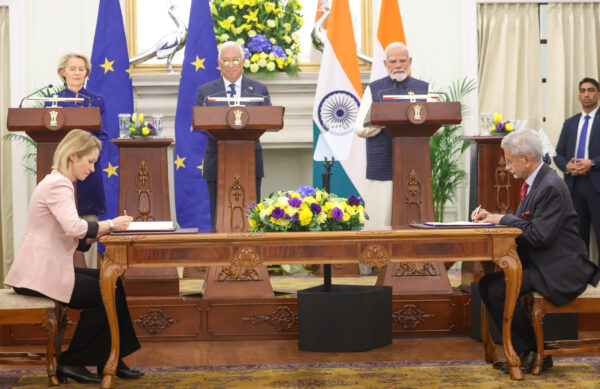
India and the European Union finally shook hands and I signed the monument Free trade agreement on January 27, 2026. This deal has been widely described as the “mother of all deals” because it took nearly two decades of stalled negotiations to reach. A formal relaxation in 2022 and a revival resulted in a comprehensive set of 23 chapters covering goods, services, digital commerce and sustainability.

For those who experienced the negotiation of India’s first major trade deal, the 2009 ASEAN-India Trade in Goods Agreement (AITIGA), it brought back memories. The ASEAN-India agreement marked a watershed: India, for the first time since liberalization in 1991, opened its markets to a multi-country regional bloc, fundamentally moving away from its protectionist trade policies.

AITIGA came into force in January 2010. The Services Agreement followed in November 2014 – after ASEAN had already secured full access to India’s vast domestic goods market. The goods sector was of interest to ASEAN at that time, while India had a well-established services sector. By agreeing to sequence them at the time, India gave up its main negotiating leverage. New Delhi then waited in vain for reciprocity of services which never fully materialized.

With its new market access, ASEAN reduced India’s trade deficit from around $7.5 billion per year before the FTA to more than $7.5 billion per year before the FTA. 44 billion dollars After. Even though India’s exports to ASEAN increased by 65 percent in the decade following the FTA, its imports jumped 186 percent during the same period. The services deal finally arrived well over four years later, but it offered a weak and late way of balancing an already bloated equation.

As a negotiator on the Indian side during this period, the lesson learned was clear and difficult: do not make a deal until all parties agree.

Other failures compounded a bad deal: weak rules of origin, tariff asymmetry and institutional gaps. The India-EU Free Trade Agreement attempts to address these flaws and provides a blueprint for revising AITIGA.

Under AITIGA, a product can be considered “ASEAN Origin” with only 35% value added in an ASEAN country. In other words, up to 65% of its value could still come from non-ASEAN sources, such as China. To solve this problem, the India-EU FTA uses a two-criteria rule: goods must be substantially transformed (i.e. a change in customs category) and cannot use too high a share of parts from outside countries.

The deal was also asymmetrical from the start. India has opened about 74 percent of its tariff lines while Indonesia, New Delhi’s largest trading partner within the ASEAN region, has only committed to about 74 percent of its tariff lines. 50 percent. On the other hand, the EU agreed to liberalize around 97 percent of its tariff lines, while India reciprocated around 92 percent..

Regarding institutional gaps, AITIGA omits investment protection, geographical indications, digital trade and sustainability. In contrast, the India-EU FTA covers these areas and includes separate negotiations on investment protection and a separate agreement on geographical indications. In the India-EU case, the parties agreed on nothing until they agreed on everything.

India is currently in the midst of a formal review of AITIGA, which began in 2020 during the 17th Indian ASEAN Economic Ministers’ Consultation. It was tentatively scheduled to end in 2025; it is already 2026 and the revision is still in progress.

The process represents both an opportunity and a risk for India. The opportunity is to apply the fundamental lesson of the European model: insist that any renegotiation of lists of goods be conditional on simultaneous binding improvements in access to services.

However, the risk is that India repeats the initial mistake in reverse. He may negotiate improvements to goods in isolation or accept promises of services which are again carried over to a future instrument. As happened with the initial FTA, ASEAN may have no incentive to honor its promises once gains are made.

THE “mother of all affairs” with the EU is not only important for its impact on trade in goods. It removes tariffs on Indian textiles, pharmaceuticals, marine products and IT services entering the European market, leading to a real transformation in the trading relationship. The EU-India FTA is also important because it shows that India is now using link problem as a structural tool rather than a simple procedural preference.

Southeast Asia and India share too many strategic interests to remain locked into a unilateral FTA. The ASEAN review gives both sides a second chance, and the EU deal has set an example.

deals Diplomat FTA IndiaASEAN learned Mother trade
Share. Facebook Twitter Pinterest LinkedIn Tumblr Telegram Email
Frank M. Everett

Related Posts

Asia is heading towards the Arctic, but it’s not easy – The Diplomat

July 2, 2026

Singapore police seize $42 million bungalow in Nvidia chip smuggling probe – The Diplomat

July 2, 2026

A sign of cautious reconciliation between Japan and South Korea – The Diplomat

July 1, 2026
Leave A Reply Cancel Reply

© 2026 Crazy Peks News | All rights reserved.
  • Home
  • Privacy Policy
  • Get In Touch

Type above and press Enter to search. Press Esc to cancel.