


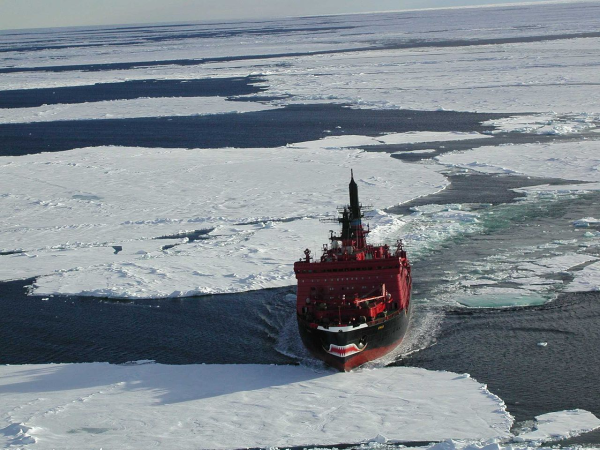
From Seoul to Singapore, Asian capitals are suddenly seeing the Arctic as the next frontier in global shipping. South Korea has committed more than $400 million to Arctic maritime infrastructure and plans to send a test container ship from Busan to Rotterdam in Septemberaimed at reducing the 40-day journey via Suez to around 20 days. Japan updates its Arctic strategy and deepens its diplomatic engagement. Singapore – a city-state with no Arctic territory – has an Arctic ambassador. Russian President Vladimir Putin met with Indian Prime Minister Narendra Modi in late 2025. and Arctic shipping was on the agenda. Russia’s Rosatom has signed cooperation agreements with Dubai’s DP World and is wooing India over Northern Sea Route (NSR) logistics.
While the Arctic is increasingly on the European agenda, with the European Union currently in the process of updating its Arctic policy, Asia is already moving faster in specific trade development, focusing on the opportunities that Arctic shipping can present. The political dynamic is real. However, shipping data is less so.
The route everyone wants, that almost no one uses
The NSR – which runs along Russia’s Arctic coast from the Barents Sea to the Bering Strait – is the corridor at the center of all this ambition. On paper, it reduces the Asia-Europe journey by around 7,000 kilometers compared to the Suez Canal. In practice, it is a seasonal, politically tense and infrastructure-dependent niche route.
In 2025, the NSR took care of 103 transit journeys carrying around 3.2 million tonnes of goods – a record, but modest. The Suez Canal, even under heavy pressure from Houthi attacks in the Red Sea that reduced traffic by more than 60 percent, still handled more than 12,000 transits that year.
Russia’s own ambitions for this route have been revised downwards on several occasions. In 2018, Russia set a target of 80 million tonnes by 2024; this eventually became 100 million at various later dates. Actual volumes in 2025 were around 37 million tonnes, most of which was Russian hydrocarbons moving east.
Allianz Commercial Maritime Transport and Safety Review 2026 – while recognizing the time-saving potential of the route – warned that the Arctic “remains one of the most risky environments for commercial shipping,” with sanctions and geopolitics posing a barrier as great as the ice itself. The Western majors – Maersk, CMA CGM, Hapag-Lloyd – have effectively pulled out, citing the risk of sanctions, insurance costs and environmental concerns.
Even COSCO, the Chinese shipping giant, has not sailed the NSR since 2022. This leaves two small Chinese companies largely unknown: Sealegend Shipping and new new shipping line – as the largest non-Russian operators on this route. Between them, they managed 14 container voyages through the Arctic in 2025, up from 11 the year before.
Operating on the NSR means engaging directly with Rosatom as the route’s sole infrastructure operator, navigating the risks of U.S. secondary sanctions, and agreeing to depend on Russian icebreaker escorts for much of the shipping season. For a company heavily exposed to Western trade, this is not an easy equation. Sealegend and New New Shipping, operating outside of this exposure, can take the risk. Major global carriers – including COSCO – cannot.
Japan’s engagement in the Arctic illustrates the complexity behind the media interest. Mitsui OSK Lines (MOL), the country’s largest shipping company and a long-time investor in Russian LNG infrastructure, was forced to change the charter contracts of four Arctic ships following American and European sanctions on the Arctic LNG 2 project, thus incurring losses. The Japanese public energy investor, JOGMEC, remains entangled in a project from which it can neither exit cleanly nor develop easily.
Yet Japan has not been afraid: it is building a new research icebreaker in the Arctic, updating its Arctic strategy and deepening its engagement in science, governance and – cautiously – access to resources. Japan’s ambitions are clear; their commercial viability is less so.
Meanwhile, the maritime map of the Arctic is about to be redrawn, not by melting ice, but by sanctions legislation crafted in Brussels. The main driver of growth in Arctic shipping over the past decade has not been climate change. It concerns a single industrial project: the Yamal LNG plant, on the Russian Yamal peninsula, which generates the gas traffic which dominates the NSR. As recently as February 2026, the European Union was import 100 percent of Yamal LNG’s total monthly production, despite years of stated ambitions to reduce Russia’s energy dependence.
This is, however, expected to change in January 2027, when the European ban on Russian LNG comes into effect. When this trade ends, a substantial portion of current Arctic tanker traffic will have to be redirected eastward – to Asian markets that already buy Russian Arctic crude through deals with a ghost fleet. India and China are logical destinations, and they both know it, giving them bargaining power to negotiate lower prices for energy that Russia can no longer sell to the West.
Rosatom is already courting both. He has signed a cooperation agreement with DP World of Dubai on a pilot route between Europe and East Asia via the Arctic. Moscow is also pursuing intergovernmental partnerships on NSR logistics. But redirecting LNG flows east requires different shipping routes and new transshipment infrastructure that does not yet exist on a large scale.
Geography, climate and geopolitics
The geography of the route also creates a strategic chokepoint at the Bering Strait, which any vessel using the NSR must pass through. The strait lies between Alaska and Russia, making it one of the most strategically sensitive maritime chokepoints in the world. Increasing maritime traffic there, combined with expanding Russian and Chinese naval activity further north, is reshaping how Washington thinks about access to the Arctic. The United States is investing in new icebreakers under the ICE Pact.
For Asian shippers, the route they are considering passes directly through a contested security environment, not a neutral trade highway.
The harsh Arctic climate further adds to the need for caution. When researchers say that the Arctic could see its first “ice-free day” before 2030that means something very specific: less than a million square kilometers of sea ice in September. This is not the same as having navigable open waters on an ocean larger than the entire European continent, all year round, for commercial ships.
Climate change may be melting the ice, but it’s also producing more extreme weather, higher waves in newly open waters, and unpredictable ice movement. The Northwest Passage – Canada’s alternative corridor – is it actually becomes more difficult to navigate in some ways as older, thicker ice moves toward previously clear sections.
And throughout the Arctic, navigation maps remain dangerously incomplete: in 2024, an experienced ship ran aground in the Northwest Passage not on the ice, but on an unexplored mud bank.
The transpolar route – directly across the central Arctic Ocean – is real in theory and practice decades from now, requiring not only consistent ice-free conditions but also a whole layer of search and rescue infrastructure that doesn’t exist. Without this, insurers will not cover the route at commercially viable rates. As Allianz Commercial puts it, the Arctic’s combination of remoteness, extreme weather and limited emergency response capacity makes it categorically different from other contested shipping corridors.
Does Arctic shipping have a future?
What could change things in terms of maritime transport in the Arctic is not the melting of the ice, but rather investment decisions. THE $3 billion railway project linking Baffinland’s Mary River iron mine in Canada to the port of Steensby will extend the Arctic shipping season and increase bulk carrier traffic, regardless of sea temperature. New LNG infrastructure, if it comes to fruition, will add routes for tankers.
Beyond investors, political decisions made in Brussels, Washington and Beijing will determine what is commercially viable on the NSR, far more than any September ice minimum. Already, the strengthening of military capabilities in all Arctic countries – NATO members or not – adds naval traffic independent of commercial maritime transport.
Asian interest in the Arctic is real, growing and geopolitically significant. But this interest is shaped by calculations of energy security, sanctions exposure, access to resources and strategic positioning – not a climate-driven maritime windfall.
This September, South Korea’s containerized test voyage from Busan to Rotterdam – with a stopover in Tromsø, Norway along the way – will be closely watched across the region. Its success or failure could tell us more about the real future of Arctic shipping than any climate model.