


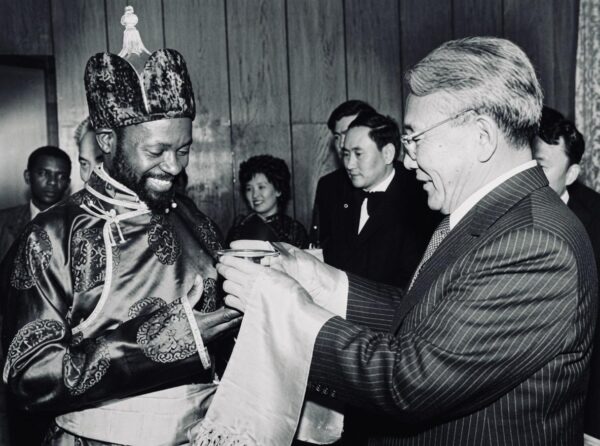
During the Cold War, Mongolia formed unlikely but surprisingly warm relations with African countries. Driven by communist solidarity rather than geography or trade, Ulaanbaatar hosted African liberation leaders, sent veterinary experts to Ethiopia and Mozambique, and interacted with Somalia and Ethiopia during the Ogaden War. Ulaanbaatar opened its first African embassy in Guinea even before Mongolia joined the United Nations. The continent, in turn, helped secure Mongolia’s seat at the UN. It was, by all accounts, a more substantial relationship than the physical distance suggested.
Then the Cold War ended, and so did most of that engagement. For three decades, Mongolia and Africa occupied separate paths. This is worth revisiting today, as the strategic case for re-engagement is considerably stronger today than it was the first time around.
It is difficult to exaggerate Africa’s growing weight in the world. The continent’s population is expected to approach 2.5 billion by 2050, more than a quarter of humanity. Africa provides most of the net growth in the world’s working-age population at a time when Europe, China and parts of Asia face demographic stagnation. Sub-Saharan Africa is expected to maintain GDP growth rates of 4-5% per year until mid-century, faster than any other region, with consumer and business spending expected to reach $16 trillion by 2050.
Africa also holds about 30 percent of the planet’s critical mineral reserves, including 55 percent of the world’s cobalt, 47 percent of manganese and 80 percent of the platinum group metals. As demand for these materials increases alongside the global energy transition, the continent’s strategic value is rapidly increasing.
Countries around the world are adjusting their diplomatic strategies to take into account the importance of Africa. Mongolia should be one of them.
The most immediate case for re-engagement concerns minerals. Mongolia and many African countries occupy structurally similar positions: resource-intensive economies, dependent on a narrow range of raw material exports, with limited processing capacity and limited access to Western markets. The giant Oyu Tolgoi copper mine in Mongolia exports almost entirely to China. African cobalt, copper and manganese also flow mainly to China. Both sides face the same vulnerability: dependence on Chinese demand and Chinese-controlled processing expose them to price pressure and political influence.
One solution that deserves serious consideration is third-party commodity trading agreements. Under such a mechanism, a Mongolian copper producer could fulfill a delivery obligation to a Chinese buyer by arranging for an African producer, closer to Chinese port infrastructure, to make physical delivery. Mongolia could then ship its production to a Western buyer, completing the exchange without either party having to bear the full cost of reorienting supply chains.
This instrument is already commonly used in oil markets and is attracting interest in critical minerals precisely because long-distance logistics make purely bilateral trade inefficient. For landlocked Mongolia, any arrangement that reduces effective transport costs is important. For African producers seeking access to Western markets, a quid pro quo could be just as valuable. Mining giant Rio Tinto, which operates both Oyu Tolgoi in Mongolia and the Simandou iron ore project in Guinea, already constitutes an institutional thread connecting the two continents.
Mongolia’s second lever is less obvious but increasingly important: it is already present in Africa, in uniform. Since 2002, Mongolian peacekeepers have served in Sierra Leone, Liberia, Sudan, South Sudan, the Democratic Republic of the Congo and Western Sahara. The deployment of a battalion to South Sudan in 2011 was an important milestone. Fifteen years later, Mongolian forces continue to protect civilians and secure humanitarian corridors in one of the United Nations’ most demanding missions.
Mongolia’s peacekeeping record shows that Ulaanbaatar can function as a neutral and credible party in conflicts where major powers are distrusted or perceived as self-serving. Mongolia has no colonial history in Africa, no rival intelligence operations and no extraction program. At a time of growing skepticism in Africa (and around the world) about the influence of great powers and distrust of their motives, this neutrality is a real diplomatic asset. The next step will be to leverage this more deliberately, not only through troop contributions, but also through a clearer definition of Mongolia as a constructive and impartial participant in African peace processes.
Finally, Mongolia and most African countries are members of the Global South, a category that takes on renewed political importance as the world fragments along major lines of force. Both face the same dilemma: how to preserve their economic and diplomatic autonomy as the United States, China, the European Union and Russia vie for alignment.
Technology is reducing some of the friction that geography once imposed. Sixteen African countries share Mongolia’s landlocked status, giving them common cause on transit rights, logistics reform and trade facilitation under frameworks such as the Vienna Program of Action. Beyond infrastructure diplomacy, there are opportunities for alignment in the governance of critical minerals, climate finance, and reform of international financial institutions. On all these issues, Mongolia and many African partners have compatible interests that none of them are currently able to exploit through bilateral coordination.
Mongolia and African countries have already demonstrated once that it is possible to build meaningful relationships across great distances and cultural differences. The first time around, ideology did the job, but those bonds did not survive the end of the Cold War. A second phase, if there is to be one, must be based on national interests. The good news is that the interests are there and growing stronger every day.