


Vietnamese authorities in recent days disrupted two groups trying to set up online scam operations in the country’s north, in what they said was a possible sign of an anti-scam crackdown spilling over into neighboring Cambodia.
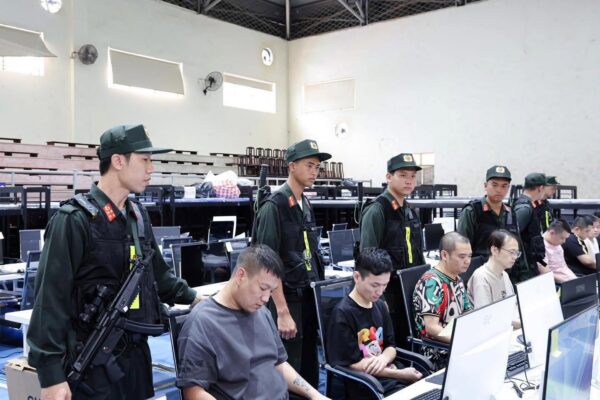
Police in Lao Cai province said yesterday that provincial investigators had recently raided a local hotel where a gang of scammers was trying to establish a cyber fraud operation, state media outlet Tuoi Tre reported.
The raid took place on Friday, just as the group began carrying out fraudulent operations targeting Chinese citizens seeking loans. “Members allegedly posed as loan app employees, informed victims about application procedures, and then defrauded them of their money,” the report states.
The gang consisted of 19 Chinese nationals led by a man identified as Wang Xiangsheng, who had left Cambodia for Vietnam to engage in online scams.
Investigators were alerted to the operation when a group entered Vietnam from Cambodia, through the Moc Bai border gate in southern Vietnam, before heading north to Lao Cai, which borders China.
All 19 were arrested during the raid. Police also seized 23 laptops, 26 mobile phones, eight 5G signal broadcasting devices and a host of other equipment.
This raid is just the latest action by law enforcement targeting new fraudulent operations linked to Cambodia-based criminal syndicates. In recent years, Cambodia has become a hub for online fraud operations, run primarily by Chinese criminal syndicates and drawing on a huge corps of trafficked workers from around the world. These operations have thrived on the alleged protection of senior government officials and prominent tycoons with close ties to the ruling Cambodian People’s Party. At its peak, the industry involved tens of thousands of trafficked workers, fraudulent complexes the size of factories, and profits equivalent to 40 percent of Cambodia’s GDP.
However, under pressure from China and the United States, and paying a growing reputational cost for its association with cyber fraud, the Cambodian government has announced plans to eradicate the scam industry.
Although questions have been raised about the legitimacy of the crackdown – Amnesty International said in a report last week that the campaign had so far “failed to dismantle the vast majority of sites in the country” – it has clearly gone much further than previous cosmetic policing operations in recent years. This likely prompted many fraudulent operations to pack up and seek more accommodating jurisdictions.
Vietnam seems to be an interesting alternative, even if it is not the only one. Yesterday’s announcement comes after the Ministry of Public Security announced that police in Phu Tho province, neighboring Lao Cai, had also “discovered and dismantled a group of foreign nationals suspected of being involved in a high-tech online fraud ring with the intention of establishing a long-term operational presence in Vietnam”, according to another report from Tuoi Tre.
In a statement released Thursday, the ministry said the investigation began after the Immigration Management Agency and local police in Tam Dao commune detected unusual accommodation arrangements involving several resorts, farm stays and villas in Hanoi, Phu Tho and Lao Cai. Preliminary findings “revealed that the suspects were linked to online fraud organizations previously operating in Cambodia,” the report added.
As in Lao Cai’s case, police seized a large amount of material, including 73 computers, 134 cell phones and 34 USB storage devices. Four people were arrested in connection with the investigation, including a Chinese national named Zhao Weizhong and three Vietnamese nationals.
In another case cited by Reuters, police in Ho Chi Minh City last week detected 83 Chinese nationals staying in a hotel in the city, allegedly preparing to set up an online scam hub there. In March, state media also reported the dismantling of three Chinese-run online scam rings in Vietnam’s Bac Ninh province, which also borders China, arresting 43 suspects.
These raids are notable in that Vietnam has so far been relatively untouched by online scam activity, at least across Cambodia, Laos and Myanmar, and suggest that the ongoing crackdown in Phnom Penh is serious enough to make Cambodia much less attractive to criminal syndicates. They also suggest that, alongside the recent increase in scam operations in Sri Lanka, the dispersal of Cambodia’s fraudulent economy will likely continue to have ripple effects in other parts of the region for months, if not years, to come.