
Close Menu
Crazy Peks NewsCrazy Peks News
  • Home
  • America
  • Asia
  • Europe
  • Business & Money
  • Politics
  • Technology
  • Sports
  • Entertainment
  • Privacy Policy
  • Get In Touch
Facebook X (Twitter) Instagram
Trending
  • Coinbase and Better fund the first Fannie Mae-backed mortgage that uses bitcoin as collateral, with a nationwide rollout planned in the coming months (Yogita Khatri/The Block)
  • Soaring stocks created 2 million new millionaires last year
  • Just 26% of Americans support increased data center construction, the lowest share among 15 major countries, including the United Kingdom, Japan and Canada (Financial Times)
  • Eli Manning’s private equity firm buys RCX to bet on youth sports
  • SpaceX gets property tax exemption for its $55 billion Terafab chip plant project in Texas, despite threats of legal action from Texans, amid local opposition to AI (Stephanie Findlay/Financial Times)
  • A profile of Anthropic as it prepares to go public and expand access to Mythos, amid criticism that commercial pressures have eroded its AI security standards (Madhumita Murgia/Financial Times)
  • Can ASEAN’s green goals survive the data center boom? – The diplomat
  • Moderators of the r/biohackers subreddit say peptide companies are spamming their forum in hopes that their posts will be deleted and used by AI chatbots (Jason Koebler/404 Media)
Facebook X (Twitter) Instagram
Crazy Peks NewsCrazy Peks News
Demo
  • America
  • Asia

    Can ASEAN’s green goals survive the data center boom? – The diplomat

    June 4, 2026

    Hong Kong’s Victoria Park remains silent on anniversary of Tiananmen crackdown – Radio Free Asia

    June 3, 2026

    Eco-brutalist resistance in Central Asia – The Diplomate

    June 3, 2026

    Uzbekistan’s new migration destination? America. – The diplomat

    June 3, 2026

    Trump’s new AI order raises the stakes in Sino-US tech competition – The Diplomat

    June 3, 2026
  • Europe
  • Business & Money

    Soaring stocks created 2 million new millionaires last year

    June 4, 2026

    Eli Manning’s private equity firm buys RCX to bet on youth sports

    June 4, 2026

    Macy’s (M) Q1 2026 Results

    June 3, 2026

    Honeywell Aerospace CEO predicts strong growth ahead of standalone debut

    June 3, 2026

    Sellers are listing homes at the fastest rate since 2020

    June 3, 2026
  • Politics

    Shocked Trump Loses Iran War Powers, Ballroom and Arms Fund on Same Day

    June 3, 2026

    Marco Rubio lied to Congress about Trump sleeping during meetings

    June 3, 2026

    Democrats will force vote to kill Trump’s slush fund and immunity program

    June 2, 2026

    Trump’s ballroom is dead and his battleships may be sunk

    June 2, 2026

    Massive defeat for Trump as his militarization fund dies

    June 1, 2026
  • Technology

    Coinbase and Better fund the first Fannie Mae-backed mortgage that uses bitcoin as collateral, with a nationwide rollout planned in the coming months (Yogita Khatri/The Block)

    June 4, 2026

    Just 26% of Americans support increased data center construction, the lowest share among 15 major countries, including the United Kingdom, Japan and Canada (Financial Times)

    June 4, 2026

    SpaceX gets property tax exemption for its $55 billion Terafab chip plant project in Texas, despite threats of legal action from Texans, amid local opposition to AI (Stephanie Findlay/Financial Times)

    June 4, 2026

    A profile of Anthropic as it prepares to go public and expand access to Mythos, amid criticism that commercial pressures have eroded its AI security standards (Madhumita Murgia/Financial Times)

    June 4, 2026

    Moderators of the r/biohackers subreddit say peptide companies are spamming their forum in hopes that their posts will be deleted and used by AI chatbots (Jason Koebler/404 Media)

    June 4, 2026
  • Sports
  • Entertainment
Crazy Peks NewsCrazy Peks News
Home » US farmers struggle to buy fertilizer amid Iran war
Business & Money

US farmers struggle to buy fertilizer amid Iran war

Stacey D. WallsBy Stacey D. WallsApril 15, 2026No Comments
Facebook Twitter Pinterest LinkedIn WhatsApp Reddit Tumblr Email
Share
Facebook Twitter LinkedIn Pinterest Email


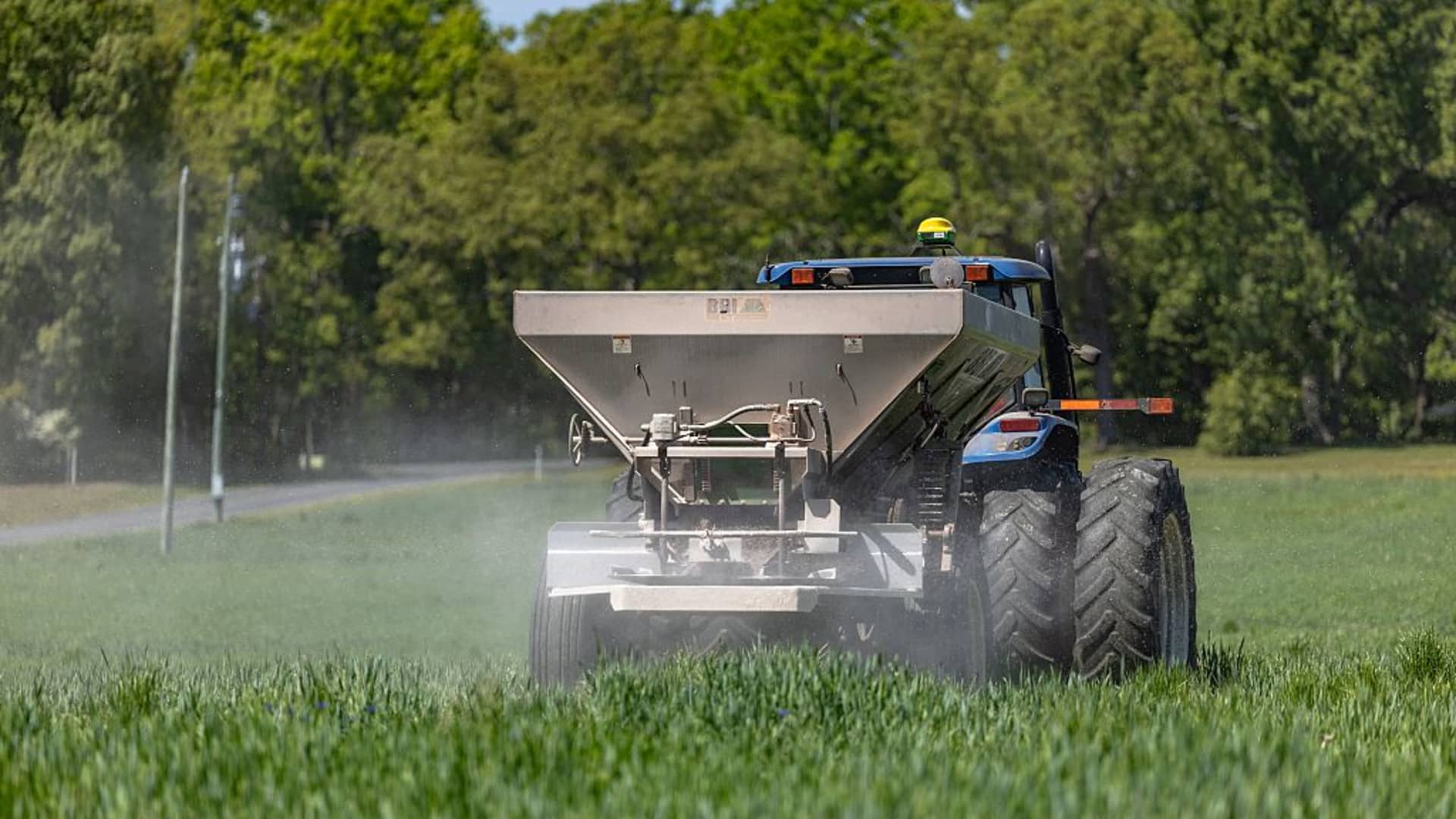
Fertilizer is spread in a field in China Grove, North Carolina, April 10, 2026.

Grant Baldwin | AFP | Getty Images

On a farm in Goldsboro, North Carolina, where her husband’s family has worked the land for generations, Lorenda Overman faces familiar obstacles, but also new pressures that she couldn’t have anticipated just a few months ago.

“We’re still battling bad weather, disease and insects,” Overman said. “For three years we’ve had record input prices and they’ve only gone up over the last six or eight weeks.”

Fertilizer prices have soared due to shipping disruptions from the war in the Middle East, and rising costs are impacting U.S. agriculture just as spring planting begins. Farmers are being forced to reduce inputs, change their crops and reconsider how much to plant, which could affect the supply of some crops in the United States and around the world.

New survey data from the American Farm Bureau Federation shows that fertilizer access and affordability is becoming a defining challenge for this year’s growing season. Nearly six in ten people, or 58%, report a deterioration in their financial conditions amid rising input and fuel costs, according to the survey conducted April 3-11.

A large portion of farmers say they can’t afford all the fertilizer they need. In the Midwest, nearly half, 48 percent, said they cannot afford the fertilizer they need. This share was at least 66% in the West, North East and South regions.

Overman said she didn’t order fertilizer in advance, which is standard industry practice, because her farm couldn’t make ends meet last year and she hoped prices would drop when the planting season started this year.

“We can’t wait for the [Strait of Hormuz] to reopen and get those ships here before we have to buy those inputs,” Overman said.

Fertilizer and nitrogen costs on his farm have increased from $139 an acre last year to an unexpected $217 this season.

Now preparing for a less profitable growing season, she is one of many farmers reviewing their accounts to try to soften the blow of rising commodity prices.

This could not only affect these farmers’ bottom lines, but also their ability to produce the amount of key crops they usually would.

Farmers and crops in the South are hardest hit

While U.S. farmers face higher costs, the impact is not distributed evenly across the country.

Growers in the South are most at risk, according to Farm Bureau data, with only 19% of fertilizer pre-reserved ahead of the season — well below the Midwest, where 67% locked in their supplies early. This time lag is critical: farmers who did not purchase in advance now face higher prices.

As a result, 78% of farmers in the South say they can’t afford all the fertilizer needed, compared to 48% in the Midwest.

This is particularly concerning given the diversity of cultures. More than 80% of rice, cotton and peanut producers say they cannot afford to purchase the necessary inputs. These crops will be most vulnerable to reduced yields this season, compared to soybeans, which tend to require less nitrogen.

That’s why farmers like Overman say they’re adjusting their planting strategy this year.

“We’re going to reduce our corn acres and try to plant a crop that’s a little less dependent on fertilizer and nitrogen, which would be soybeans,” Overman said. “We will also spread this fertilizer, a little more diluted.”

Tommy Salisbury, an Oklahoma farmer and leader of the Farm Bureau’s Young Farmers and Ranchers group, said the fertilizer price spike came at an inopportune time for farmers.

“That surge we talked about for fertilizer happened right before spring planning. It was the worst timing of all,” Salisbury said. “We had already planned our budget.”

Salisbury plans to reduce its acreage of milo, a grain similar to corn, and also shift to soybeans to offset rising costs. Worse still, crop prices are low enough that it becomes difficult to break even in the face of higher costs.

“We are paying 2026 input prices, but getting crop prices from the 70s and 80s,” he said.

All of this poses a threat to returns for 2026.

When farmers reduce their fertilizer use or change their acreage, it increases the risk of lower crop yields and a reduction in overall production. With large parts of the South, Northeast and West unable to fully fertilize crops, the Farm Bureau suggests these risks are growing.

The advocacy group aims to meet with the White House to push for more aid for farmers in the coming months.

Make CNBC your favorite source on Google and never miss a moment from the most trusted name in business news.
buy farmers fertilizer Iran struggle War
Share. Facebook Twitter Pinterest LinkedIn Tumblr Telegram Email
Stacey D. Walls

Related Posts

Soaring stocks created 2 million new millionaires last year

June 4, 2026

Eli Manning’s private equity firm buys RCX to bet on youth sports

June 4, 2026

Shocked Trump Loses Iran War Powers, Ballroom and Arms Fund on Same Day

June 3, 2026
Leave A Reply Cancel Reply

© 2026 Crazy Peks News | All rights reserved.
  • Home
  • Privacy Policy
  • Get In Touch

Type above and press Enter to search. Press Esc to cancel.