


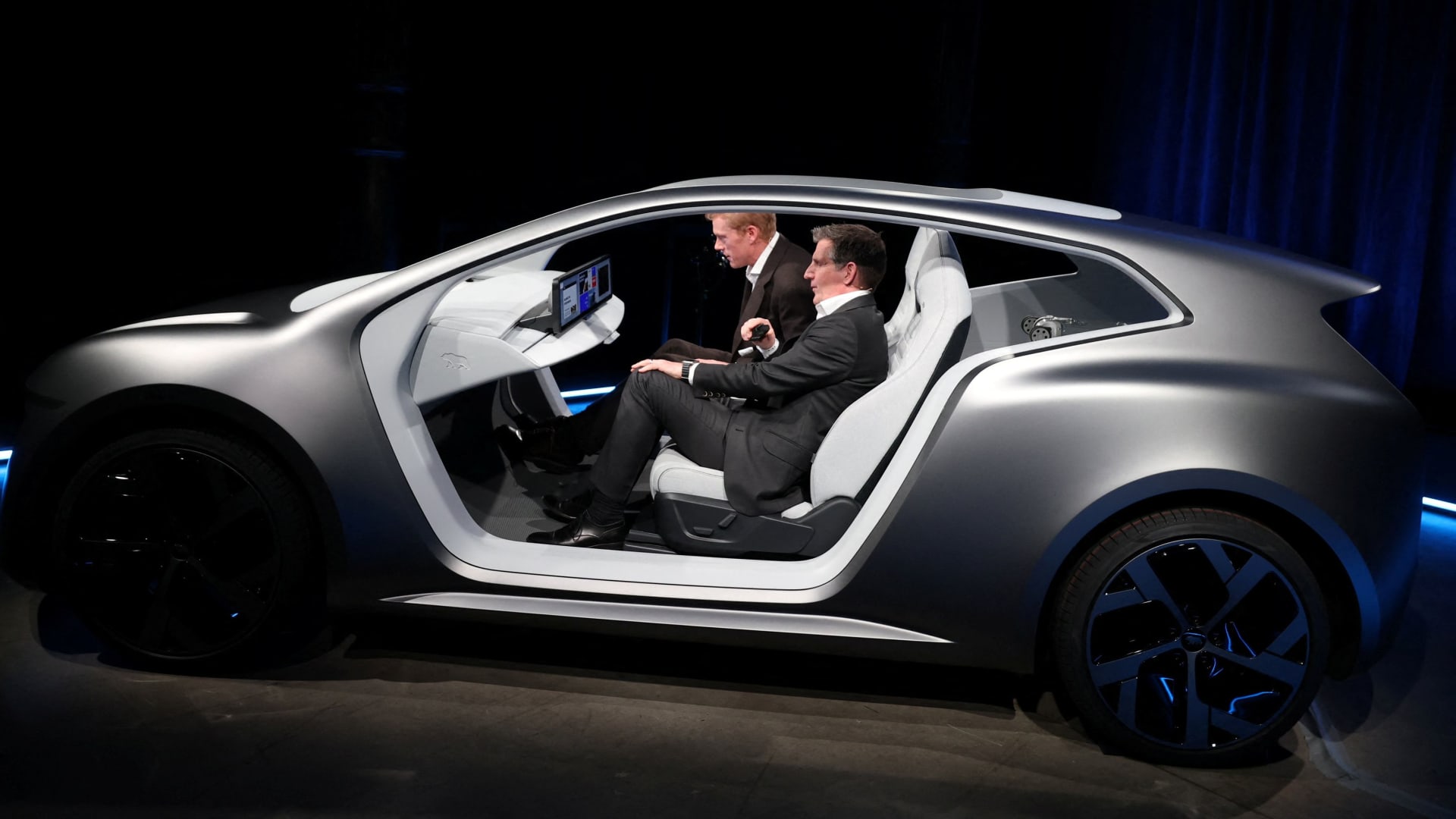
The Lucid Display can be seen at the New York International Auto Show on April 16, 2025.
Danielle DeVries | CNBC
NEW YORK — Lucid Group expects to be cash flow positive at the end of this decade as it plans to expand its vehicle lineup and significantly increase its software and technology offerings, the all-electric vehicle maker announced Thursday during its first investor day in nearly five years as a public company.
The electric vehicle company aims to generate positive cash flow through market expansion in mid-size vehicles and robo-taxis, as well as international expansion in markets such as Europe and Saudi Arabia. It also hopes to achieve efficiency gains and software revenue growth through the introduction of improved advanced driver assistance systems and a new artificial intelligence assistant Lucid, executives told dozens of investors and Wall Street analysts on Thursday.
Lucid stock closed Thursday at $9.84, down 7.9%. Shares fell about 6% to 8% through much of the event, although the company laid out its most detailed product and expansion plans yet, underscoring the tough market conditions for electric vehicle companies.
“We view the mid-term and end-of-decade goals as an important benchmark against which investors can measure LCID’s progress, which will improve transparency,” Baird analyst Ben Kallo said in a note to investors Thursday. “The near-term environment for electric vehicles remains challenging, with headwinds such as tariffs and policies dampening investor confidence.”
Lucid’s cash flow target is challenging given the automaker’s current performance and declining demand for electric vehicles in the United States. Although Lucid managed to increase sales and reduce losses, the company lost $2.7 billion on revenue of $1.35 billion in 2025. It reported negative free cash flow of $3.8 billion in 2025, a loss about 31% larger than a year earlier.

Lucid interim CEO Marc Winterhoff — who unexpectedly took over from company founder Peter Rawlinson last year — said the company’s “north star” is “accelerating toward profitability,” reiterating the event’s theme for investors. He and other executives declined to disclose the exact year the company aims to be cash flow positive.
The automaker is trying to increase investor interest in the company as it prepares to launch a new mid-size vehicle later this year. Its largest shareholder, the Public Investment Fund of Saudi Arabia, also changed its investment strategy in the company from an equity investment to a revolving credit.
Robotaxi, autonomy plans
Lucid on March 12, 2026, previewed plans for a new two-seater robotaxi that the company is developing based on its upcoming mid-size electric vehicle platform.
Michael Wayland/CNBC
Lucid said Thursday it expects to make about $1 billion in additional annual non-vehicle revenue from services such as recurring software subscriptions by the end of this decade. It also previewed plans for a two-seater robo-taxi, including a designer concept car, but it did not specify a timetable for the vehicle.
Winterhoff told CNBC after the event that dedicated robotaxi was a “mid-term” goal for the company in the coming years.
Company executives spent much of the event discussing Lucid’s upcoming driving technologies, including robotaxis, and plans to launch a subscription service by early 2027 that will cost between $69 and $199 per month, depending on capabilities.
“Autonomy plays an external role in Lucid’s future,” said Kay Stepper, Lucid’s vice president of advanced driving systems, adding that the company plans to offer vehicles capable of driving themselves in certain circumstances by 2029.
Winterhoff and Uber President and Chief Operating Officer Andrew Macdonald announced Thursday that they plan to expand their previously announced robotaxis partnership to include upcoming mid-size vehicles.
The expansion into midsize and autonomous models is expected to significantly increase Lucid’s total addressable market, or TAM, from $40 billion for its current Air sedan and Gravity SUV to $700 billion, executives said Thursday.
Winterhoff said he sees the company’s autonomy technologies growing essentially to match Tesla’s current FSD by next year.
Intermediate vehicles
Lucid announced plans Thursday to produce three mid-size vehicles, starting with a vehicle called Cosmos this year, followed by a model called Earth about a year later and an unnamed vehicle for an unspecified period after that.
“We believe these three unique products will give us the maximum opportunity to reach the widest possible audience. And that audience is where we are today, but it’s a different audience than our current market,” said Derek Jenkins, Lucid’s senior vice president of design and brand.
A teaser image provided by Lucid of its upcoming mid-size vehicle behind its current Gravity SUV.
Lucid
A preview of the Cosmos shown to event attendees on Thursday featured a more muscular look with slimmer headlights and a silhouette reminiscent of the automaker’s current Gravity SUV, but in a smaller package. The vehicle’s interior continues Lucid’s focus on a roomy cabin with ample storage space and a large single-piece screen spanning most of the car’s front dashboard.
The three midsize vehicles are aimed at high-end buyers, young “forward-thinkers” and outdoor enthusiasts, Jenkins said. The latter would be a direct competitor to another EV competitor Rivian Automobilewhich is expected to launch a new R2 mid-size vehicle this spring, starting with a version of the vehicle priced around $58,000.
Lucid said its midsize vehicle is expected to cost around $50,000. This would position it in line with average transaction prices for new vehicles in the United States as well as entry-level models of Rivian’s R2.
Rivian and Lucid are trying to reassure investors that they can not only compete in a struggling electric vehicle market, but also thrive through the expansion of new vehicles and technologies to better compete with the U.S. electric vehicle leader. Tesla. Lucid said its new mid-size EV platform will be top-notch in efficiency, something the company has strived to do with all of its vehicles.
Both claim to have enough capital to carry out short-term initiatives, but their long-term viability remains a major question for investors.
Lucid said its total liquidity of $5.5 billion, including a delayed draw term credit facility of approximately $2 billion from the Saudi PIF, was sufficient to get through the first half of 2027.
Rivian ended the fourth quarter with $6.59 billion in total liquidity, including nearly $6.1 billion in cash, cash equivalents and short-term investments, as the company attempts to ramp up production of its mid-size vehicles and new autonomy technologies this year.
—CNBC Michael Bloom contributed to this report.