



At least 371 families displaced by the construction of the Laos-China railway project, completed three years ago, have still not received full compensation after refusing to accept what they consider inadequate offers from the Laotian government.
The families, most of whom live in the capital Vientiane, have been forced to leave their land because of the project, part of Chinese President Xi Jinping’s Belt and Road initiative to develop infrastructure linking China to its neighbors.
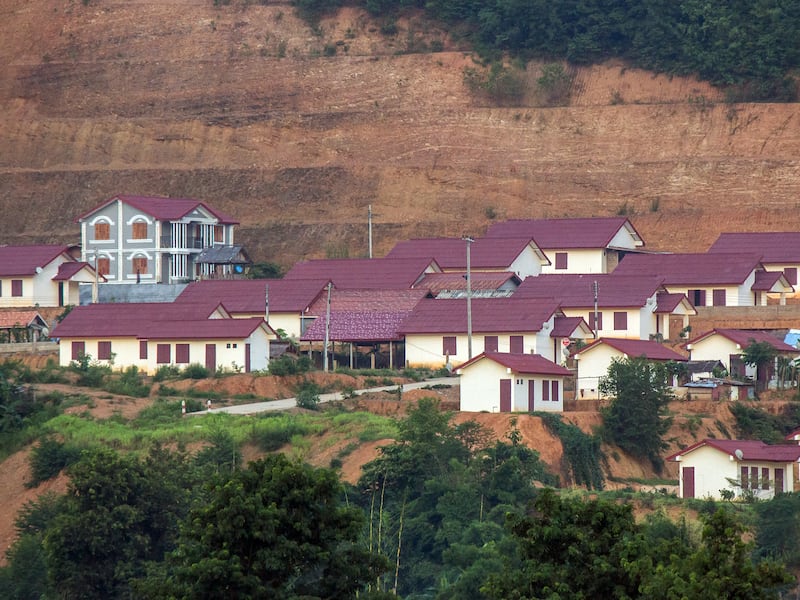
Khamphan Phommathat, chairman of the Lao State Inspection Authority, confirmed that the 371 families remained uncompensated at a meeting of the Lao National Assembly last week, noting that the government had already paid $83 million to 6,504 of the 6,875 families affected by the project.

“The reason why the problem remains unresolved is that the government and the affected families still cannot agree on the calculation of a unit price for their houses, farmland and trees lost due to the project, while in other cases, some families simply cannot accept the unit price proposed by the government,” he said.
RELATED STORIES
Some Vientiane villagers demand higher compensation for Laos-China railway
Laotian villagers unhappy with compensation as SEZ development begins
Four months later, Laotian farmers await compensation for Chinese developers
In August last year, residents told RFA that they were offered 80,000 kip ($4.10) per meter, but were asking for 150,000 kip ($7.70) per meter.
The $6 billion railway linking the two communist neighbors was inaugurated in December 2021. The World Bank predicted it would boost tourism, freight transport and agricultural trade.

The line connects Vientiane to northern Laos, passing through 10 stations in the country, including the main tourist attraction of Luang Prabang and the Chinese border town of Boten. It ends in Kunming, in China’s southwest Yunnan province.
It is the first railway to penetrate any distance into Laos, a country whose transport infrastructure has long been limited by poverty, mountainous terrain and small population.
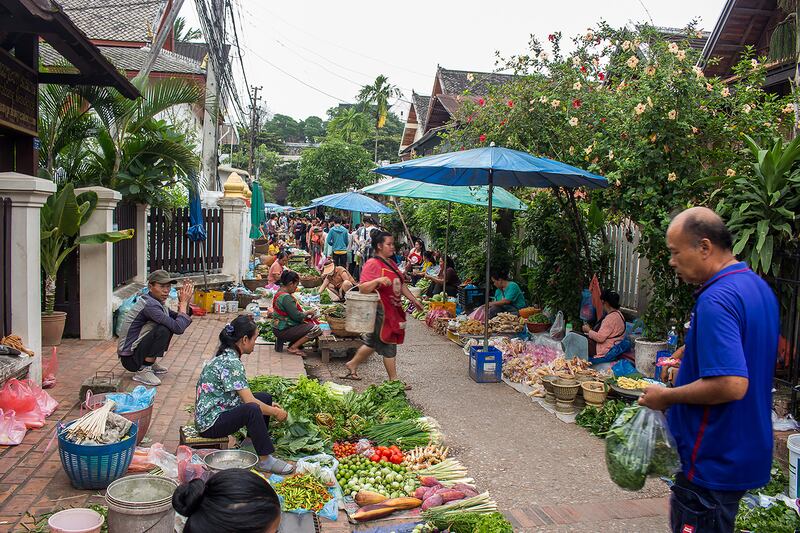
But the project has been criticized for driving several thousand farmers off their land. Many faced long delays in getting reimbursed for their lost property, while others were shortchanged in the payments they received.
Speaking to RFA, an official involved in the compensation negotiations said the main reason for the delay was that the government underestimated residents.
“There will be an increase in the previously proposed unit price which [the government] “However, many years have already passed and the economic situation [in Laos] has changed, so it seems that the unit price offered is too low.

Another official working on the compensation issue, who also requested anonymity, echoed the assessment that the government’s offer is too low.
“The National Assembly has already approved the unit price of compensation, but in practice, the affected families find it too low and do not want to accept it,” he said. “The government also cannot accept the unit price offered by the affected families. The only thing the government can do is to push the villagers to accept its offer.”
There is currently no forecast as to when the compensation system will be completed, but Khamphan Phommathat of the National Inspection Authority told the National Assembly that the government would do its best to finalize the unit price of the offer.
“We will continue to push for people to get compensation for what they have already lost because of the Laos-China railway project,” he said.
Translated by Phouvong. Edited by Joshua Lipes and Malcolm Foster.