


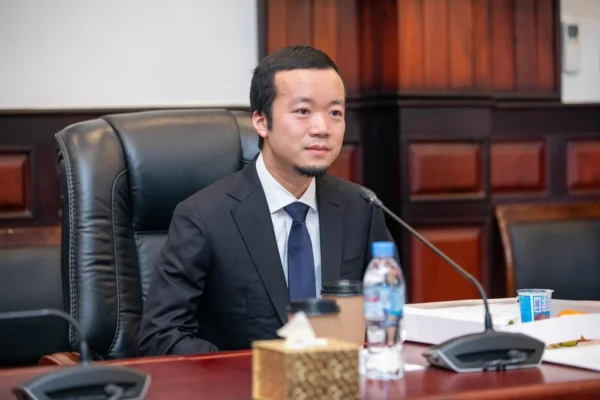
The US government announced on Tuesday a new round of sanctions against individuals and entities linked to the Cambodian Prince Holding Group, which it had previously accused of running a “cyberfraud empire” spanning regionally.
In a statement, the Treasury Department’s Office of Foreign Assets Control (OFAC) announced that it listed nine individuals and 26 entities linked to Prince, including “executives, investors in fraudulent schemes, and shell companies.”
“Southeast Asian fraud centers steal billions of dollars from American victims each year,” Treasury Secretary Scott Bessent said in the statement. “Treasury will continue to use its tools to disrupt the networks behind this egregious fraud and protect Americans.”
This action builds on efforts announced by OFAC in conjunction with the United Kingdom last October, when it imposed sanctions on 146 individuals and entities linked to Prince, including its chairman, Chen Zhi. At that time, Treasury designated Prince as a “transnational criminal network,” detailing his involvement in cyber fraud, human trafficking and large-scale money laundering.
Meanwhile, federal prosecutors also unsealed an indictment accusing Chen, a Chinese-Cambodian tycoon who served as an advisor to former Cambodian Prime Minister Hun Sen and his son and successor Hun Manet, with wire fraud and money laundering. This involved the seizure of approximately $15 billion in bitcoin, which the Justice Department described as “the largest forfeiture action ever.”
Treasury described the efforts as the largest ever to disrupt Southeast Asia-based fraudulent operations, which are primarily run by Chinese criminal syndicates and rely on a huge corps of trafficked workers from around the world. According to U.S. government estimates cited by the Treasury, these scams will cost American citizens at least $10 billion in 2024, a 66% increase from the previous year.
Among those targeted by yesterday’s sanctions was Hu Xiaowei, who has been described as Prince’s “second in command” and Chen’s “big brother,” who was arrested and extradited to China in January. Treasury alleged that Hu, who was arrested in Japan earlier this month, helped establish a network of shell companies in Hong Kong, Singapore and the British Virgin Islands that were used to launder money from fraud schemes linked to Prince.
In particular, it says Hu controls three companies in the British Virgin Islands: Eagle Fortitude Limited, Leisure Focus Limited and Future King Inc. Through the latter, he “owns an extensive network of companies that he uses to manage funds and properties,” Treasury said. In particular, a Hong Kong-based subsidiary of Future King had “received millions of dollars in funds allegedly from victims of cryptocurrency investment scams.”
The sanctions also targeted a number of Hu’s subordinates, investors in fraudulent schemes linked to Prince and other prominent figures in the organization.
Also on Tuesday, Treasury’s Financial Crimes Enforcement Network (FinCEN) proposed amending its rule on Cambodia-based financial services conglomerate Huione Group to include H-Pay Service PLC, a successor entity. As part of last October’s actions, FinCEN cut off Huione Group from the U.S. financial system, alleging that it had “laundered the proceeds of virtual currency scams and heists on behalf of malicious cyber actors,” including the Prince Group and its network.
This would “effectively protect against attempts by the Huione Group to circumvent its cutoff from the U.S. financial system,” the Treasury said.
In a parallel action, the U.S. Department of Justice said it seized a cloud computing account used by Huione subsidiaries that also helped move proceeds from cyber scams into the legitimate banking industry.
“The Huione Group used this cloud computing account as part of a technological backbone that enabled the transfer, movement and concealment of billions in fraud proceeds, much of which was stolen through Southeast Asian fraud hubs,” Assistant Attorney General A. Tysen Duva said in a statement.
The latest actions demonstrate the astonishing complexity of the networks set up by the Prince Group and its various subsidiaries in order to channel and clean up the billions of dollars generated by its fraud operations on an industrial scale. For this reason, this is unlikely to be the last action announced by the US government against the group and its leaders.