


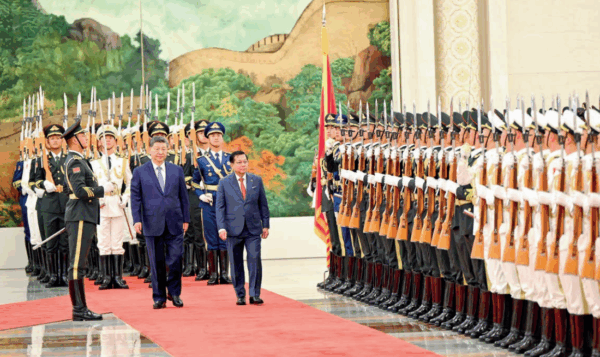
During Burma’s junta leader Min Aung Hlaing’s state visit to Beijing this week, Chinese President Xi Jinping delivered a statement that requires careful deciphering. Xi officially endorsed the regime as the “new government of Myanmar” and urged the junta to find a development path that wins popular supportand explicitly called for advancing peace and reconciliation through “talks” with all parties.
In diplomacy, observers must constantly read between the lines. Objectively, this rhetoric could be interpreted as calculated political posturing. By publicly advocating dialogue and public consent, Beijing projects the image of a responsible and stabilizing power on the world stage. It also allows the Chinese Communist Party (CCP) to strategically hedge its bets; If the junta continues to lose ground to resistance, Beijing maintains plausible deniability by saying it advised the military to seek peace.
However, by interpreting this language through the lens of China’s domestic governance and official authorities, joint statement published by the two countries on June 17, a darker and more realistic translation emerges.
Xi explicitly linked his remarks to protecting the China-Myanmar Economic Corridor (CMEC) and Belt and Road Initiative (BRI) projects. The joint declaration of June 17 doubled down on this point, committing both countries to accelerate the Muse-Mandalay railway and the Kyaukpyu Deepwater Port. From Beijing’s perspective, a genuine democratic transition in Myanmar is highly undesirable, as it would empower local communities and a vibrant civil society to review, block or reverse these opaque Chinese infrastructure deals. To protect its investments and its land access to the Indian Ocean, Beijing needs a peaceful population.
In the CCP playbook, “dialogue” rarely implies democratic power sharing. This was proven in the joint statement of June 17, in which China officially expressed its approval of general elections organized by the junta. When Beijing called for “reconciliation,” China provided diplomatic cover for a sham electoral process where genuine opposition is criminalized and resistance groups are forced to capitulate under a predefined regime hierarchy.
Likewise, the CCP does not gain “popular support” at the polls. It manufactures conformity through mass surveillance, internet censorship, and rapid suppression of dissent. Urging the junta to gain popular support while demanding security for the project, Xi warns Min Aung Hlaing that brutal military force is a failure and that he must instead rein in CCP-style totalitarian controls to appease the public.
To enforce this obligatory stability, the junta is already multiplying extreme tactics. Failing on the battlefield, they are laying the foundations for a digital prison through draconian cyber laws, random street searches to criminalize virtual private networks (VPNs), and the rapid expansion of forced informant networks.
The joint declaration of June 17 confirmed this terrifying trajectory, with the two countries explicitly committing to new bilateral cooperation on artificial intelligence and digital economy – the fundamental architecture required for mass digital surveillance, of which Beijing is already providing to the military.
Simultaneously, the junta is expanding collective sanctions through mass conscription, the use of starvation as a weapon against displaced populations, and a record number of indiscriminate airstrikes on civilian infrastructure. Given the horrific atrocities the military has already committed, it is unthinkable how far the regime will have to descend to the deepest moral depths to achieve the absolute totalitarian control Beijing expects.
Yet we must recognize a profound and objective reality: establishing a Chinese-style surveillance state in Myanmar is a practical impossibility. Unlike China’s highly centralized and technologically confined environment, Myanmar is characterized by rugged terrain, porous borders, and a decentralized armed resistance that currently controls three-quarters of the country. The military simply does not have the administrative capacity, technological infrastructure, and geographic advantage to impose total digital and physical subjugation.
The profound tragedy of Myanmar’s current trajectory is that the junta’s desperate and doomed pursuit of this CCP project ensures horrific and prolonged bloodshed rather than the stability Beijing desires.
The international community cannot afford to view this situation as a localized and peripheral crisis. To the governments of the United States, European Union, ASEAN, Australia, Japan, India and New Zealand: if you stand by and let this happen, you need to think about what could happen to your own countries and regional security architectures.
Allowing the CCP to successfully field test its digital authoritarian model in Myanmar provides a testing ground for coercive AI tactics that adversaries will eventually turn against established democracies. The normalization of state-sponsored cyber surveillance, forced labor and mass terrorism in Myanmar poses a direct threat to global security.
We must not accept the illusion that Beijing is negotiating a peaceful settlement. Regional democracies and their Western allies must urgently adapt to target this nexus between technology and terrorism before regional stability completely collapses.
Policymakers must aggressively expand sanctions against the junta’s supply chains – including cutting off their access to aviation fuel, which enables their air terror campaigns, and blocking the importation of Chinese artificial intelligence and technology. telecommunications interception technology. In addition, the international community must formally designate the financial facilitators of this regime and the transnational scam networks they protect.
We must deprive the junta of the tools necessary to pursue this impossible and bloody project before its quest for absolute control costs thousands more innocent lives.