


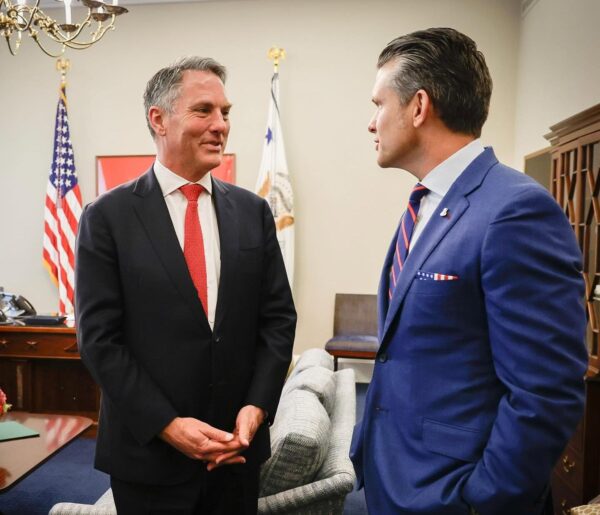
By all accounts, Australian Defense Minister Richard Marles is a nice man. One of his passions is his extensive collection of snow globes. The fascination with snow globes has been described as a desire for nostalgia, childhood innocence, and a desire to preserve a moment in time. They represent a magical escape from reality.
Marles is also known for his love of all things American. Years ago, he was delighted to be “appointed” a Kentucky colonel by the governor of that American state. His desk is littered with various American memorabilia. He is also well known for his uncompromising views on China. Like his companion, US Secretary of War Pete Hegseth, he believes in the slogan “peace through strength”.
Speaking at Singapore’s Shangri-La Dialogue last month, Marles told his audience that our region faces the most complex and threatening strategic landscape since World War II. After condemning the alleged sabotage of submarine cables in the Baltic Sea and the Gulf of Finland, he turned to the Asia-Pacific with a vague story of recently severed submarine cables in the Taiwan Strait. Whistling our favorite enemy, China, Marles told his audience that “this is important in Australia because we are threatened by this threat…cutting cables with an anchor in the middle of the night.” These cables, he says, “are the arteries of modern civilization, they are strategic targets.”
Marles then went on to list vague claims, namely the “looting” of illegal fish catches and water cannon skirmishes at sea presented as evidence of the emergence of “new vectors of coercion”. Tying all these new threats to his favorite theme of rules-based policing, Marles then described Australia’s “hard power transformation” with substantial shipbuilding of submarines, frigates and air warfare destroyers.
Before Marles delivered his speech, the Shangri-La delegates were absorbing earlier messages from the U.S. Secretary of War. Abandoning last year’s repeated references to Taiwan’s security, Hegseth shifted his focus to a new Trump policy of “constructive strategic stability” with China. Telling his audience that the United States had abandoned the strategic rhetoric of the past, he asserted that the United States was “the power that works to maintain the balance, not to disrupt it.” Regarding the rules-based order, he said he was not interested in “empty globalist rhetoric.” He wanted “less Shangri-La and more ships, more submarines.” Hard power, he insisted, is what matters.
In response to a question from a New Zealand delegate, Hegseth argued that his country was “taking advantage” of American military power. During that exchange, he revealed his “direct talk” with Richard Marles about “what our capabilities are and where our allies need to be to ensure we lock down arms and shields in light of the world’s threats.” He added a warning that a long-standing friendship was not enough. Unless Australia develops the capabilities the United States expects, he said, “the alliance makes no sense.”
Days earlier, Foreign Minister Penny Wong met her Indian, Japanese and American counterparts in New Delhi for their one-day meeting. Despite years of attempts by Australia to make the Quad into something more than a discussion forum, the forum has struggled to remain relevant. The Department of Foreign Affairs and Trade describes Quad as a key pillar of Australian foreign policy. Yet its Leaders Forum has not met since Joe Biden convened a meeting in Washington in September 2024. Trump’s tariff war with India scuttled the planned 2025 meeting.
Following previous statements, the Quad’s final communiqué once again emphasized the partners’ commitment to the complete denuclearization of North Korea. Of course, this is completely unrealistic.
Two things stand out from these defense and foreign policy speeches. First, the Quad has further lost ground as a forum for articulating important foreign policy discourse. Second, the Shangri-La Defense Forum confirmed the ascendancy of militarism over statecraft in the dialogue between the United States and the nations of the Indo-Pacific. There is no opportunity to discuss development issues. Instead, the dialogue agenda is clogged by the obsessions of a declining superpower intent on extorting tribute from nations apprehended by China’s rise.
Australia is praised by Hegseth, not for promoting the values of human rights, tolerance and conflict resolution between nations, but for Marles’ promise to step up investment in arms, ready for what Hegseth calls a “high-level fight”. We are also praised for investing in “real combat power” and for our willingness to integrate more deeply with U.S.-led joint forces. Our reward, Hegseth says, will be to be recognized as a “model ally.”
Returning to Australia after Shangri-La, Marles had to admit that Hegseth told her bad news about AUKUS after the meeting. For once, the minister faced intense questions from the Australian media. He repeatedly struggled to explain why the original US commitment to provide one new Virginia-class submarine and two “in-service” submarines had been downgraded by Hegseth to three “in-service” models. The reaction was seismic. Despite Marles’ desperate efforts to present the news as a victory, the decision reignited a heated debate within the Labor Party over the purpose and value of AUKUS. Importantly, the public reaction to this news also raised doubts within the ranks of the Liberal Party about the AUKUS deal. There are now serious calls for a plan B.
The misguided emphasis on AUKUS by successive Australian governments has corrupted defense and foreign policy priorities. Its failure jeopardizes Australia’s prestige and the soft power we retain in our region. Allowing Richard Marles to dominate Australian foreign policy, as a traveling companion of the toxic Trump administration, is a huge mistake. But the error is more serious than the probable failure of AUKUS. It is significant that Australia’s international reputation and national security are so deeply attached to a flawed defense project.
The deepest problem in Australian foreign policy lies in the failure of our leaders to understand the decline of the hegemonic power of the United States. Despite all the warlike speeches Marles has learned from Hegseth, the emperor is naked. The Trump-Xi summit in May announced the new policy of “constructive strategic stability” between the United States and China. Australia still does not see the United States’ concession of regional power to China. Marles’s insistence that we live in a world of growing strategic tensions is outdated. Our national security posture remains anchored in our belief that the United States will remain the dominant power in the Asia-Pacific region. This is simply not the case anymore.
Foreign Minister Penny Wong remains on the periphery of the Quad. She also faces the thorny task of explaining our tacit support for Israel’s war crimes and Australia’s sketchy efforts to counter Chinese influence in the Pacific. Despite his disproportionate influence on foreign policy, Richard Marles has thus far escaped the political scrutiny he deserves.
It is becoming clear to many in Labor that prioritizing defense over statecraft does not enhance Australia’s historic strengths. No matter how much we spend to strengthen our armed forces to meet the expectations of the Pentagon hawks, we cannot hope to counter China’s military might. Nor should we try.
But it is realistic to rebuild our diplomatic capabilities and reclaim our aspiration to become a creative and independent middle power. It remains for policymakers to recognize that the Australian armed forces must be an instrument of foreign policy and not its master. As Gareth Evans and others have long advised, it is time to articulate a foreign policy that balances traditional security and economic interests with moral decency and cooperation in the face of global challenges.
This article was originally published by the Pearls and Irritations website and is reprinted with permission.