


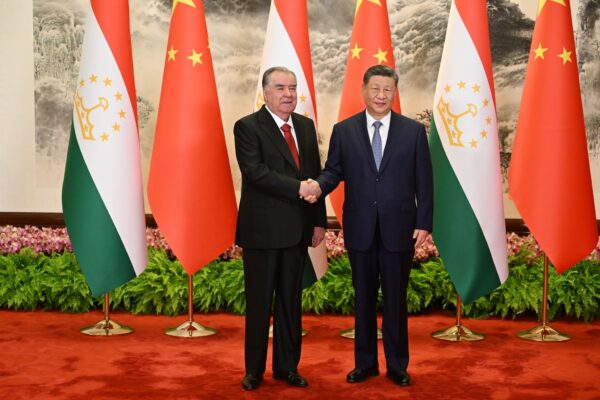
Tajik President Emomali Rahmon and Chinese President Xi Jinping sign the China-Tajikistan Treaty of Permanent Good-neighborliness, Friendship and Cooperation at the Great Hall of the People in Beijing on May 12, the political culmination of Rahmon’s four-day state visit.
The two leaders also signed a joint statement on deepening the comprehensive strategic cooperative partnership in the new era and witnessed the signing of about 31 intergovernmental cooperation documents covering trade, investment, artificial intelligence, green mining, agriculture, culture, education, housing, inspection and quarantine, as well as market surveillance.
The partnership had been elevated to the status of “comprehensive strategic cooperation” during Xi’s visit to Dushanbe in July 2024; the treaty now anchors it in a binding instrument.
The day before, Tajik and Chinese companies signed more than 50 agreements is expected to attract more than $8 billion in investment. A “Tajik-China Digital Business Connect” IT forum ceded cooperation agreements worth $647 million. Rahmon and Asian Infrastructure Investment Bank President Zou Jiayi signed a long-term investment plan by committing more than $800 million in new AIIB funding on top of the $400 million already allocated to ongoing infrastructure projects.
Bilateral trade reached $790 million in the first quarter of 2026up more than 50 percent year-on-year. In 2025, China overtook Russia as Tajikistan’s largest trading partner for the first time in over two decades, with annual trade of approximately $4.3 billion by Chinese customs data. Rahmon put Accumulated Chinese investments in Tajikistan amount to nearly $6 billion since 2017 – including around $3.5 billion in direct investments – outstripping Russia’s stock of around $2 billion. About $900 million, or 12.5 percent, of the $7 billion in foreign investment Tajikistan received last year came from China, and more than 700 Chinese-invested companies now operate in the country.
The pivot extends beyond bilateral arithmetic. China’s trade with the five Central Asian republics exceeded 100 billion dollars in 2025a jump of 12 percent over one year. The first container train from China arrived in Dushanbe in February 2026 via a new corridor crossing Kyrgyzstan and Uzbekistan. Last month, Tajik and Chinese officials met in Dushanbe to coordinate access to Tajik territory. critical minerals – the supply chains for antimony, gold, lithium and tungsten which guarantee clean energy.
China is strengthening its influence in Tajikistan and Dushanbe today does not have many alternatives to attract foreign investment. Moscow’s ability to compete is limited: more than four years after the start of the war in Ukraine, Russia’s resources are strained and its influence eroded by domestic xenophobia against Central Asian migrants. New regulations – mandatory geolocation tracking for foreigners in Moscow and a QR code system before arrival for visa-free visitors – have altered Russia’s attractiveness for Tajik labor. October 2025 CIS Summit in Dushanbe, these were mainly symbolic gestures.
This growing dependence carries risks that Beijing has begun to absorb directly. At the end of November 2025, two cross-border attacks from the Afghan province of Badakhshan killed five Chinese workers at a Chinese-owned gold mine and at a China Road and Bridge Corporation site. The Chinese embassy ordered evacuations and construction of the Dushanbe-China highway was suspended. In March 2026, China agreed to finance nine new border crossings along the Afghan-Tajik border, adding to at least 15 Chinese-funded security facilities already built over the past decade.
The political alignment was also explicit. Rahmon said Xi said Taiwan is “an inalienable part of China” and reaffirmed Tajikistan’s adherence to the one-China principle. He endorsed Xi’s Global Governance Initiative and credited Beijing with playing “an important role in easing tensions in the Middle East,” a relevant framework given Iran’s continuing war and Central Asia’s exposure to its economic fallout. China, in turn, welcomed Tajikistan as a new signatory to the International Organization for Mediation Convention, Beijing’s means of positioning itself as an alternative to Western-led dispute resolution.
For Tajikistan, the economic situation still goes in one direction. Of the $4.3 billion in trade reported by Chinese customs in 2025, Tajik exports accounted for $560 million; the remaining $3.7 billion went the other way. The treaty signed in Beijing locks in the framework – but the trade deficit, mining concessions and surveillance infrastructure that underpin this framework all give China more cards to play.