


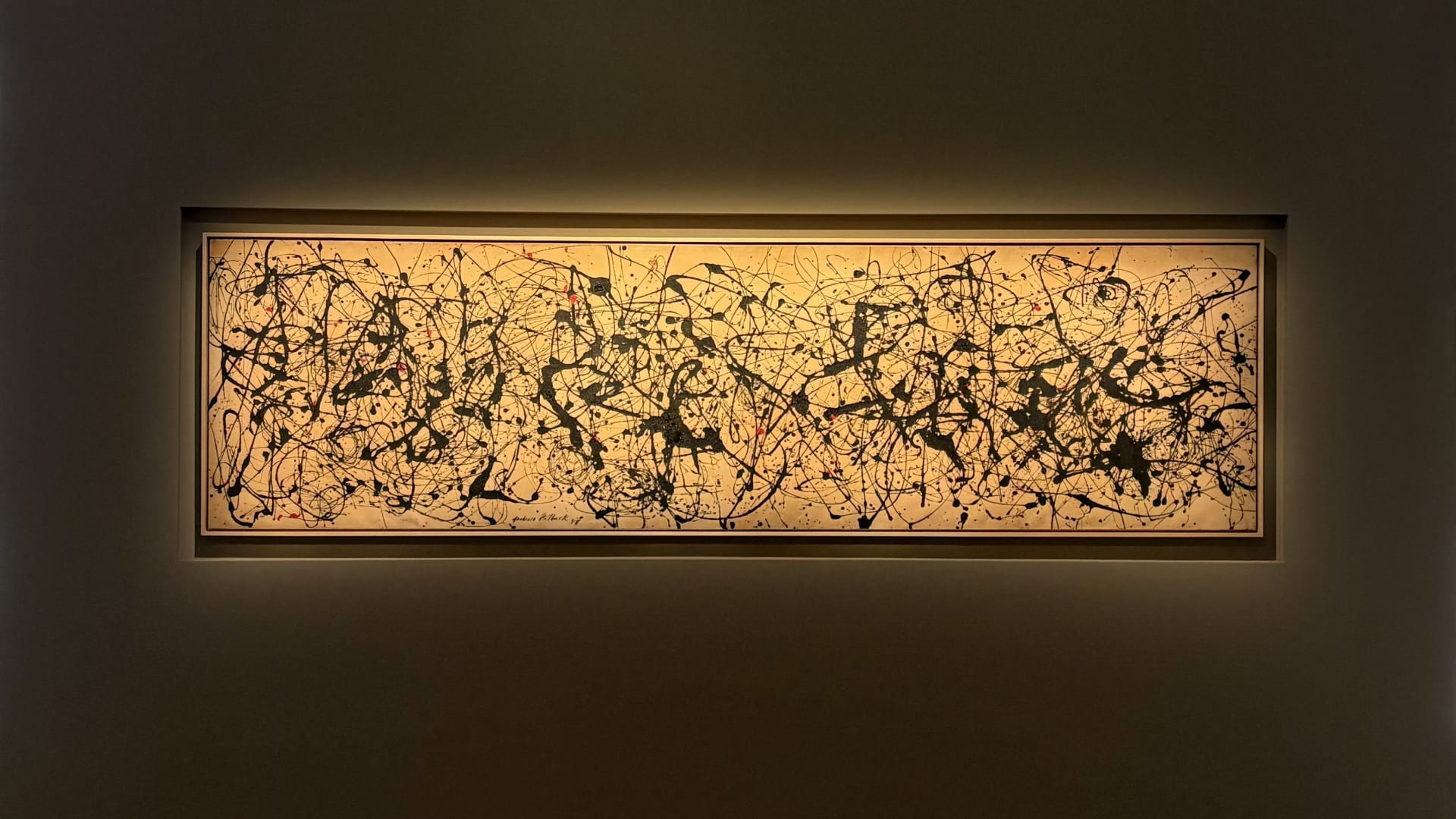
A large-scale drip painting by Jackson Pollock titled “Number 7A, 1948”.
Crystal Lau | CNBC
A version of this article first appeared in CNBC’s Inside Wealth newsletter with Robert Frank, a weekly guide for wealthy investors and consumers. Register to receive future editions, straight to your inbox.
Nearly $2 billion worth of artworks will be auctioned in New York next week, in what will be the biggest test for the art market since the start of the Iran war.
Major auction houses rely on blockbuster works from famous collections to lift the market out of the gloom of geopolitical conflict and financial market volatility. Despite growing fears of a slowing global economy and a potential lack of buyers from the Middle East, dealers and art experts say the art market’s rapid rebound that began last fall shows no signs of slowing.
“Buyers are engaged and looking for opportunities right now,” said Philip Hoffman, president and founder of Fine Art Group, the art consulting and sales agency.
Hoffman said today’s megacollectors, like Ken Griffin, Steve Cohen, Jeff Bezos and the new crowd of Asian tech billionaires, have seen their fortunes skyrocket in recent years and are looking for long-term stores of value.
“They have enormous amounts of cash,” he said. “For them, this money is just peanuts.”
Three works up for auction are expected to sell for up to $100 million, and more than 20 works are estimated at $20 million or more, more than triple last year’s total. Sales from the three auction houses are expected to total between $1.8 billion and $2.6 billion, according to ArtTactic. At $2 billion, sales would nearly double last year’s total.
Marc Porter, president of Christie’s Americas, said the crowds lining up to view the works for sale are the largest in nearly a decade.
“There’s an energy and a buzz in the rooms that we haven’t seen in a long time,” he said. “It’s hard to determine whether it’s about the quality of the artwork, or whether it’s the world situation and whether art is a refuge, or whether art is a hedge. It’s hard to say. We’ll know in a week or two.”
Sales should continue the rapid rebound in the art market that began last fall. In 2023, auctions began to decline, with sellers holding back their finest works. Without supplies, particularly at the high end, total sales plummeted and many galleries began downsizing or closing their doors.
Last fall, however, with the release of a few major collections, sales picked up. Recent auctions in London – including a $175 million “white glove” sale at Sotheby’s – have shown strong bidding at almost every price level and in every category, advisers say.
The success of this month’s New York sales will largely depend on a handful of trophy works from well-known collections. Christie’s is offering works from the collection of Samuel Irving “SI” Newhouse Jr., the media titan who died in 2017.
“Danaïde”, a sculpture by Constantin Brancusi from 1913
Crystal Lau | CNBC
Headlining the collection is “Danaide,” a 1913 sculpture by Constantin Brancusi and estimated at $100 million. A large-scale drip painting by Jackson Pollock titled “Number 7A, 1948” is also estimated at $100 million.
Christie’s is also selling works by the late collector Agnes Gund, including Mark Rothko’s “No. 15 (Two Greens and Red Stripe),” estimated at $80 million.
A Rothko also headlines the collection of the late Robert Mnuchin sold at Sotheby’s. Mnuchin, a former Goldman Sachs partner turned gallery owner and father of former Treasury Secretary Steven Mnuchin, was a major collector of Rothko, Willem de Kooning, Franz Kline and other Abstract Expressionists.
The auction includes Rothko’s imposing “Brown and Blacks in Reds,” estimated at $70 million to $100 million.
Auction assistants pose with Mark Rothko “Brown and Blacks in Reds” during the May Marquee Modern & Contemporary Auctions press preview at Sotheby’s The Breuer in New York, NY on May 1, 2026.
Lév Radin | P.A.
Advisors say the ownership history of an artwork – known as “provenance” – matters more than ever. Artworks sold by famous collectors like the Rockefellers, Paul Allen, the Lauder family or Newhouse command increasingly higher premiums as new collectors seek validation.
Collectors like Newhouse “were connoisseurs,” said Betsy Bickar, head of art consulting at Citi Private Bank. “They bought art because they understood the importance of the work they were looking for. So they were willing to pay any price.”
The wildcard for the auction is the Middle East. The governments and royal families of Saudi Arabia, Qatar and the United Arab Emirates – particularly Abu Dhabi and Dubai – have embarked on an arts spending spree in recent years by building new museums. Some believe the war could cause countries to focus more of their capital on reconstruction rather than buying art.
Dealers and art experts say Middle Eastern buyers have been mainly active in private sales rather than public auctions, so this season’s impact may be limited. And despite the war, many say Middle East leaders remain committed to the long-term importance of building cultural institutions to diversify their economies.
“There are buyers from the Middle East who are always looking to bolster the holdings of these new museums and make sure that these museums have really quality work,” Bickar said. “I wouldn’t be surprised if you see a lot of Middle Eastern buyers at this round of sales.”
Americans, however, have been the driving force in the global art market for years. Porter said that while bidding from foreign buyers is low, sales in New York look promising.
“The bulk of the purchases are American purchases,” he said. “Americans who have money in the stock market or who are in the financial markets or the technology markets, even the real estate markets, are all making a lot of money and buying art. The Europeans have been consistent and strong. The Asians, especially the mainland Chinese, are a little less represented, but still very strong.”
Many of the most notable works come with third-party guarantees or irrevocable offers, meaning a buyer has already agreed in advance to purchase the works at a minimum price if there are no higher bids at auction. While this practice removes some of the excitement of live auctions, it is becoming more common as auction houses and sellers seek to reduce their risks.
“We advise our customers to take out guarantees,” Hoffman said. “It’s a win-win situation.”