


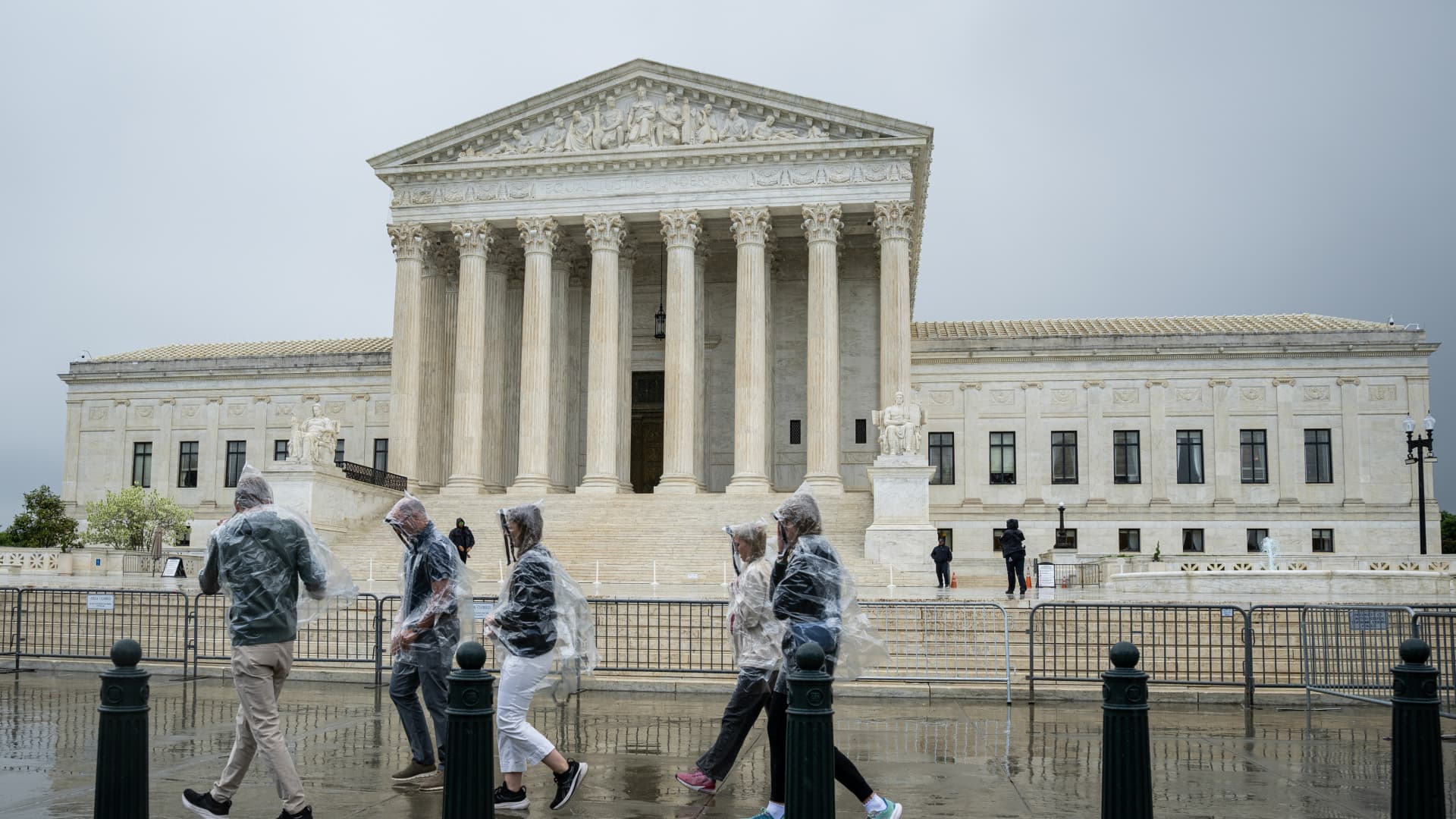
The United States Supreme Court in Washington, DC, USA, on Monday, April 20, 2026.
Graeme Sloan | Bloomberg | Getty Images
The U.S. Supreme Court on Monday allowed Alabama Republicans to adopt a congressional map more favorable to their party ahead of the November midterm elections, the latest fallout from the Court’s seismic voting rights ruling.
The justices overturned a lower court’s ruling that blocked the state’s Republican-favored map, calling it racist and an illegal dilution of the voting power of Black Alabamians.
The politically conservative Southern state is expected to seek to return to that previous map, which would reduce the number of districts where black voters make up a majority, or near-majority, from two to one out of the state’s seven House districts. Using the previous map could benefit Republicans.
The order was passed by the conservative majority of the nine-member court. The three liberal justices disagreed and suggested the lower court could reapply its judicial block to the Alabama Republican-favored map.
President Donald Trump’s Republicans are fighting to maintain their control of the House of Representatives as well as the Senate in the midterm elections.
Alabama is among a group of Republican-led states that have sought to eliminate majority-black congressional districts and boost their party’s chances ahead of the election following the Supreme Court’s ruling undermining a key provision of the Voting Rights Act. Black voters tend to support Democratic candidates.
In its historic decision on April 29, the court, by 6 votes to 3, supported by its conservative members, invalidated an electoral map that had given Louisiana a second majority black district in the United States Congress. The redrawn map, the majority ruled, relied too heavily on race, in violation of the constitutional principle of equal protection.
Following the Supreme Court’s ruling, Alabama immediately filed emergency motions asking the justices to allow it to revert to an older map with a single black-majority district.
Alabama, where black voters make up a quarter of the electorate, was ordered by a lower court to use a map that includes two out of seven majority black districts. Both are held by black Democrats.
The lower court ruled that an earlier map intentionally discriminated against black voters and illegally diluted their voting power.
Alabama officials had argued in Supreme Court filings that Alabama’s court-ordered map had the same constitutional flaws as Louisiana’s.
In a dissent, liberal Justice Sonia Sotomayor pointed out that the lower court’s ruling on Alabama’s map was broader than the case involving Louisiana and included a finding of unconstitutional discrimination by intentionally diluting the votes of black voters in Alabama.
The majority’s decision to overturn the lower court’s decision is therefore “inappropriate and will only cause confusion as Alabamians begin voting in elections scheduled for next week,” Sotomayor wrote in a dissent joined by his two liberal justice colleagues.
She said the lower court “remains free, on remand, to decide for itself whether Callais has any bearing on its analysis of the Fourteenth Amendment or whether its prior reasoning is unaffected by this decision,” referring to the court’s April 29 ruling, titled Louisiana v. Callais.
By 2023, the court had upheld the lower court’s ruling that the state’s Republican electoral map had diluted the power of black voters, violating the Voting Rights Act. The 5-4 decision was written by Chief Justice John Roberts, who was joined by fellow conservative Justice Brett Kavanaugh and the court’s three liberal justices.
In a process called redistricting, the boundaries of legislative districts across the United States are reconfigured to reflect demographic changes measured by the national census taken every 10 years. Redistricting is typically done by state legislatures once a decade.
Republicans and Democrats are waging a fight over multistate redistricting, sparked last year when Trump launched an unprecedented effort in the middle of the decade to redraw the maps of Republican-led states, starting with Texas.