


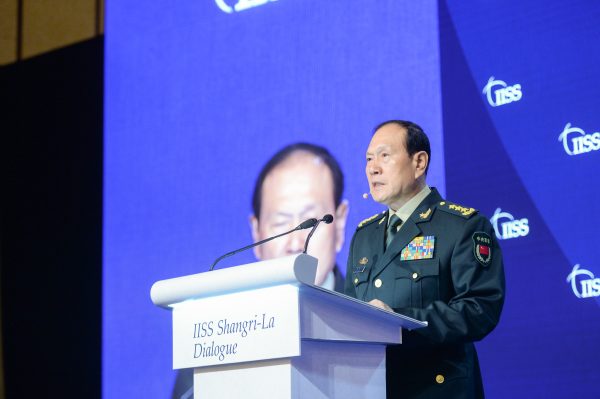
After nearly two years of investigation, China officially announced on May 7 that former defense ministers and members of the Central Military Commission (CMC), Wei Fenghe and Li Shangfu, had been sentenced to death with a two-year reprieve, as well as confiscation of all their personal property. According to the official press releaseWei was found guilty of accepting bribes, while Li accepted and gave bribes.
This marks a significant development in the ongoing purge within the People’s Liberation Army (PLA). Until now, no member of the military’s top brass had received such harsh sanctions since the early days of the anti-corruption campaign. What factors may have led to such harsh sentences and what are the broader implications for other PLA leaders?
In China, a two-year suspended death sentence is generally reserved for serious crimes, including major corruption cases, premeditated murder and large-scale drug trafficking. The latest confirmed case of a high-ranking PLA officer to receive a suspended death sentence is that of Gu Junshan, former deputy director of the General Department of Logistics, whose corruption case allegedly involved more than 600 million yuan (around $98 million). Apparently, Gu helped anti-corruption investigators by “expose others“, which earned him a death sentence with a two-year reprieve rather than an outright execution. It is believed that he is currently serving a life sentence in a military prison.
Gu’s case triggered an avalanche of investigations within the PLA, leading to the downfall of former CMC vice chairmen Guo Boxiong and Xu Caihou. In 2017, PLA Chief of Staff Fang Fenghui also fell from grace. Xu died while awaiting sentencing, while Guo and Fang received life sentences rather than the harsher sentence of suspended death sentences.
Like Gu, Wei Fenghe and Li Shangfu are unlikely to be executed after the reprieve period. Their sentences will be commuted to life imprisonment. Despite their initial resistance Against any cooperation with investigators, Wei and Li likely gave in and provided critical information about their former colleagues. Such cooperation likely spared them from execution, but will involve more high- and mid-ranking PLA officers. Additional PLA officers should be drawn into the anti-corruption vortex.
China’s military courts are not politically neutral, and judging high-profile cases requires approval from the commander-in-chief, particularly under the CMC chairman’s accountability system. Rather than giving Wei and Li life sentences, what prompted Xi to impose a harsher sentence?
First, the sanction serves as a powerful deterrent against corruption and other types of official malfeasance. Using Gu Junshan’s case as a reference, Wei and Li’s cases must have involved exorbitant amounts of stolen funds, likely affecting the performance of the rocket force and equipment development department they once headed.
That said, imposing an actual death sentence on senior officers would be too costly for PLA morale and could destabilize the officer corps. A suspended death sentence therefore represents an intermediate solution: severe enough to inspire respect based on fear, but with fewer political risks.
Finally, as the 21st Party Congress approaches next year, which will extend Xi’s term for another five years, he must ensure firm control over the PLA – and the proven method is to use fear tactics. A climate of anxiety already permeates the PLA and is likely to persist until the next Party Congress.
As the Chinese proverb says, “accompanying an emperor is like accompanying a tiger”. So far, Xi has shown little hesitation in handing out harsh punishments to former subordinates who helped him to the top of power. The suspended death sentences handed down to China’s 12th and 13th defense ministers do not bode well for the ongoing cases of former CMC members Miao Hua, He Weidong, Zhang Youxia and Liu Zhenli, who will likely face lengthy prison terms in the future.
Overall, this episode highlights that the upper echelon of the PLA has become an extremely dangerous zone. A high rank offers no protection against the ongoing anti-corruption campaign, and the fear among elite officers seems real as they await the fall of the sword of Damocles. Going forward, survival within the PLA will depend on loyalty rather than demonstration of talent – a dynamic that will have a definite impact on military capability and readiness.