



Even as many international consumer brands shrink their footprint in China, McDonald’s is bucking the trend thanks to consumers like Yue Ma.
During the May Day holiday, Yue showed up at the American fast food giant’s new McDonaldland store in Beijing’s Chaoyang Park – one of the few stores in the country to reintroduce the chain’s classic strawberry and vanilla milkshakes on May 1.
The businessman, born in the 1980s, told CNBC he came not only for the shake, but also for the childhood memories.
“McDonald’s has left a great first impression on those eating Western fast food for the first time,” he said. “Nowadays we have so many options when it comes to fast food, Western or Chinese, but for me, 70% of the time I go to McDonald’s.”
As brands like Starbucks, Nike and LVMH struggle in the country, McDonald’s is expanding its presence. The chain plans to have 10,000 stores in mainland China by 2028, up from more than 7,700 by the end of 2025. Only the United States has more McDonald’s stores than China.
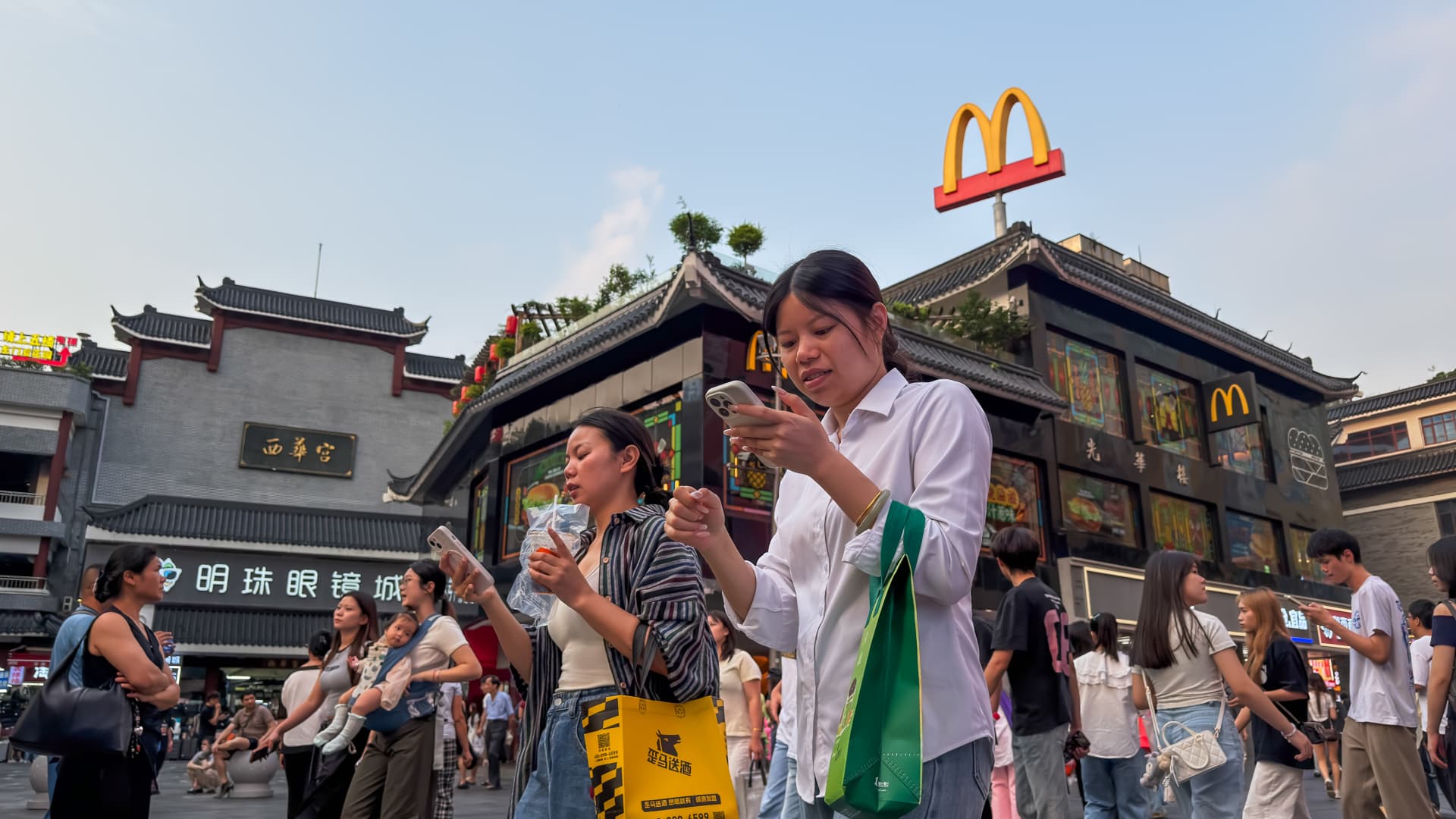
Pedestrians use smartphones while passing a McDonald’s restaurant on Dongmen Pedestrian Street on April 18, 2026, in Shenzhen, Guangdong province, China.
Cheng Xin | Getty Images
The market is an important source of growth for the company’s units. Last year, half of its new stores were in mainland China.
The Chinese business is part of what the U.S. company calls its International Licensed Development Markets segment, where same-store sales rose 3.4% in the first quarter, McDonald’s reported Thursday. The majority, 52%, of McDonald’s business in China is owned by Chinese investor Trustar, a private equity unit of Citic Capital.
The McDonald’s brand is capitalizing on nostalgia in China. The country’s first McDonald’s opened in 1990, and its iconic golden arches reflect the excitement over China’s opening to the world and increasing wealth.
Last summer, when McDonald’s brought back the classic shake for a limited time, it went viral. The company announced this year that the milkshake – in vanilla and strawberry flavors – would again be available in just 44 stores in 15 cities, including Beijing, starting in May. The shake was discontinued in China in 2014.
“I remember drinking this shake the first time when I was a kid,” Zhu Ming told CNBC after picking up his vanilla shake at the Chaoyang Park store with his girlfriend. “We drove half an hour up here to get it.”
And now, McDonald’s is adapting to the new zeitgeist: affordability in a declining economy.
Foreign brands, once seen as superior in quality to local companies, have suffered in recent years as local brands have improved and Chinese consumers have shifted to local brands due to both nationalism and falling prices.
Yet McDonald’s has maintained its reputation for international standards in food quality and consistency while still managing to be competitive on price.
McDonald’s has its own version of what the Chinese call “the poor man’s meal.” The one plus one combo allows a customer to get a burger with a drink or dessert for as little as 14 yuan ($2.06).
The menu is a mix of classic dishes like the Big Mac and frequently refreshed local additions like honey barbecue chicken bones or a dragon fruit McFlurry. These products appeal to Chinese consumers who are always looking for something new, even if it is a traditional McDonald’s milkshake.
Many Chinese view McDonalds as a good quality restaurant on a budget, even against local competitors like Tastien.
“The Chinese consumer mentality is not just about price, it’s more about value,” said Tracy Dai, chief operating officer of Shanghai-based branding consultancy China Skinny. “McDonald’s is slightly more expensive, but if you think about the experience and then the taste and quality you get out of it, there’s definitely more value.”