


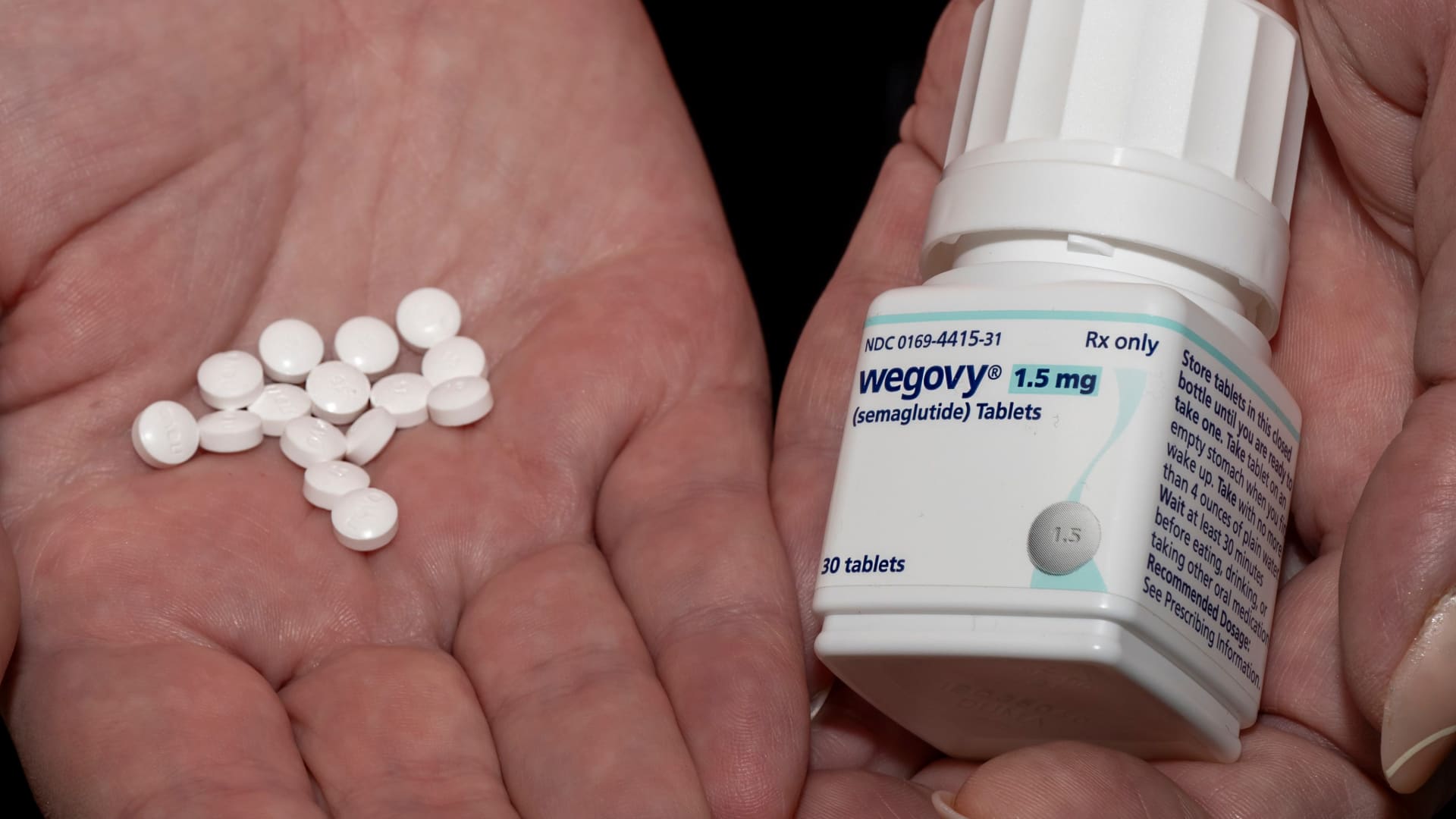
Semaglutide tablets Wegovy.
Michael Siluk | Universal Images Group | Getty Images
When the Wegovy pill launched in January, telehealth provider LifeMD said its business doubled almost overnight.
LifeMD went from 300 to 400 new patients per day to 600 to 1,000 new patients per day, CEO Justin Schreiber said. He knew there would be demand, but this level of interest surprised him.
“There is no doubt that the launch of oral medications has improved access,” Schreiber said.
Tens of thousands of people have started taking Novo Nordisk’s Wegovy pill in the four months since its launch in the United States, the majority of them new to the GLP-1 category. Investors will get a new look at the Wegovy pill’s dynamics when Novo reports its first-quarter results on Wednesday.
The launch has already forced investors to rethink the oral GLP-1 opportunity – and which company could win it. While obesity and diabetes market leader Eli Lilly launched its own pill, Foundayo, last month, early signs indicate its rollout has been more modest than the Wegovy pill launch.
“We were all in this camp of Foundayo, Foundayo, Foundayo because Lilly was talking about it and we were also concerned about producing enough peptides because Novo was still coming out of shortage,” said Evan David Seigerman, an analyst at BMO Capital Markets.
Now, Novo’s early successes have upended the expectations of some investors and analysts who expected the Danish company to lag behind its U.S. rival in the oral category, as it has in injectables.
Novo’s Wegovy pill uses the same main ingredient as its weekly dose. The company sometimes struggled to produce enough peptide to meet the growing demand for injection, and the oral formulation required even more. Meanwhile, Lilly was telling investors that its GLP-1 pill was easier to make and would not face the shortages that hampered injections.
Doubts about Lilly’s presence on the market arose last summer when the company said its pill helped people lose about 12 percent of their weight on average. Seigerman noticed that Novo seized the opportunity and began highlighting the effectiveness of oral semaglutide, the active ingredient in Novo’s Wegovy, which achieved weight loss of nearly 17 percent in a separate trial.
When the Wegovy pill was approved around the New Year, Novo and its telehealth partners launched a high-profile promotional campaign. Advertisements invaded New York subways and television broadcasts. The Danish drugmaker even tapped celebrities like DJ Khaled for its first-ever Super Bowl ad.
Novo pushed the pill’s entry price to $149 per month and its effectiveness comparable to that of an injection. The company used its three-month head start over Lilly to shape the narrative and combat concerns that people wouldn’t want a pill that must be taken early in the morning with no food and little water, which Novo CEO Mike Doustdar said was “kind of fueled by our competitor.”
“Well, I have news for you, that absolutely hasn’t been the case,” Doustdar told CNBC in March. “People are really interested because it’s the most effective pill on the market right now.”
The Wegovy pill — and now Lilly’s oral drug — is helping expand the market for GLP-1, reaching patients who otherwise would not have sought treatment due to fear of needles or difficulty accessing injections, which once cost much more than today’s pills for many patients.
“There are a fair number of patients who don’t want to be stuck by the needle in the case of a vial and syringe or stung by the price,” Jamey Millar, head of Novo’s U.S. operations, said in a March interview.
People are choosing GLP-1 pills “to a large extent” over injections through telehealth platform Sesame, said president and co-founder Michael Botta. He attributes this preference to the lower price of pills compared to injections and the fact that people are more comfortable trying oral medications than going straight to injections.
This could bring a more diverse set of patients to the category. More men are “definitely” starting drugs than before, he said, even though women still make up the majority of new patients.
Shortly after the launch, Novo said many of the early users were taking the lowest starting dose of the drug. Millar told CNBC that the company is closely monitoring the number of patients moving up to the higher doses over the coming months.
What to watch in Novo vs. Lilly
Eli Lilly appears to have some work to do to catch up to Novo.
While Novo was able to leverage Wegovy’s brand recognition early on, Lilly is attempting to introduce introducing people to a completely new brand. Its Foundayo pill contains a different active ingredient than its best-selling weight-loss vaccine, Zepbound. Lilly executives last week sought to reassure investors that it will take time to introduce the drug to doctors and patients.
In the first weeks of the launch, more than 20,000 people started taking Foundayo, Lilly CEO Dave Ricks told CNBC following the company’s first-quarter earnings report. More than 1,000 people start taking the drug every day, and 80% of those patients are new to GLP-1 drugs, he said. Lilly still needs to educate consumers about the pill, Ricks said, adding that the company has not yet begun to advertise it widely on television.
“So what we’re seeing now is basically organic demand, which is very strong for us,” Ricks said.
RBC analyst Trung Huynh said investors should wait two or three months to judge the dynamics of Lilly’s Foundayo launch due to high initial volatility. He thinks it will take a year or two for the story to unfold. He pointed to the weekly injection market: Prescriptions for Zepbound surpassed those for Wegovy de Novo six months after Zepbound was introduced in the United States, even though the product was launched two years later.
Because Lilly raised its full-year sales forecast due to the strength of its GLP-1 business, it should ease some pressure on Foundayo’s prescriptions in the near term, said Emily Field, an analyst at Barclays. The company plans to begin introducing Foundayo to other countries later this year and has touted the pill as the key to reaching people around the world.
Novo has not disclosed any details regarding a potential launch of its Wegovy pill outside the United States, but in March it announced a $500 million manufacturing investment in Ireland to meet current and future demand for its oral products outside the United States. The European Medicines Agency is expected to approve the Wegovy pill later this year.
Investors will get a better look at the Wegovy pill’s performance this week when the company reports results for the first quarter it was available in the United States. Analysts praised the strength of the rollout, which even outpaced the rollout of its injections.
Still, Wall Street expects overall sales to decline significantly this quarter as generic competition for the Wegovy vaccine threatens sales in India, China and Canada. The pill’s lower price could also hurt sales in the United States.
Investors will be on alert for any data related to the Wegovy pill and whether Novo maintains the gloomy forecast it issued in February, when it said sales and profits would both decline 5% to 13% in 2026. Novo’s pipeline will also be in focus. Clinical disappointments have weighed on the stock, leading investors to question whether Novo’s pipeline is rich enough to help the company remain competitive.
And while the pills are important to both Novo and Lilly, analysts say they won’t define either company.
“Yes, it shakes things up, but I still think Lilly has enough components to excel,” BMO’s Seigerman said. “And even if Novo can win with this, he needs more than one win to be champion.”
Correction: This story has been updated to correct Michael Botta’s headline. A previous version incorrectly stated its title.