


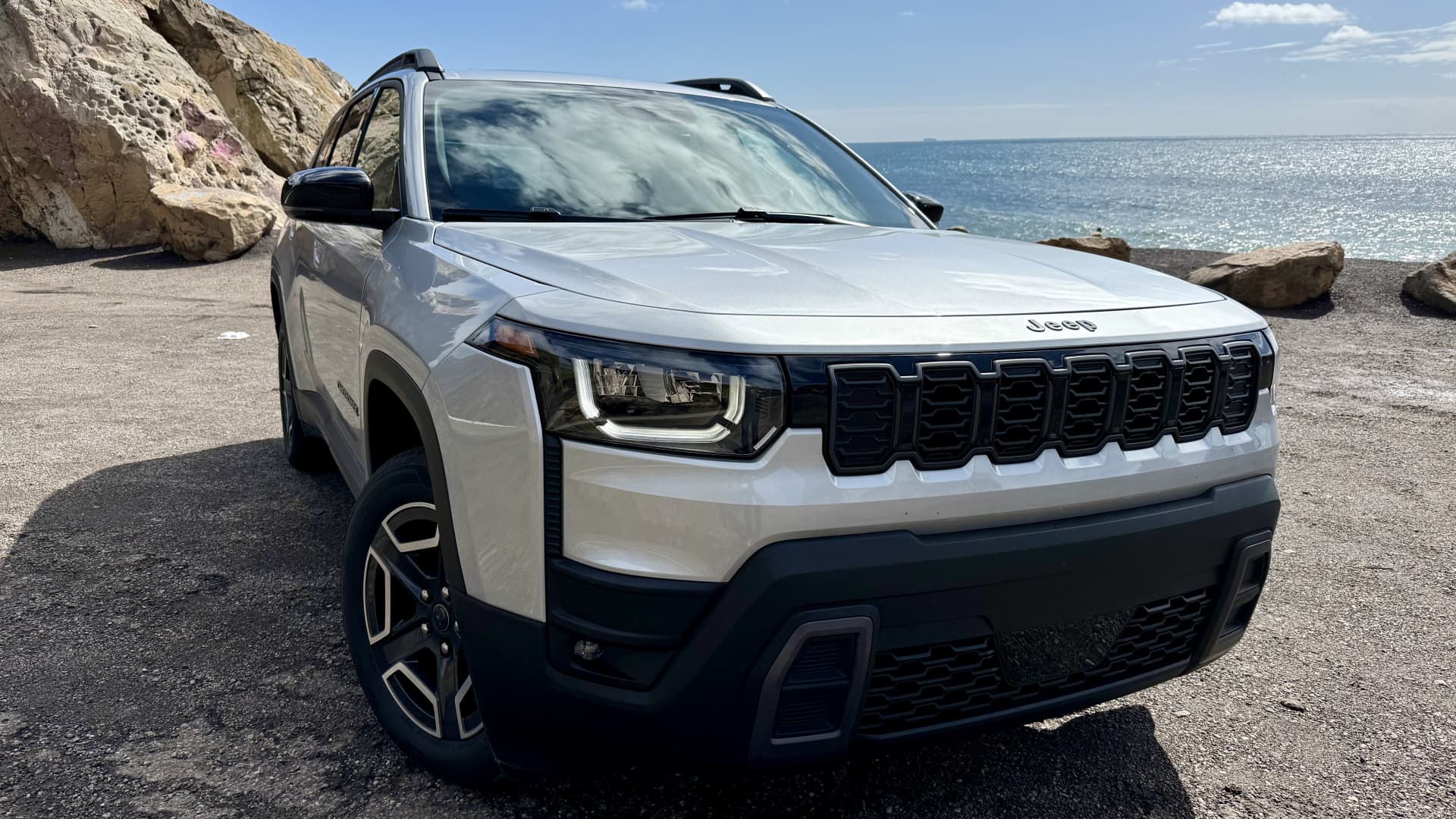
2026 Jeep Cherokee
Michael Wayland/CNBC
LOS ANGELES – Stellantis is counting on the return of the Jeep Cherokee to contribute to the American recovery of the struggling SUV brand and automaker.
The Cherokee returns after a three-year hiatus, joining the compact and midsize vehicle markets, which represent the largest segments in the United States. It’s also Jeep’s first traditional hybrid model and its most fuel-efficient gasoline vehicle ever in the United States.
“This is a critical vehicle for us,” Richard Cox, senior vice president of Jeep brand operations, told CNBC during a media event for the 2026 Cherokee. “I think it expands our reach with this level of powertrain, with this level of fuel efficiency and capability.”
The vehicle is currently arriving in U.S. dealerships and is arguably the most significant U.S. launch for the automaker this year. Stellantis is trying to regain market share after significant losses in recent years.
The automaker has set a goal of increasing its retail sales by about 25% in 2026 to 1.15 million vehicles, thanks to updated and new models as well as price and product realignments to remove vehicles from dealer lots.
“It’s a big part of our growth,” Cox said of the new Cherokee. “That positions us well in 26.”
The interior of the 2026 Jeep Cherokee Overland.
Stellantis
Last year, Jeep narrowly recorded its first annual sales increase – up less than 1% – since 2018, when the brand sold more than 973,200 units. That compares to sales of 593,401 Jeeps in 2025, a 39% decline over a seven-year period.
However, Jeep’s 1% annual sales growth wasn’t enough to push Stellantis’ overall U.S. sales into the black for the year. The parent company reported a 3% drop in U.S. sales in 2025 – marking its seventh consecutive decline amid a failed push toward fully electric vehicles and significant cost cuts and price increases under former CEO Carlos Tavares.
Sean Hogan, a Los Angeles-area dealer who heads Stellantis’ national franchise dealer council, believes the goal of a 25 percent increase in U.S. sales is achievable thanks to the company’s new management and product line.
“We missed the Cherokee. It’s huge for us. It’s huge for Jeep, and I think they nailed it,” said Hogan, vice president of Sierra Auto Group. “It is essential for us to get the machine running again to boost the volume that will circulate and generate the capacity of our dealerships. This brings new customers.”
The Jeep Cherokee is the priority
Jeep believes it has a winner with the Cherokee, even more than the last generation of the vehicle which peaked at nearly 240,000 units sold in 2018.
The company declined to discuss its production expectations, but it likely won’t be able to achieve similar sales figures until it adds production capacity in the United States. Plans to increase production at an Illinois plant are expected as early as next year.
The Cherokee is currently only produced at a factory in Toluca, Mexico, which also makes a smaller Jeep Compass SUV and Jeep Wagoneer S EV, and is expected to produce the upcoming Jeep Recon EV as early as the second quarter.
Stellantis’ Toluca plant is estimated to have the capacity to produce 303,000 vehicles per year, according to AutoForecast Solutions.
The automotive intelligence and forecasting company expects U.S. Jeep sales to increase this year by about 10% to 650,000 units, led by the Cherokee, according to Sam Fiorani, AFS vice president of global forecasting.
Jeep CEO Bob Broderdorf told CNBC in December that Cherokee was the brand’s priority amid slowing electric vehicle sales.
“Once Cherokee is finished and has a good run rate, then we can start on Recon,” he said. “Recon, I’m not in a hurry. I want to get the quality of the Cherokee, and as soon as we’re confident, OK, turn on the Recon.”
Broderdorf has been leading a turnaround strategy for Jeep since he was named CEO in February. Those efforts included slashing prices and model complexity and scrapping the brand’s all-electric plans as part of a broader exit from Stellantis that will cost the company $26 billion.
Cherokee 2026
The 2026 Cherokee is a traditional hybrid – a technology pioneered by the Toyota Prius – that doesn’t require an outlet, but uses a small battery and electric motors to help fuel economy.
Jeep is historically known for its large, gas-guzzling SUVs, but the Cherokee is expected to achieve 37 miles per gallon combined, including 35 mpg on the highway and 39 mpg in the city.
“These are very competitive numbers,” said Jeep Cherokee manager Mike Cockell. “It’s a vehicle that has to do everything for the customer, and we feel like we can do everything. It’s like a Swiss army knife.”
The updates aim to make the vehicle more competitive with brands such as Toyota as well as capitalize on the expected growth of hybrid vehicles.
“Electrification trends are pretty stable. Hybrid trends are growing,” Cox said. “So I think it was a big step in the right direction.”
The Cherokee features a 1.6-liter turbocharged four-cylinder hybrid powertrain that produces 210 horsepower and 230 foot-pounds of torque. It comes with standard four-wheel drive, relatively large interior displays, and 140 standard and optional safety and security features.
The Cherokee’s starting price ranges from about $37,000 to $46,000, according to Stellantis. The best-selling model is expected to be the $39,995 Cherokee Laredo, which Stellantis estimates is expected to account for 36 percent of the vehicle’s sales.
The price allows the midsize vehicle to be competitive in its own segment as well as against compact SUVs such as the Toyota RAV4 and Honda CR-V.
Jeep officials say these two brands served as a benchmark for the updated Cherokee.
“We have a number of customers who have either defected or moved elsewhere because we didn’t have a product offering for them. So this is our chance to bring them back into the family, and I think to do some conquest as well,” Cox said.