


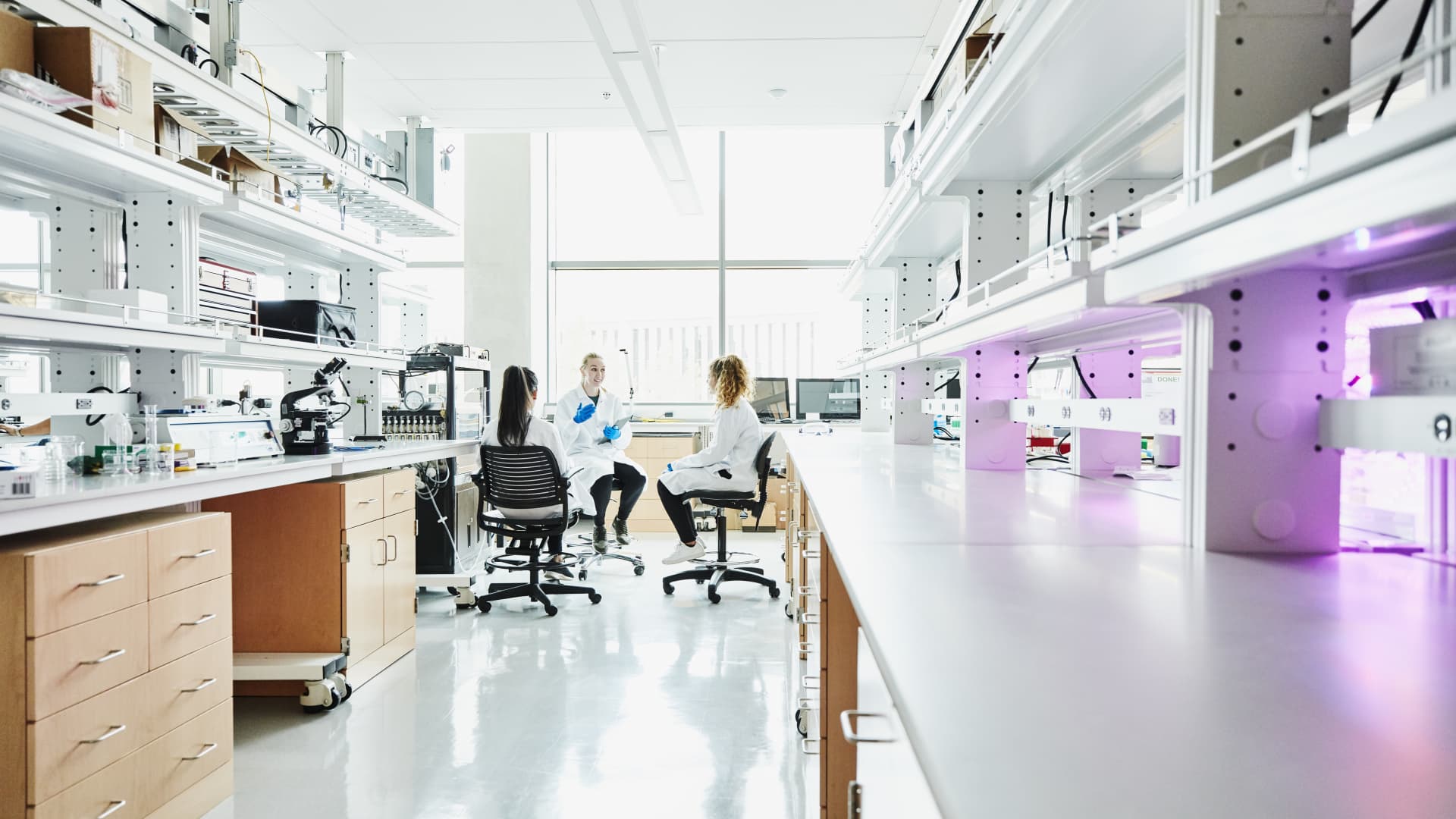
A version of this article first appeared in the CNBC Property Play newsletter with Diana Olick. Property Play covers new and evolving opportunities for the real estate investor, from individuals to venture capitalists, private equity funds, family offices, institutional investors and large public companies. Sign up to receive future editions, straight to your inbox. Life sciences labs, primarily in biotechnology and biopharmaceuticals, saw a massive drop in demand last year after the National Institutes of Health was forced to cancel billions of dollars in research grants. Funding for the NIH has been significantly cut by the federal government. Across the 10 largest life sciences markets tracked by JLL, the overall vacancy rate was 27.4% in the first quarter of this year, compared to 25.7% during the same period in 2025. Major markets like Boston and the Bay Area had vacancy rates above 30%. However, the sector is starting to stabilize. A separate report from CBRE shows that venture capital investment in life sciences in the second half of 2025 was the strongest since 2022. Additionally, the amount of space under construction is at its lowest level since 2017. An October JLL report predicted “a gradual stabilization of the market driven by the rationalization of supply rather than a dramatic recovery in demand.” JLL projects availability rates will decline to around 20% by 2030, “assuming absorption remains below average, coupled with significant supply outflows via distress sales and adaptive reuse projects.” The market correction in this sector, however, has been historic, according to Travis McCready, head of industrial leasing consulting at JLL. And the problem isn’t just funding cuts. McCready characterized the current oversupply situation as the combination of unprecedented construction combined with a fundamental shift in the way life sciences companies use real estate. “This whole story and this whole narrative is evolving in real time,” McCready said. “We’re really, really good at building this asset class based on the hypothesis of what kind of equipment and enabling technologies biotech companies needed, and then along came AI and robots.” This is where the opportunity presents itself. McCready projects that nearly 19 million square feet of available lab space will be shifted to other uses by 2030, but the companies and markets that adapt will end up stronger and more competitive. This adaptation comes in architecture. Gensler, the world’s largest architectural firm, recently completed a year-long interdisciplinary research initiative examining how AI, automation and robotics are reshaping not only laboratory operations, but real estate strategy itself, from infrastructure requirements and space ratios to workforce composition, according to the company. “It’s transformative,” said Ryley Poblete, global science practice area leader at Gensler. “Where we’re going with science, especially with these new automation and AI tools, it’s completely changing the way we think about how you would do this.” Poblete highlighted the transformation of the so-called wet bench area, where scientists use instruments to conduct experiments. Many of these experiments can now be done with AI or automation, meaning that as robotics and computers come into play, the test tubes disappear. From a real estate perspective, businesses are learning what new technologies can do and re-evaluating the facilities they have to see if a space can be upgraded. “This is happening in the real estate portfolios of large clients, those that own campuses and assets,” Poblete said. According to the Gensler study, vacancies actually mask a quality problem: Much of today’s empty inventory was never truly “Class A” lab space. Although it appears that laboratory science real estate needs are diminishing, there is a growing debate over what type of laboratory real estate will survive and outperform during the next cycle. “Large biotech companies and even large chemical companies today are evaluating their own infrastructure to really validate that it’s worth moving forward, or considering a consolidation strategy or a new build strategy that brings these things together in the right environments,” Poblete said. Gensler is actively studying older spaces, assessing the increased energy and air requirements of large computers running artificial intelligence. They are also looking to see if spaces can be modified to accommodate robotics. Poblete described it as essentially putting small data centers in lab spaces. Of course, they also need to check whether the building structure can support the weight of all the new systems. Newer buildings, for the most part, can, but older buildings are in question. Spaces are being redesigned for machines, but there is still a need to create some sort of creative laboratory environment where scientists can validate what the machines are doing. This involves deep concentration, Poblete said, which requires quiet areas, not the often noisier, open workspaces more popular in today’s newer offices. Then there is the collaborative process. Scientists no longer work entirely alone. They work with AI researchers, engineers and process designers. “These people are now working together and not separately, and this represents a big change for the industry, not only from a life sciences perspective, but also from a chemistry perspective,” Poblete said. “They all saw themselves as such, the scientific heroes, in a way. Now that the whole interdisciplinary science movement is in place, it is essential that you work with these partners to create real future projects.” Poblete cited Genentech as an example. The company is undergoing a major, multi-year construction of its global headquarters in Basel, Switzerland. It is investing more than 3 billion Swiss francs ($3.82 billion) in developing the site, including a new 72-meter research building scheduled for completion in 2029, according to its parent company, Roche, which says the development aims to modernize research facilities and consolidate R&D functions.