


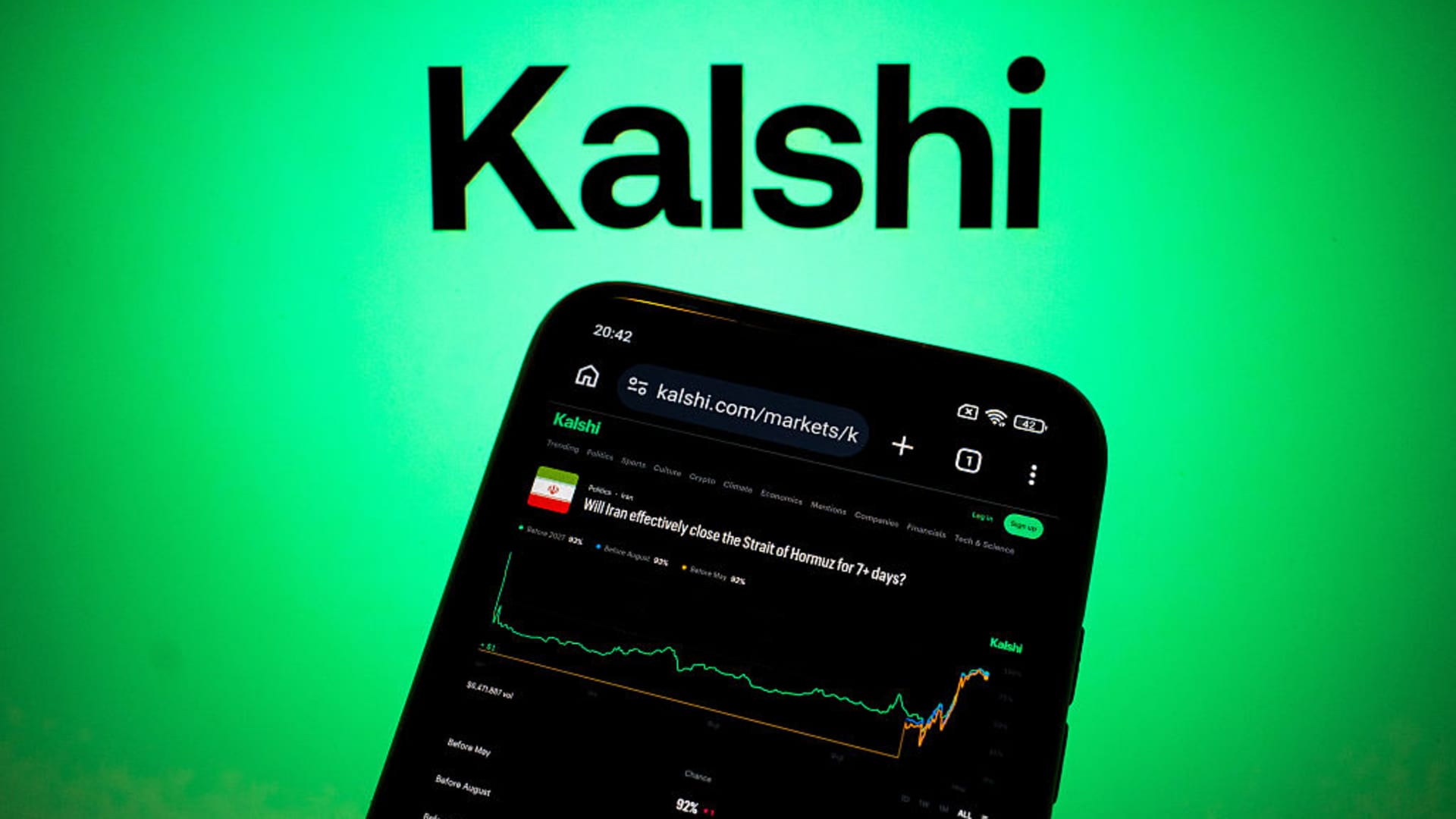
Kalshi Market “Will Iran effectively close the Strait of Hormuz for more than 7 days? appears on a smartphone screen, with the Kalshi logo displayed on a laptop screen in the background, in this illustrative photo taken in Chania, Greece, on March 9, 2026.
Nikolas Kokovlis | Nuphoto | Getty Images
The Arizona Attorney General filed a misdemeanor complaint against Kalshi, accusing the prediction platform of running an illegal election gambling and betting operation in the state.
These are the first criminal charges filed against Kalshi, although the company is involved in multiple lawsuits and investigations and has received dozens of cease and desist letters across the country.
Prediction platforms like Kalshi have drawn comparisons to online sports gambling because they allow users to bet on the outcomes of events in pop culture, politics, sports and more.
Several states have argued that the legalization and regulation of sports betting falls within the purview of local regulators and falls outside the authority of the Commodity Futures Trading Commission, which regulates event contracts and prediction markets.
States including Michigan and Massachusetts have filed civil lawsuits aimed at stopping operations or forcing Kalshi to meet gaming licensing requirements.
In the Arizona filing, Attorney General Kris Mayes charged Kalshi with 20 counts of accepting various bets in Arizona without a license, including bets on state elections, which are separately and explicitly prohibited by Arizona law.
“No company can decide for itself which laws to follow,” Mayes said in a statement.
Kalshi makes distinctions between the event contracts he offers and what sportsbooks and casinos offer.
“Unfortunately, a state can file criminal charges based on flimsy arguments,” the company said in a statement to CNBC. “States like Arizona want to individually regulate financial exchanges nationwide and are trying every means possible to do so. As other courts have recognized and as the CFTC asserts, Kalshi is subject to federal jurisdiction.”
Last week, Kalshi filed a preliminary injunction to try to stop Arizona from enforcing his state’s laws.
On Tuesday, federal Judge Michael Liburdi denied Kalshi’s request for a temporary restraining order and ordered Kalshi to demonstrate why the case should be brought in federal court given the state’s charges against Kalshi.
Kalshi filed preemptive lawsuits to prevent other states from taking punitive action, a strategy Mayes described as intimidating states, “running into federal court to try to avoid liability.”
Video game lawyer Daniel Wallach meticulously follows lawsuits and countersuits against prediction platforms. He described pre-emptive prosecution as Kalshi’s modus operandi.
“This strategy of ‘winning the race to the courthouse’ has proven to be an effective tactic so far,” Wallach said, noting Kalshi’s legal victories in obtaining preliminary injunctions in New Jersey and Tennessee.
Wallach is not involved in any of Kalshi’s legal disputes.
Still, the Arizona attorney general’s office pointed to Kalshi’s recent defeat of a preliminary injunction against Ohio, in which federal Judge Sarah Morrison said Kalshi’s concerns were “overshadowed by Ohio’s interest in exercising its police power, enforcing its duly enacted laws, and regulating sports gaming to promote the public welfare.”
CFTC Chairman Michael Selig recently told CNBC that the agency would require prediction platforms, which currently self-certify, to do a better job of restricting event contracts that encourage manipulation, such as, for example, asking whether an athlete might suffer an injury.

A bipartisan bill has been introduced in the House of Representatives that would ban sporting event contracts unless a state specifically allows it. The bill would also entirely ban prediction markets on elections and government actions.
As lawmakers, regulators and courts struggle to define what gambling is, 61% of Americans say they view event-based contracts in prediction markets more like gambling than an investment, according to a poll released Tuesday by Ipsos and the American Institute for Boys and Men.
Disclosure: CNBC and Kalshi have a business relationship that includes a minority investment from CNBC.