


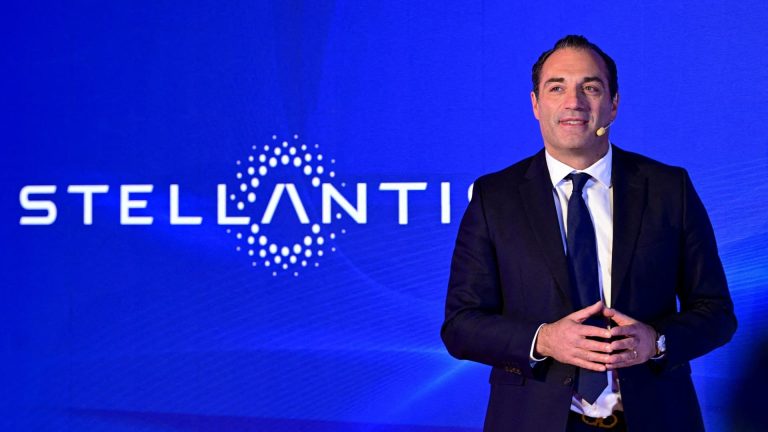
Stellantis CEO Antonio Filosa speaks during an event in Turin, Italy, November 25, 2025.
Danièle Mascolo | Reuters
DETROIT — Stellantis CEO Antonio Filosa said Friday the automaker plans to move forward as a single company amid speculation it would be better off selling brands or breaking up after disappointing results.
“Stellantis is a very strong global company that takes great pride in having very deep regional groups,” Italian-born Filosa told reporters on a media call. “It makes perfect sense to stay together. We want to stay together for many more years.”
His comments came hours after the company announced charges of 22 billion euros ($26 billion) resulting from a business restructuring that includes scrapping electrification plans and re-introducing V8 engines in U.S. models.
Filosa described these actions as a “significant strategic reset of our business model, with the sole intention of putting our customers’ preferences back at the center of what we do globally and in every region.” He said the “mission is to grow” after notable declines in market share in recent years.
Stellantis shares plunged more than 20% on the Milan and New York markets.
Filosa did not specifically rule out Friday the possibility of a regional refocus or reduction of the company’s vast portfolio of 14 auto brands, which includes U.S. brands Jeep, Ram and Chrysler, as well as Italian brands Fiat and Alfa Romeo, which have not performed well domestically.

Stellantis side shared in Milan and New York
“We really want to manage our brands in the sense of providing them with the products and technology that our customers, who are now at the center of our strategic reset, will tell us they want and need,” he said. “This is our main mission.”
Filosa said additional information on the company’s future plans will be provided during the May 21 investor day.
Friday’s announcement comes days after Stellantis executives met with the company’s U.S. franchise dealers at their annual National Automobile Dealers Association conference with a message that the automaker planned to increase sales across its lineup of U.S. brands, according to two dealers who attended the meeting.
26 billion dollars in charges
The majority of the charges announced on Friday – 14.7 billion euros – are linked to the realignment of product plans with consumer preferences and new emissions regulations in the United States.
Other charges include 2.1 billion euros for rightsizing the company’s electric vehicle supply chain, 4.1 billion euros for warranty costs and 1.3 billion euros for restructuring European operations.
The automaker also canceled its dividend for 2026 and issued a €5 billion non-convertible hybrid bond.
2026 Jeep Grand Wagoneer
Jeep
EV-related charges follow General engines And Ford engine announcing billions of dollars in similar spending due to the withdrawal of fully electric vehicle plans.
Shares of Ford and GM weren’t hit as much as those of Stellantis, which also issued lower-than-expected guidance amid years of strategic issues with the company.
Stellantis said it expects a net loss for 2025. For 2026, the auto giant is targeting a mid-single-digit increase in net sales and a low-single-digit increase in its adjusted operating margin.
“While a fee was expected, the amount is higher than F ($19.5 billion) and GM ($7.6 billion). As a result, we expect shares to trade significantly lower today. We continue to believe STLAM is a show-stopper story. In the U.S., the company has lost substantial market share due to high pricing and a perceived lack of product investment,” said RBC Markets analyst Tom Narayan of Capital, in a note to investors published Friday.
Past mistakes
Filosa on Friday called out the mistakes of the company’s former leaders more than he has since succeeding Carlos Tavares as CEO in June.
Tavares, who was ousted in December 2024 over disagreements with Stellantis’ board, reportedly said in a book last year that the group’s French, Italian and U.S. operations may have to be split up under pressure from its key stakeholders.
It’s been just over five years since Stellantis was created through a $52 billion combination between Italian-American automaker Fiat Chrysler and France-based Groupe PSA on January 16, 2021.

The merger created the fourth-largest automaker by volume, but the company has faced significant problems in recent years due to its investments in fully electric vehicles, its focus on profits rather than market share, and its efforts to cut costs at the expense of products.
Stellantis’ global sales under Tavares fell 12.3%, from 6.5 million in 2021 – the year the company was founded – to 5.7 million in 2024. That included a collapse of about 27% in the United States during that period, to 1.3 million vehicles sold. The automaker fell from fourth to sixth in U.S. sales, dropping from an 11.6% market share to 8% during that period.
Stellantis’ global market share fell from 8.1% in 2020 to around 6.1% last year, according to S&P Global Mobility.
Correction: Stellantis’ global market share fell from 8.1% in 2020 to about 6.1% last year, according to S&P Global Mobility. An earlier version misinterpreted the percentage.