

Close Menu
Crazy Peks NewsCrazy Peks News
  • Home
  • America
  • Asia
  • Europe
  • Business & Money
  • Politics
  • Technology
  • Sports
  • Entertainment
  • Privacy Policy
  • Get In Touch
Facebook X (Twitter) Instagram
Trending
  • What some executives think about using universal basic income to mitigate AI-related layoffs: Musk calls it the "best way"OpenAI policy document mentions a public wealth fund (Siladitya Ray/Forbes)
  • Sources: Recursive Superintelligence, a four-month-old startup developing self-learning AI and founded by former DeepMind and OpenAI engineers, has raised more than $500 million (Financial Times)
  • Jared Kushner under investigation for potential violations of federal bribery and foreign agent laws
  • Cerebras files for IPO on Nasdaq, reports 2025 revenue of $510 million, up 76% year-over-year, with net profit of $87.9 million, compared to net loss of $485 million in 2024 (Jordan Novet/CNBC)
  • World expands its Tinder partnership and partners with Zoom and others to verify human users, as it continues its shift from crypto to identity verification (Maxwell Zeff/Wired)
  • Trump’s Broken Brain Tries to Fool America With Iran War Hallucinations
  • Award-winning Burmese journalist Shin Daewe released from prison – Radio Free Asia
  • Some shareholders question whether Sam Altman should lead OpenAI through the turbulence of an IPO and have proposed Bret Taylor as successor (Wall Street Journal)
Facebook X (Twitter) Instagram
Crazy Peks NewsCrazy Peks News
Demo
  • America
  • Asia

    Award-winning Burmese journalist Shin Daewe released from prison – Radio Free Asia

    April 17, 2026

    RFA welcomes release of Shin Daewe, RFA contributor in Myanmar – Radio Free Asia

    April 17, 2026

    Soft power ‘wins’ Beijing as Chinese medical ship treats 5,400 people in PNG for free – Radio Free Asia

    April 15, 2026

    US to establish fuel depot in Philippines to support operations in South China Sea – Radio Free Asia

    April 10, 2026

    Japan’s combat role in Philippine war drills signals shift in regional strategy – Radio Free Asia

    April 8, 2026
  • Europe
  • Business & Money

    Netflix has long been “a builder, not a buyer.” Are those times over?

    April 17, 2026

    Some grocers are using AI to reduce food waste and increase profit margins

    April 17, 2026

    Trump names Erica Schwartz director of CDC

    April 16, 2026

    RFK Jr.’s Peptide Policy Could Boost Hims & Hers as Its GLP-1 Business Scales

    April 16, 2026

    Netflix (NFLX) Q1 2026 Results

    April 16, 2026
  • Politics

    Jared Kushner under investigation for potential violations of federal bribery and foreign agent laws

    April 17, 2026

    Trump’s Broken Brain Tries to Fool America With Iran War Hallucinations

    April 17, 2026

    Donald Trump has lost his power to America

    April 16, 2026

    RFK Jr. collapses in front of the country during a hearing at home

    April 16, 2026

    Democrats decide to impeach Pete Hegseth for recklessly endangering US troops

    April 15, 2026
  • Technology

    What some executives think about using universal basic income to mitigate AI-related layoffs: Musk calls it the "best way"OpenAI policy document mentions a public wealth fund (Siladitya Ray/Forbes)

    April 18, 2026

    Sources: Recursive Superintelligence, a four-month-old startup developing self-learning AI and founded by former DeepMind and OpenAI engineers, has raised more than $500 million (Financial Times)

    April 17, 2026

    Cerebras files for IPO on Nasdaq, reports 2025 revenue of $510 million, up 76% year-over-year, with net profit of $87.9 million, compared to net loss of $485 million in 2024 (Jordan Novet/CNBC)

    April 17, 2026

    World expands its Tinder partnership and partners with Zoom and others to verify human users, as it continues its shift from crypto to identity verification (Maxwell Zeff/Wired)

    April 17, 2026

    Some shareholders question whether Sam Altman should lead OpenAI through the turbulence of an IPO and have proposed Bret Taylor as successor (Wall Street Journal)

    April 17, 2026
  • Sports
  • Entertainment
Crazy Peks NewsCrazy Peks News
Home » China investigates US company for refusing to buy Xinjiang cotton – Radio Free Asia
Asia

China investigates US company for refusing to buy Xinjiang cotton – Radio Free Asia

Frank M. EverettBy Frank M. EverettSeptember 27, 2024No Comments
Facebook Twitter Pinterest LinkedIn WhatsApp Reddit Tumblr Email
Share
Facebook Twitter LinkedIn Pinterest Email


[  Read RFA coverage of this story in Uyghur. Opens in new window ]

China has opened an investigation into PVH Corp., the U.S. parent company of fashion brands Calvin Klein and Tommy Hilfiger, for alleged discriminatory actions in refusing to buy cotton and other products from its northwest Xinjiang region, home to 12 million Uighurs.

Analysts said the move appears to be a retaliatory response by Beijing against companies that comply with U.S. laws banning the import of materials and products from Xinjiang suspected of using Uyghur forced labor.

“China is trying to retaliate against U.S. sanctions against the Xinjiang region by imposing its own sanctions on companies that follow U.S. sanctions,” said Anders Corr, director of New York-based political risk firm Corr Analytics. “This is a very bad idea.”

“Beijing is trying to tell Calvin Klein not to follow American law but to follow Chinese law,” he said.
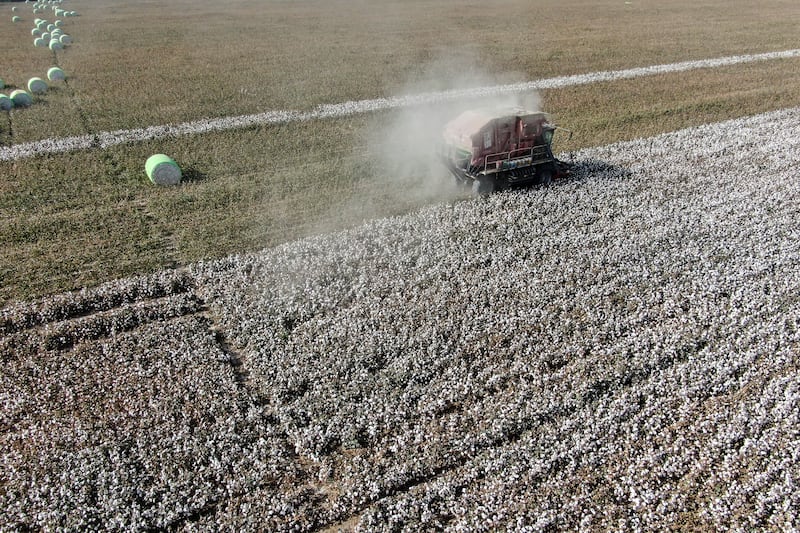
A cotton picker works in a cotton field on September 28, 2025 in Aksu Prefecture, Xinjiang Uyghur Autonomous Region.
Uighur-Xinjiang cotton A cotton picker works in a cotton field on September 28, 2025 in Aksu Prefecture, Xinjiang Uyghur Autonomous Region. (Chinese News Service via Getty Images)

China’s Ministry of Commerce said Tuesday that PVH Corp. had to provide documents and evidence within 30 days demonstrating that it had not engaged in discriminatory practices over the past three years.

“The US PVH Group is suspected of violating normal market trade principles and unreasonably boycotting Xinjiang cotton and other products without factual basis, seriously harming the legitimate rights and interests of relevant Chinese enterprises and endangering China’s sovereignty, security and development interests,” the ministry said in a statement.

Earlier this month, China passed a resolution condemning a series of US sanctions against the Xinjiang Uyghur Autonomous Region and providing support to affected companies.

RELATED STORIES

[ China introduces resolution opposing US sanctions on XinjiangOpens in new window ]

[ Uyghur rights advocates applaud addition of Chinese companies to US blacklistOpens in new window ]

[ Uyghur forced labor bill heads to Biden’s desk after unanimous House, Senate votesOpens in new window ]

In response to the move, Alison Rappaport, PVH’s vice president of external communications, said the company strictly complies with the laws and regulations in force in the countries and regions where it operates.

“We are in communication with the Chinese Ministry of Commerce and will respond in accordance with applicable regulations,” it said, without further comment.

Genocide

In 2021, the US government declared that China’s repression of Uyghurs and other Muslims in Xinjiang, including mass detentions, sterilization of women, forced labor, and cultural and religious erasure, amounted to genocide and crimes against humanity. Legislatures in several Western countries have adopted similar declarations.

To punish China and get it to change its policies, the United States and other countries have banned the importation of Xinjiang products made by Uyghur labor. About 90% of China’s cotton is produced in Xinjiang, most of which is exported.

Since June 2022, the U.S. government has blacklisted Chinese companies that manufacture products linked to forced labor in Xinjiang under the Uyghur Forced Labor Prevention Act, or UFLPA.

The law also authorizes sanctions against foreign individuals and entities found responsible for human rights violations in the northwest region.

More than 80 companies are now on the Entity List.

Last May, the US Department of Homeland Security added 26 Chinese textile companies to the list of entities covered by the law, effectively barring them from accessing the US market.

Consequences

Henryk Szadziewski, research director at the Uyghur Human Rights Project, said China is using the move to retaliate against criticism of its policies in Xinjiang.

“This is really a message to multinational companies that they should not comply with sanctions and other types of prohibitions imposed on entities operating in Xinjiang,” he said. “This is undoubtedly a countermeasure to what is being done outside China. »

Still, multinational companies that adhere to U.S. sanctions and exclude forced labor products from their supply chains could face repercussions in China, Szadziewski said.

“If you want to operate in China, you really have to operate by their rules and not by those elsewhere,” he said.

Translated by RFA Uighur. Edited by Roseanne Gerin and Malcolm Foster.

Asia buy China company cotton Free investigates Radio Refusing Xinjiang
Share. Facebook Twitter Pinterest LinkedIn Tumblr Telegram Email
Frank M. Everett

Related Posts

Award-winning Burmese journalist Shin Daewe released from prison – Radio Free Asia

April 17, 2026

RFA welcomes release of Shin Daewe, RFA contributor in Myanmar – Radio Free Asia

April 17, 2026

Soft power ‘wins’ Beijing as Chinese medical ship treats 5,400 people in PNG for free – Radio Free Asia

April 15, 2026
Leave A Reply Cancel Reply

© 2026 Crazy Peks News | All rights reserved.
  • Home
  • Privacy Policy
  • Get In Touch

Type above and press Enter to search. Press Esc to cancel.