



Four Filipino crew members were injured Tuesday when Chinese coast guard ships used water cannons to block Philippine ships carrying supplies to Manila’s military outpost at Ayungin (Second Thomas) Shoal in the South China Sea, Philippine officials said.
Chinese and Philippine ships have been engaged in a cat-and-mouse chase in the waters around the shoal for more than a year, with Manila accusing Beijing of “aggressively” trying to prevent its ships from delivering supplies to Philippine troops stationed in Ayungin.
Tuesday’s incident marked the first time Manila said people were injured during the maneuvers. China claims almost the entire South China Sea, while the Philippines maintains that the shoal is located inside its exclusive economic zone (EEZ) in the waterway.
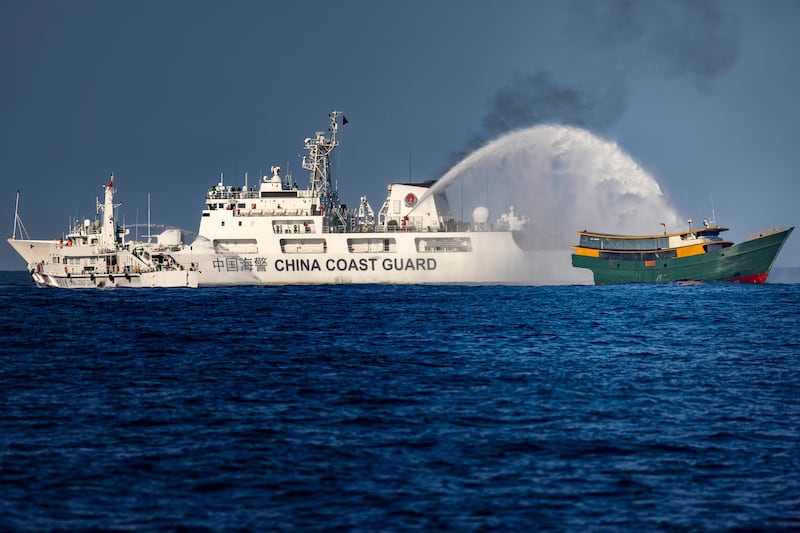
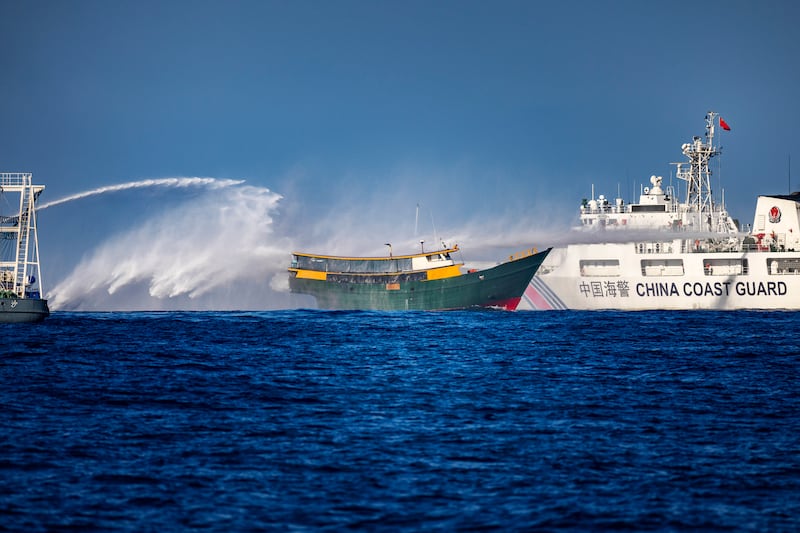
On Tuesday, Chinese Coast Guard (CCG) ships and Chinese maritime militia vessels again attempted to block a resupply mission of the BRP Sierra Madre, a rusting World War II-era military vessel that the Philippines beached on the shoal to serve as an outpost in the disputed waters, Philippine officials said.
A CCG vessel early Tuesday morning “executed dangerous blocking maneuvers against the PCG vessel MRRV 4407, resulting in a minor collision and minor damage,” the National Task Force for the West Philippine Sea said in a statement.
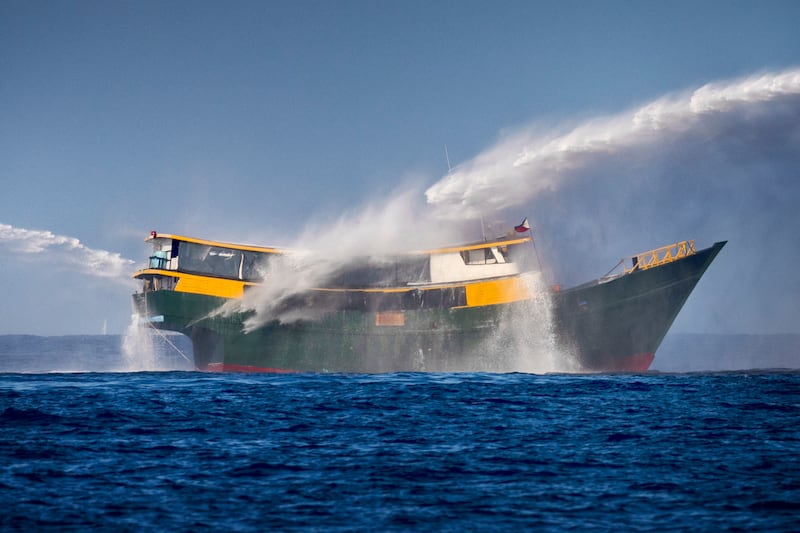
About two hours later, four crew members aboard the Philippine supply boat Uniza May 4 were injured when two CCG vessels simultaneously fired at the boat with a water cannon, shattering the windshield, the task force said.
The West Philippine Sea is Manila’s name for the waters of the South China Sea located within its EEZ.
The resupply boat was forced to turn around, but its sister ship, the Uniza May 1, was able to reach the BRP Sierra Madre and complete the resupply mission, the task force said.
“The systematic and consistent manner in which the People’s Republic of China is carrying out illegal and irresponsible actions calls into question the sincerity of its calls for peaceful dialogue and easing of tensions,” he said.
Later in the day, the Philippine government summoned the deputy head of the Chinese mission in Manila to convey a diplomatic protest over the incident, Philippine Foreign Affairs spokeswoman Ma. Thérèse Daza said.
“During the meeting, the Philippines highlighted, among other things [things]that China’s interference in the Philippines’ routine and lawful activities in its own exclusive economic zone is unacceptable,” she said.
“The Philippines demands that Chinese ships immediately leave the vicinity of Ayungin Reef.”
In Beijing, Chinese Foreign Ministry spokeswoman Mao Ning said the Philippine ships had “entered” the shoal waters “without authorization” from the Chinese government.
“[The] The Chinese Coast Guard took necessary measures against the Philippine vessels in accordance with [the] law. The actions taken at the scene were professional, restrained, justified and lawful,” Mao said.
“The Chinese Foreign Ministry has made serious representations to the Philippine side to express strong protests.”
The latest tense incident at sea came less than 24 hours after Enrique Manalo, the Philippines’ top diplomat, called on countries to respect the international rule of law in the South China Sea and other maritime regions.
“Shared management of the region’s seas and oceans falls on us to come together to uphold the rule of international law so we can ensure fair and sustainable outcomes for all,” Manalo said on Monday in a speech in Melbourne on the sidelines of a summit marking the 50th anniversary of Australia’s relationship with the Association of Southeast Asian Nations.
“It also calls on us to strongly oppose actions that contradict or are inconsistent with international law. »
“Peacetime blockade”
Maritime security expert Ray Powell said China had demonstrated it would enforce its blockade through violence.
“This incident – in which four Filipinos were injured aboard a civilian vessel during a legitimate resupply mission to a Philippine outpost located in that country’s exclusive economic zone – should spark outrage among the international community as it proclaims concern over the rules-based order,” Powell, a retired US Air Force officer, told BenarNews.
“There is no other place on the planet where a country is blockading another country’s outpost in broad daylight in peacetime. This should elicit more than just finger-wagging from the international community.”
Last week, President Ferdinand Marcos Jr. told Australian lawmakers that his administration would resist any attempt by a foreign power to encroach on Philippine sovereignty.
“I will never tire of repeating the statement I made on the first day I took office: I will not allow any attempt by any foreign power to take even one square centimeter of our sovereign territory,” Marcos told Australian lawmakers, without naming China.
China claims almost the entire South China Sea, but its claims overlap with those of Brunei, Malaysia, Taiwan, the Philippines and Vietnam.
In 2016, the Philippines won a landmark case at the Permanent Court of Arbitration in The Hague, which rejected China’s broad claims. Beijing, however, ignored the decision and continued its military expansionism in this strategic waterway, including building artificial islands.
US Ambassador to the Philippines Marykay Carlson has spoken out strongly against the latest incident in the South China Sea.
“We strongly condemn [China’s] dangerous maneuvers at Second Thomas Shoal, which endangered lives, resulted in injuries and damaged Philippine Coast Guard vessels,” Carlson said.
“The United States stands with the Philippines and supporters of international law for a free and open Indo-Pacific. »
Jason Gutierrez and Jeoffrey Maitem in Manila contributed to this report.
BenarNews is an online news organization affiliated with RFA.