


Rivian CEO and founder RJ Scaringe (right) speaks with longtime employee and engineer Max Koff during a June 2, 2026 launch event for the company’s R2 SUV in Park City, Utah.
Michael Wayland/CNBC
PARK CITY, Utah — Rivien CEO RJ Scaringe is energetic as he walks through displays of the electric vehicle maker’s new R2 SUV.
The company founder is quickly moving from the electric vehicle’s suspension systems and software to various models of the R2 that will soon begin reaching U.S. consumers, including a roughly $45,000 entry-level model that, Rivian said Tuesday, will be delayed from late 2027 until next summer.
But there’s some anxiety in Scaringe’s voice as he speaks to employees and media at the R2’s launch event in western Utah and prepares to release the vehicle, starting Tuesday for current reservation holders, worldwide.
Scaringe founded the electric vehicle maker in 2009. He grew Rivian into a company with a $22 billion market capitalization that ranked first in Consumer Reports’ most recent customer satisfaction survey but ranked lowest in the industry in predictive reliability due to consumer-reported problems with its early vehicles.
This is unusual for a car brand. Generally, the more problems a brand has, the lower its customer satisfaction ranking – but not Rivian.
It’s a testament to the brand that Scaringe, a 43-year-old car enthusiast and tech entrepreneur, has built. This type of customer satisfaction is also harder to maintain as the brand grows, which is Rivian’s goal with the R2.

The new SUV is intended to transform Rivian from a niche electric vehicle maker that sells luxury vehicles — primarily in California and states where electric vehicles sell well — into a more mainstream brand that can not only compete with the U.S. electric vehicle leader. Tesla but with broader mainstream automotive brands such as Jeep and Subaru.
“His goal is to make this a high-volume product,” Scaringe told CNBC. “Certainly we will appeal to some Tesla customers, but the market for non-Tesla customers is much larger.”
Wall Street analysts described the R2 as the watershed moment for Rivian, comparable to Tesla’s shift from its expensive first-generation electric vehicles to the mainstream Model 3 and Model Y that currently dominate the U.S. market.
Scaringe does not object to such categorization.
“When you start a business from scratch, everything is make-or-break. There’s no business if things don’t work,” he said. “To say it’s ‘make it or break it’ is like, of course it is.”
Shares of Rivian fell about 5% during intraday trading Tuesday following the announcement of the new schedule for the entry-level model as well as expert reviews released for the R2, which were largely positive.
Rivian R2 will have positive cash flow
Rivian also hopes to achieve its main goal with the R2: profitability. The electric vehicle maker lost $3.6 billion last year even though it delivered just 42,247 vehicles.
After promising investors it would be profitable on an adjusted basis by 2027, Rivian withdrew that target earlier this year without disclosing a new timeline for reaching that milestone. This comes as its automotive segment lost about $6,000 per vehicle delivered during the first quarter of this year.
Scaringe reconfirmed to CNBC that Rivian now hopes to achieve that goal once a multibillion-dollar factory in Georgia gets underway. Production is expected to start in late 2028 and could reach full capacity by the end of this decade.
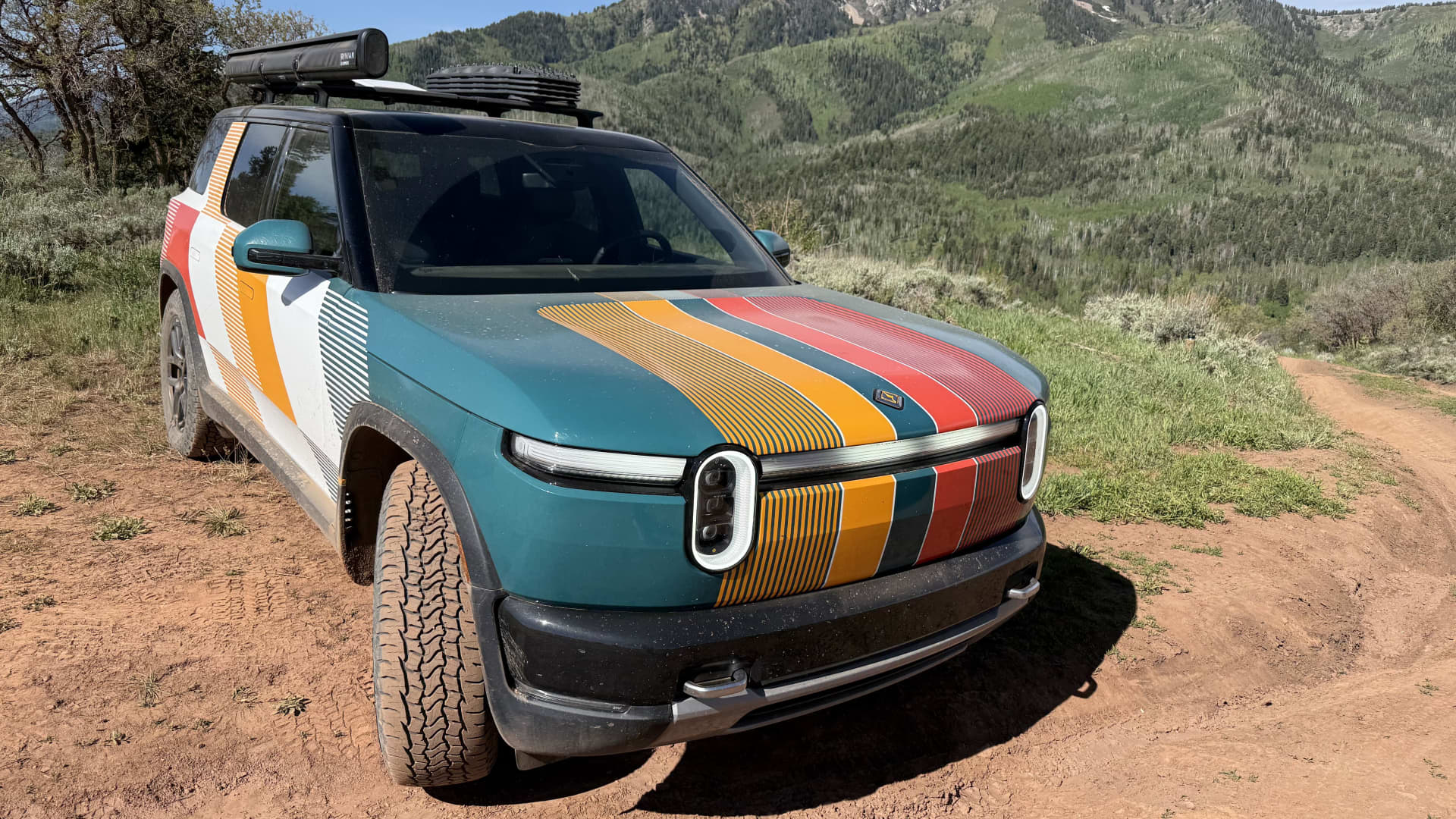
Exterior of Rivian’s new fully electric R2 SUV.
Michael Wayland/CNBC
Scaringe said Rivian will achieve profitability on a per-unit production basis with the R2 this year. But he said the company needs more scale than the 160,000 units already planned for the vehicle at its current plant in Normal, Illinois, to reach profitability.
“Georgia brings the volume needed to generate a gross margin for vehicle sales that covers everything,” Scaringe said. “The good news is we’re starting to really reduce our burn rate. That’s the beauty of volume, and these vehicles are all cash flow positive at the vehicle level.”
Once the Georgia plant is fully operational, the company’s production is expected to include the R1T pickup, R1 and R2 SUVs, R3 crossover, robotaxis and delivery vans. The company also announced plans to offer additional vehicles based on the R2 platform.
Although the R2 looks similar to its nearly $80,000 R1S SUV, Rivian said it has cut the vehicle’s construction material costs in half, reduced production complexity and made other major efficiency gains.
Scaringe said each R2 model – with starting prices ranging from around $45,000 to $58,000 – would generate positive cash flow for the company: “It’s a requirement. Every vehicle has a positive gross margin,” he said.
That positive cash flow includes its $45,000 entry-level model that the company upgraded after facing online backlash over the timing.
Scaringe, during a media roundtable, said the change was made to address potential perception concerns that the R2 would be a more expensive vehicle as well as the “desire to market it.”
“Even though the base version gets a lot of attention, very few people end up buying it,” Scaringe said. “It doesn’t affect the company’s economics that much, but it generates a lot of noise.”
Tesla Model Y tops sales
Once full production of the R2 comes online, Scaringe said, the company expects the sweet spot for sales to be around $50,000, which Cox Automotive said would put it slightly above the average U.S. sales price of $49,000 and below the average electric vehicle sales price of more than $55,000.
That price and the vehicle’s size put it in the heart of the compact and midsize SUV markets, which Cox Automotive said accounted for 45 percent of U.S. sales last year.
Interior of Rivian’s new fully electric R2 SUV.
Michael Wayland/CNBC
For electric vehicles in particular, the Tesla Model Y dominates in the United States. Cox Automotive estimates that Tesla, which does not release sales by region, sold more than 357,500 Model Y units, or about 40% of the U.S. electric vehicle market, in 2025.
“I think it will work well. Rivian has a strong brand and there is room for another compelling vehicle, especially in this mid-size segment,” said Stephanie Valdez Streaty, director of industry insights at Cox Automotive, which is an investor in Rivian. “It’s not just about electric vehicles, they’re going to try to compete and compete. [internal combustion engine] vehicles too.”

Rivian action in 2026
Challenges for Rivian remain numerous, Valdez said. In addition to the slower-than-expected adoption of electric vehicles and lack of charging infrastructure, the company also needs to prove it can scale production quickly without quality issues.
Among non-electric vehicles in these segments, the Toyota Rav4 and Honda CR-V lead the compact SUV segment, while the larger Ford Explorer and Jeep Grand Cherokee lead the midsize SUV segment.
“We want people to look and just say… ‘this is the best car in this price range,’ and through that it will attract new customers, non-EV customers,” Scaringe said.
To do this, Scaringe believes, Rivian will also need to become a leader in software and embedded technologies such as automated driving and artificial intelligence.
Rivian received outside validation for its emerging technology efforts in the form of a $5.8 billion deal with Volkswagen that includes integrating Rivian’s software and electrical architecture into the German automaker’s future electric vehicles.
Exterior of Rivian’s new fully electric R2 SUV.
Michael Wayland/CNBC
Volkswagen is now Rivian’s largest shareholder, followed by long-time backer Amazonwhich remains its largest customer in terms of delivery vehicles.
The R2 will launch with an advanced driver assistance system, or ADAS, that will largely control itself in certain conditions through driver monitoring, but it won’t have an AI voice assistant until later this year. Both systems will continue to be updated via over-the-air updates, according to Rivian.
Scaringe said he sees the company’s emerging software services as being just as important as the vehicles.
“You need both. It’s like asking if the heart or the brain is more important in a human. You can’t survive without both,” Scaringe said. “It’s a false binary. I don’t consider them separate.”