


The six original American Girl historical figures — Kirsten Larson, Samantha Parkington, Molly McIntire, Felicity Merriman, Addy Walker and Josefina Montoya — are on display in the brand’s flagship store,
Luc’s Fountain
American Girl Place at Rockefeller Center in New York seems frozen in time.
The air smells faintly of vanilla. Young girls dash between doll displays, clutching miniature shirts and sequined shoes. Beneath the sparkling chandeliers, the brand’s iconic red boxes line the shelves with museum-quality precision. Hairdryers buzz in the dolls’ living room, and downstairs, pink-frosted cupcakes land on cafe tables in front of the dolls sitting upright in their miniature high chairs.
“It feels timeless,” said Jamie Cygielman, global head of dolls for Mattelthe parent company of the brand.
And yet, behind the scenes, the American Girl doll business isn’t what it once was.
As American Girl celebrates its 40th anniversary, the brand faces more modern challenges: digital competition, changing gaming styles and an aging, more cost-conscious customer base.
“This anniversary comes at a precarious time for American Girl and the entire doll industry,” said Jaime Katz, an analyst who covers Mattel for Morningstar. “Children play more with digital technology, and [American Girl] the brand has been struggling.”
A decade ago, at its peak, American Girl was raking in more than $600 million in annual sales. By 2023, annual sales had fallen to around $200 million, only a third of previous levels.
While American Girl has declined significantly since the mid-2010s, the brand recently posted five consecutive quarters of sales growth – one of the few stable performances within Mattel’s portfolio.
“Growing from a base that’s down over 60% doesn’t mean the brand is back. It means it’s stabilizing,” Katz told CNBC.
Earlier this month, Mattel reported fourth-quarter revenue of $1.77 billion, falling short of Wall Street expectations after holiday demand was lighter than expected and deeper discounts weighed on margins. Earnings per share also fell short of expectations, and Mattel issued lower-than-expected earnings guidance for 2026.
Mattel shares have fallen about 19% since the Feb. 10 report and about 20% over the past year. Citi And JPMorgan also downgraded the stock after the results.
“People are looking at Mattel this year…they’re looking forward to it, because they’re spending a ton and it seems unlikely they’re going to bring in big profits,” Katz said.
A doll gets her hair washed, brushed and curled at the American Girl Salon at the brand’s flagship store in Rockefeller Center.
Luc’s Fountain
Long-standing issues
Even before the Covid pandemic forced American Girl to shrink its retail footprint from about 15 stores in 2019 to seven locations in the U.S. today, the brand was facing increasing competition from cheaper alternatives at major retailers like Target “Our Generation” line.
A traditional 18-inch American Girl typically starts at $135, excluding accessories, which can cost up to $250 for a bunk bed or $275 for a beach cruiser.
The high price tag once meant for many parents a mark of quality and prestige, said Laura Tretter, co-host of the American Girl Women podcast. But in an inflation-sensitive environment, that has reduced the customer base, Katz said.
“Parents are more selective about discretionary spending right now,” Katz said. “This price [for an American Girl doll] This seems steep for many households.
Across the toy industry, companies, including competitors like Hasbroare wondering how to get kids interested in their products, especially amid uneven consumer spending and, recently, market uncertainty.
“There are so many more things today that a child could be enticed to play with,” Cygielman told CNBC. “There is also more competition today, and we have seen in the past that tariffs can impact the toy market, but we are adapting.”
For many children, gaming has migrated to tablets, game subscriptions and short-form videos.
“The definition of ‘toy’ has changed,” Katz said. “An iPad or Nintendo Switch is in direct competition with a doll. There are simply more claims on the same discretionary dollar.”
Overall, Mattel’s doll and preschool categories have seen steady declines over the past three quarters, even after the halo effect of the 2023 “Barbie” movie. Global doll sales fell 7% in the most recent quarter, while the infant, toddler and preschool segment declined 17%.
Struggling sales of American Girl and Mattel’s Fisher Price brand motivated activist investor Barington Capital in 2024 to push the company to streamline its portfolio and improve returns, raising the possibility of selling the brands.
“American Girl is not a large part of Mattel’s overall financial profile,” Katz said. “But for investors, the question isn’t whether the brand is valued. It’s whether it’s strategically essential. That has held back profits.”
A girl waits with her new Truly Me doll at the American Girl flagship store in Rockefeller Center.
Luc’s Fountain
Capitalize on loyalty
Inside the Rockefeller Center store, these industry headwinds seem distant.
On a recent visit, Lisa Kandoski was looking at Molly McIntire — the World War II heroine adorned with round wire-rimmed glasses, a navy blue argyle sweater and braids tied with red ribbons — just like the doll Kandoski said her grandmother put under the Christmas tree in 1990.
“It’s not just a doll,” Kandoski, now 40, told CNBC, misty-eyed. “I kind of realized the impact Molly had on me as a child. She taught me that you could be brave even when the world was scary, that you could ‘do your part’ even when you were little. She shaped who I am.”
This emotional chemistry has defined American Girl since it disrupted the doll industry in 1986. At the time, the market was dominated by either fashion dolls reflecting adulthood or dolls to rehearse motherhood.
The six original American Girl characters—Samantha, Kirsten, Molly, Felicity, Addy, and Josefina—came with books that covered topics rarely taught to young children, like child labor or racism, and all of the dolls viewed childhood itself as a formative stage.
“American Girl remains a moral compass for many of us,” said Tretter of the American Girl Women podcast. “I love that girls today still receive positive messages about inclusion, friendship and difficult change.”
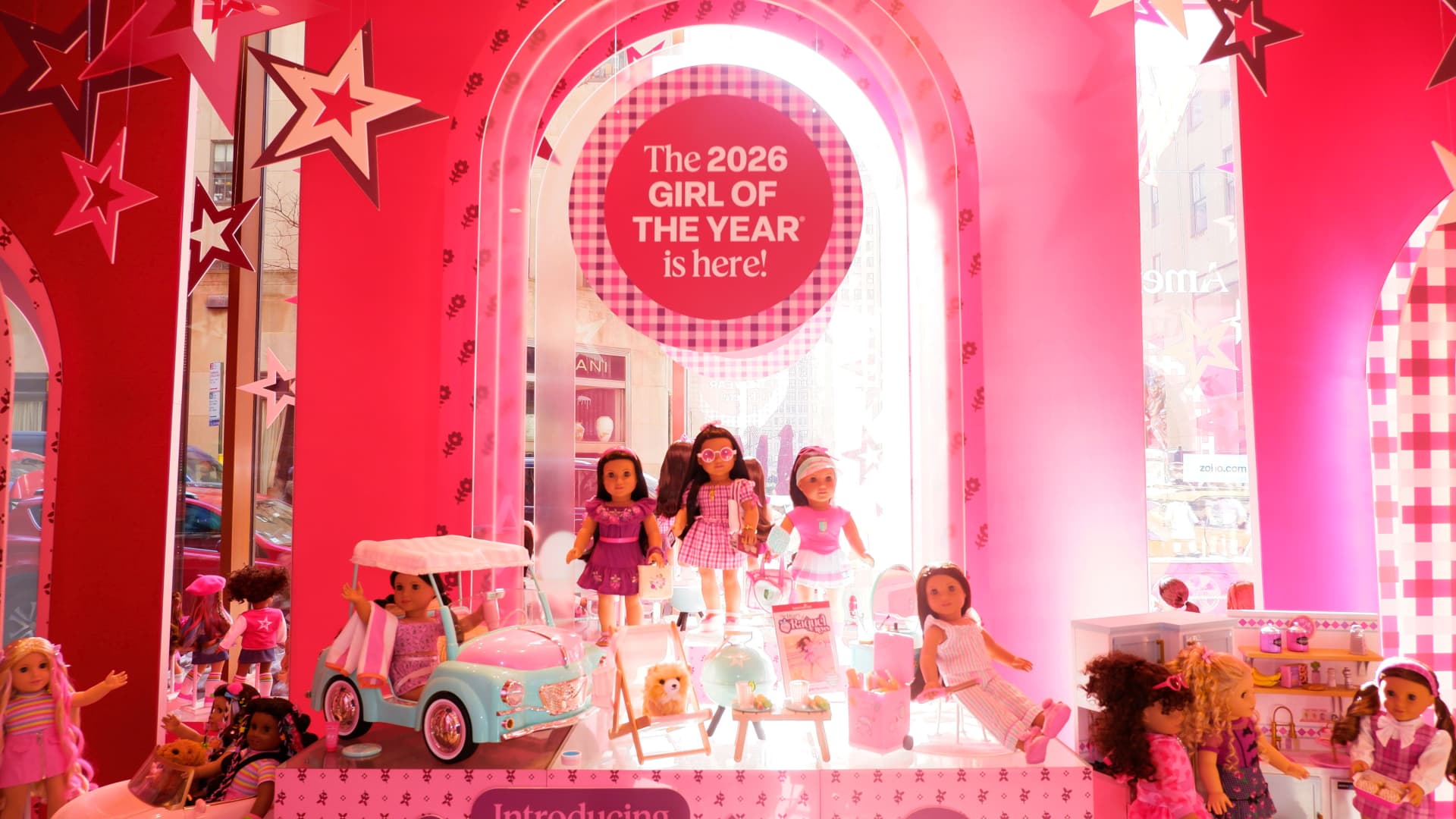
Over time, American Girl has expanded into publishing, film, and retail while diversifying its characters, such as with “Girl of the Year 2026,” Raquel Reyes, a biracial DJ and animal rescuer who helps run her family’s pallet store in Kansas City.
The brand’s serious whimsy became a differentiator and fostered generational loyalty, said Justine Orlovsky-Schnitzler, folklorist and author of “An American Girl Anthology: Finding Ourselves in the Pleasant Company Universe.”
Look no further than the Doll Hospital, where “doctors” in white coats triage patients, adjust wheelchairs, perform eye exams and apply miniature casts to doll owners of all ages.
“That’s what people come back for,” Orlovsky-Schnitzler said. “You’re not just buying plastic and fabric. You’re revisiting a version of yourself.”
And while the dolls remain preserved in the innocence of childhood, their original owners, now adults, keep returning to American Girl through podcasts, memes, cosplay, and fan fiction.
Some pass their dolls on to their children. Others buy new ones for themselves.
“There is something powerful about giving your daughter the doll you once slept next to,” Orlovsky-Schnitzler said. “It’s also just as comforting to return to the days of your youth with your own doll.”
American Girl is releasing a modernized version of its six original characters for the brand’s 40th anniversary.
Mattel
A growing base
Mattel is struggling to convert that nostalgia into broader sales growth.
So-called “kidult” consumers, i.e. adults who buy toys for themselves, have become a coveted demographic group. By the end of 2024, spending on toys for adults aged 18 and over had exceeded that of children aged 3 to 5, according to market research firm Circana. This cohort continued to drive industry growth in 2025.
Mattel is increasingly seeking to monetize its intellectual property across publishing, collectibles, entertainment and digital platforms. In interviews and calls with investors, Mattel CEO Ynon Kreiz said mobile games and interactive platforms were particularly promising areas.
However, “nostalgia must translate into sustainable revenue and sales growth,” Katz said. Relying too heavily on adult collectors can cause a brand to risk “aging alongside its original audience.” Pivot too aggressively toward digital trends, and it “risks diluting what made it distinctive.”
Competitors did the same. For example, Lego continues to release more adult-oriented brick building sets, such as flowers, artwork and collectibles, based on millennial pop culture favorites such as the 1990s TV hit “Friends.”
For American Girl, its 40th anniversary provides a natural inflection point for finding a balance between child and adult fans, Cygielman said.
American Girl releases modernized versions of its six original characters and publishes its first adult book, centering on Samantha Parkington and set as an adult in the 1920s.
At the same time, the brand strives to keep the next generation engaged through contemporary “Girl of the Year” storylines and investments in digital platforms, including YouTube, TikTok and “American Girl World” on Roblox.
“Nostalgia is an entry point, not the end game,” Cygielman said. “The question is how to extend this emotional equity to new platforms and new audiences.”